Hello there!
Need Help? We are right here!

Your DPDP Compliance Deadline Is Approaching. May 2027 is closer than you think.
Need Help? We are right here!
Search Results:
×
For SaaS and IT businesses, personal data powers products, customer experiences, and daily operations. As applications grow, integrations expand, and data moves across cloud services and partners, maintaining privacy becomes increasingly complex. DPDP compliance helps address some of the biggest challenges facing modern SaaS organizations, including :
Personal data flows through multiple systems, creating privacy risks that require continuous visibility, governance, and protection.

Websites, mobile apps, and customer portals continuously collect and process personal data.

Customer records, application data, backups, and storage services often span multiple environments.

CRM, HR, finance, marketing, and support platforms store personal and employee information.

Development, QA, and AI environments frequently contain replicated or production-like personal data.

Cloud providers, SaaS applications, payment gateways, and service partners process personal data on your behalf.

Directories, authentication services, and privileged accounts determine who can access sensitive information.
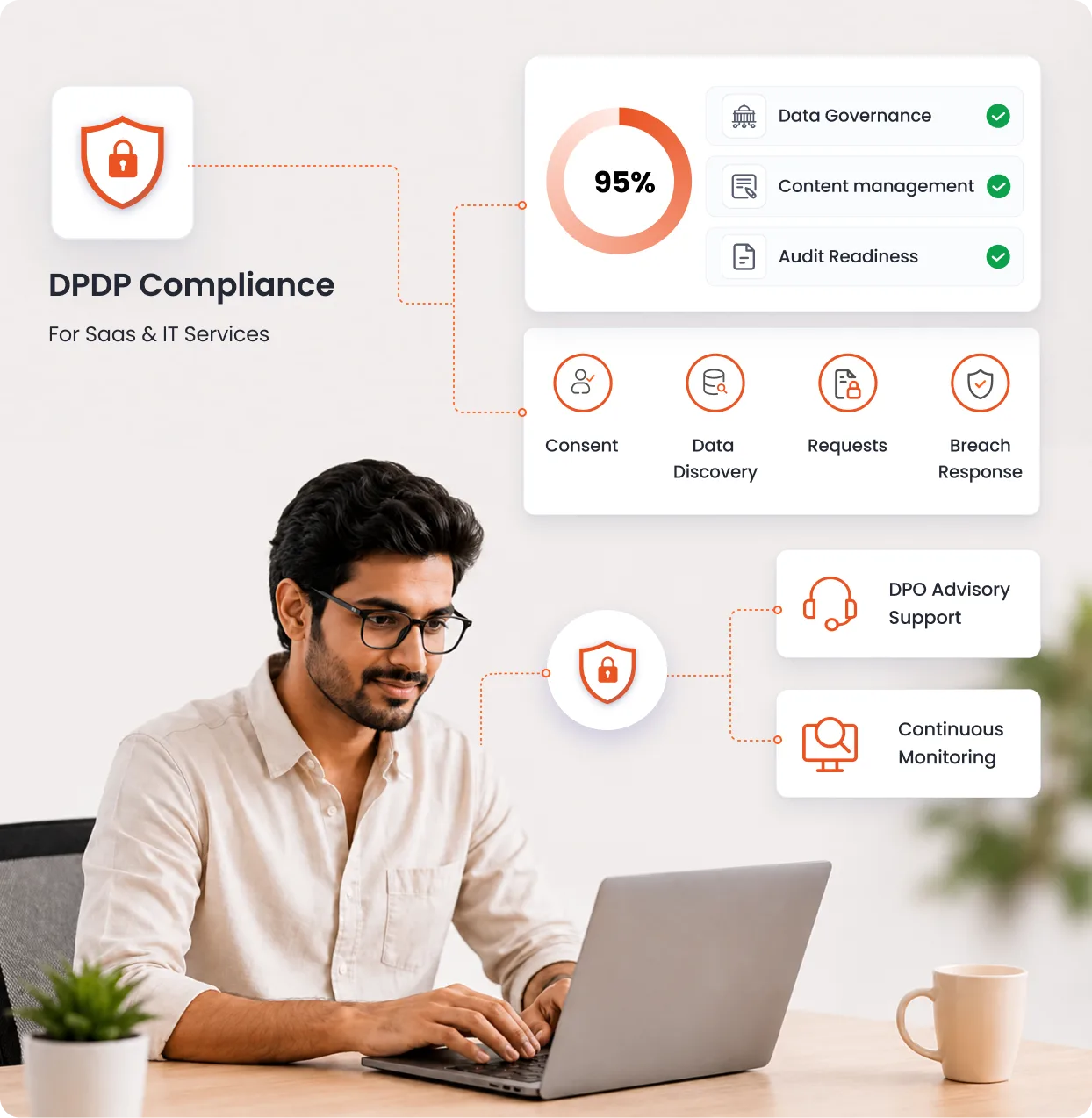
Address every major DPDP obligation with capabilities designed for SaaS platforms, software products, cloud infrastructure, and IT service operations.
Understanding where customer, employee, and tenant data exists is fundamental to DPDP compliance. Automated discovery identifies and classifies personal data across applications, APIs, cloud infrastructure, databases, and development environments from one platform.
A structured implementation approach that helps SaaS and IT organizations achieve, manage, and continuously strengthen DPDP compliance.
Evaluate your current privacy posture, identify compliance gaps, map data flows, and define an implementation roadmap.
Configure consent management, Data Principal rights, governance workflows, DLP, and security controls seamlessly.
Implement policies, assign responsibilities, monitor processing activities, oversee vendors, and maintain audit-ready documentation.
Continuously assess compliance posture, adapt to regulatory updates, onboard new systems, and improve privacy controls.
Organizations that collect, store, process, or manage personal data must establish appropriate privacy controls under the DPDP Act.

Manage customer accounts, subscription platforms, multi-tenant environments, APIs, and cloud infrastructure while protecting personal data throughout its lifecycle.
Embed privacy into product development, feature releases, analytics, AI initiatives, and customer data management from design to deployment.

Secure client and employee data across managed environments, support operations, outsourcing engagements, and service delivery workflows.

Protect personal data while implementing, integrating, customizing, and supporting enterprise applications across customer environments.

Manage customer registrations, employee records, marketing platforms, and operational data while building privacy into rapidly growing businesses.

Process high volumes of customer and employee data on behalf of clients while maintaining privacy, governance, and contractual compliance obligations.
Eliminate fragmented privacy processes by managing consent, data discovery, governance, Data Principal requests, data protection, reporting, and compliance activities through one platform.
Support SaaS platforms, software companies, cloud providers, managed services, and enterprise IT environments with deployment models and integrations that fit existing technology investments.
Strengthen internal privacy teams with DPO advisory, implementation support, governance reviews, legal guidance, and ongoing compliance services throughout your privacy program
Respond confidently to customer security reviews, vendor assessments, procurement requirements, regulatory requests, and compliance audits with centralized evidence and reporting.