Standalone Architecture
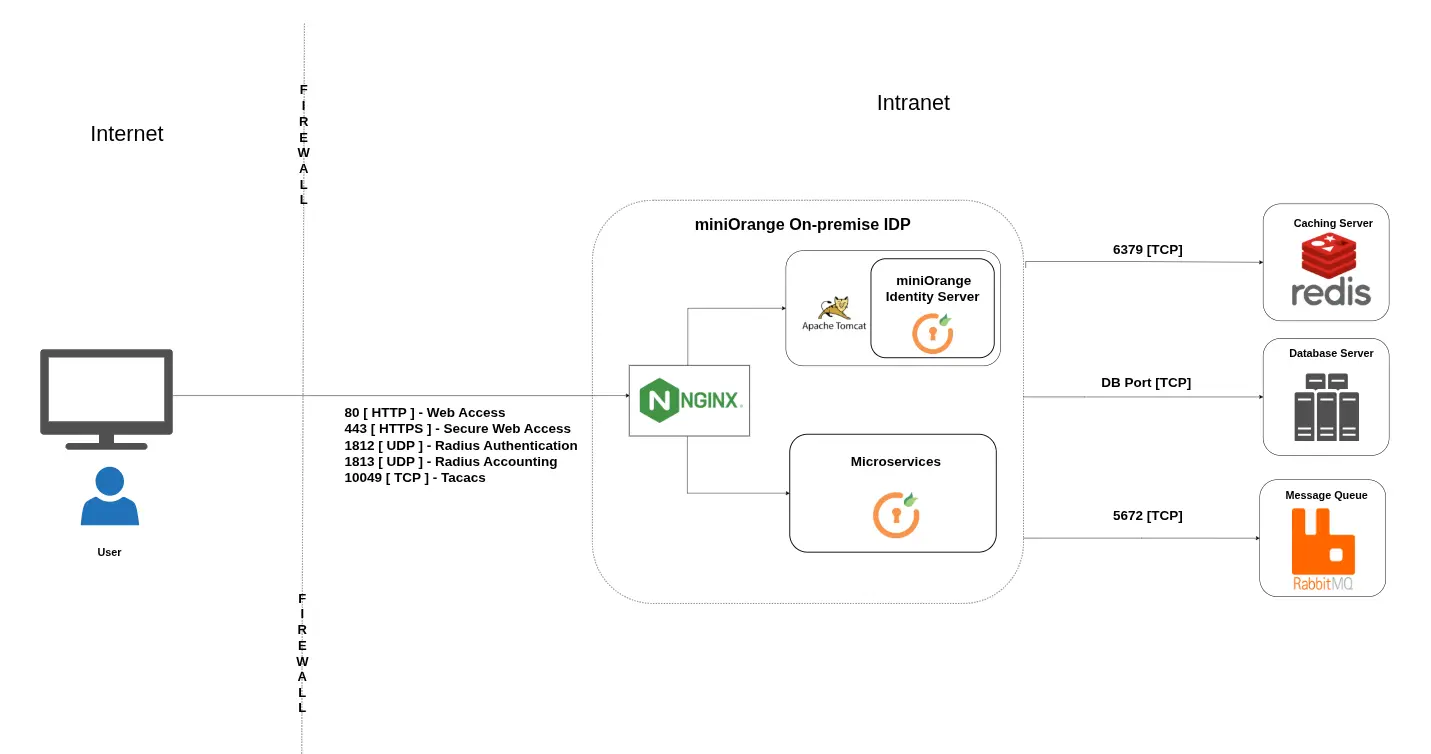
The Standalone Architecture is designed for single-node on-premise deployments of the miniOrange Identity Platform. It provides a simplified setup while still offering the essential components of an enterprise-grade IAM solution.
- Components:
- NGINX: Acts as the reverse proxy and entry point for web access.
- Apache Tomcat: Hosts the miniOrange Identity Server.
- Microservices: Provide modular identity and access management (IAM) functionality.
- Caching Server (Redis): Ensures faster access to frequently used data.
- Database Server: Stores persistent identity and configuration data.
- Message Queue (RabbitMQ): Manages communication between internal services.
- Connectivity:
External access is provided via standard ports:
- 80 (HTTP): Web Access
- 443 (HTTPS): Secure Web Access
- 1812 (UDP): RADIUS Authentication
- 1813 (UDP): RADIUS Accounting
- 10049 (TCP): TACACS
Internal connectivity is maintained with the caching server, database server, and message queue for efficient processing and data flow.
- Use Case:
The Standalone setup is best suited for development, testing, or small-scale production environments, where high availability (HA) and disaster recovery (DR) are not critical requirements.
Standalone with Disaster Recovery Architecture (Standalone + DR)
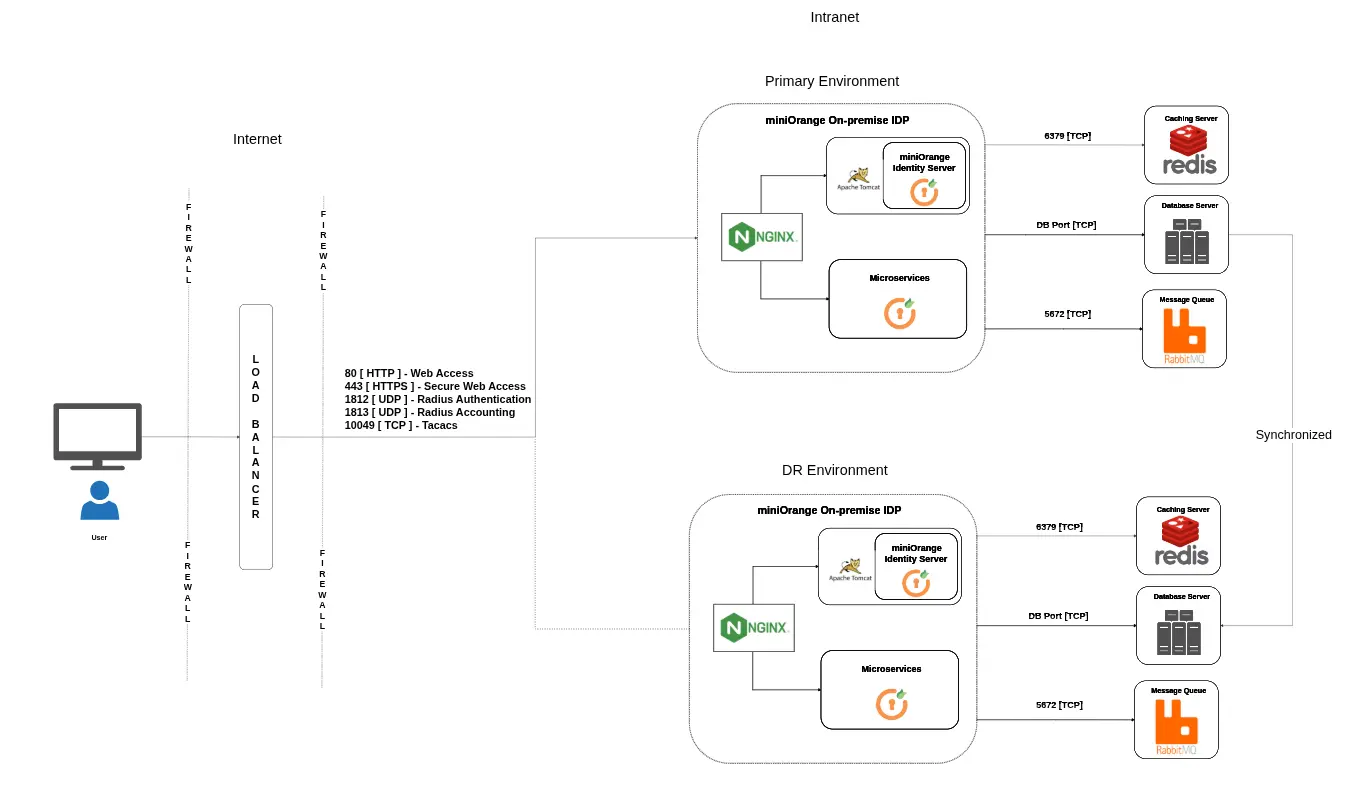
The Standalone + DR Architecture extends the standalone deployment by adding a dedicated disaster recovery environment for business continuity.
- Primary Environment:
Runs the core Identity Server, microservices, caching server, database, and RabbitMQ message queue.
- DR Environment:
- Mirrors the primary setup.
- Maintains synchronization through database replication and data consistency across caching and messaging layers.
- Failover:
- All traffic is routed through a load balancer.
- In case of a primary environment failure, requests automatically fail over to the DR environment without user disruption.
- Use Case:
Ideal for organizations that need business continuity and resilience, ensuring services remain operational even during data center outages.
High Availability Architecture
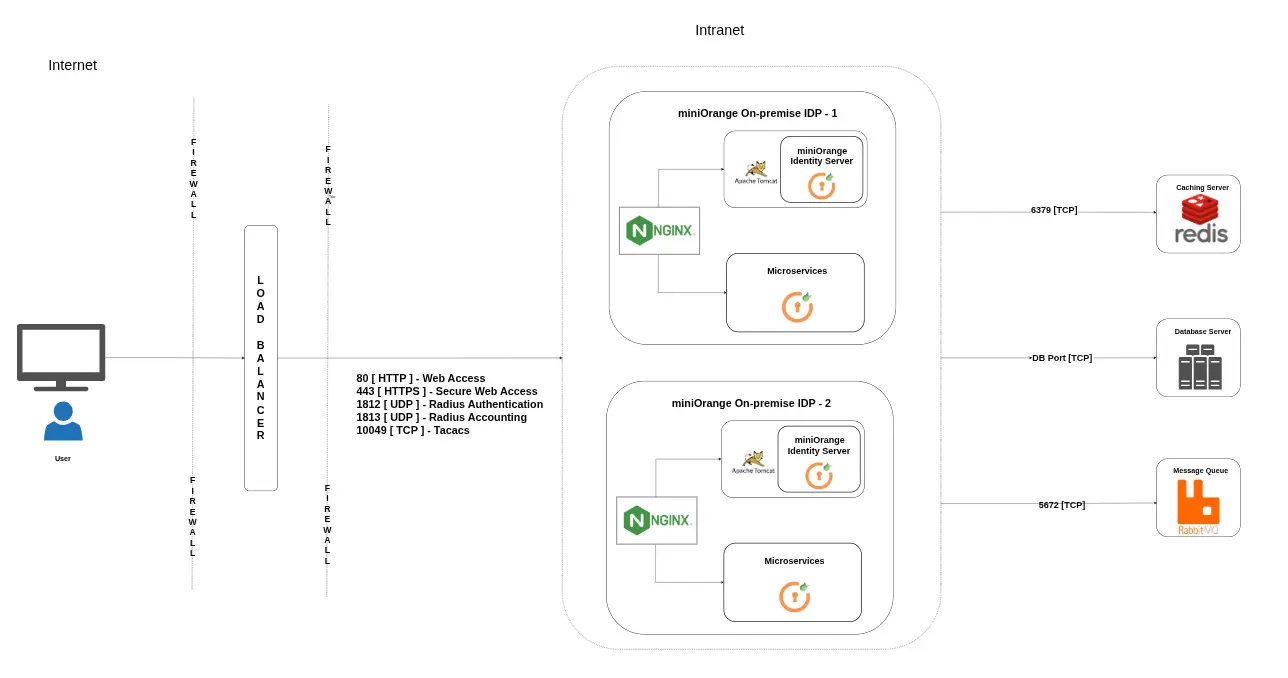
The HA Architecture ensures zero downtime and fault tolerance by running multiple nodes in parallel.
- Components:
- Two or more miniOrange IDP nodes, each with NGINX, Tomcat, the Identity Server, and microservices.
- Shared Redis caching server, database, and RabbitMQ message queue.
- Load Balancer:
- Distributes user requests across multiple IDP nodes.
- Provides scalability and redundancy, preventing single points of failure.
- Use Case:
Well-suited for medium to large-scale deployments, where uptime, performance, and scaling are critical operational requirements.
High Availability with Disaster Recovery (HA + DR)
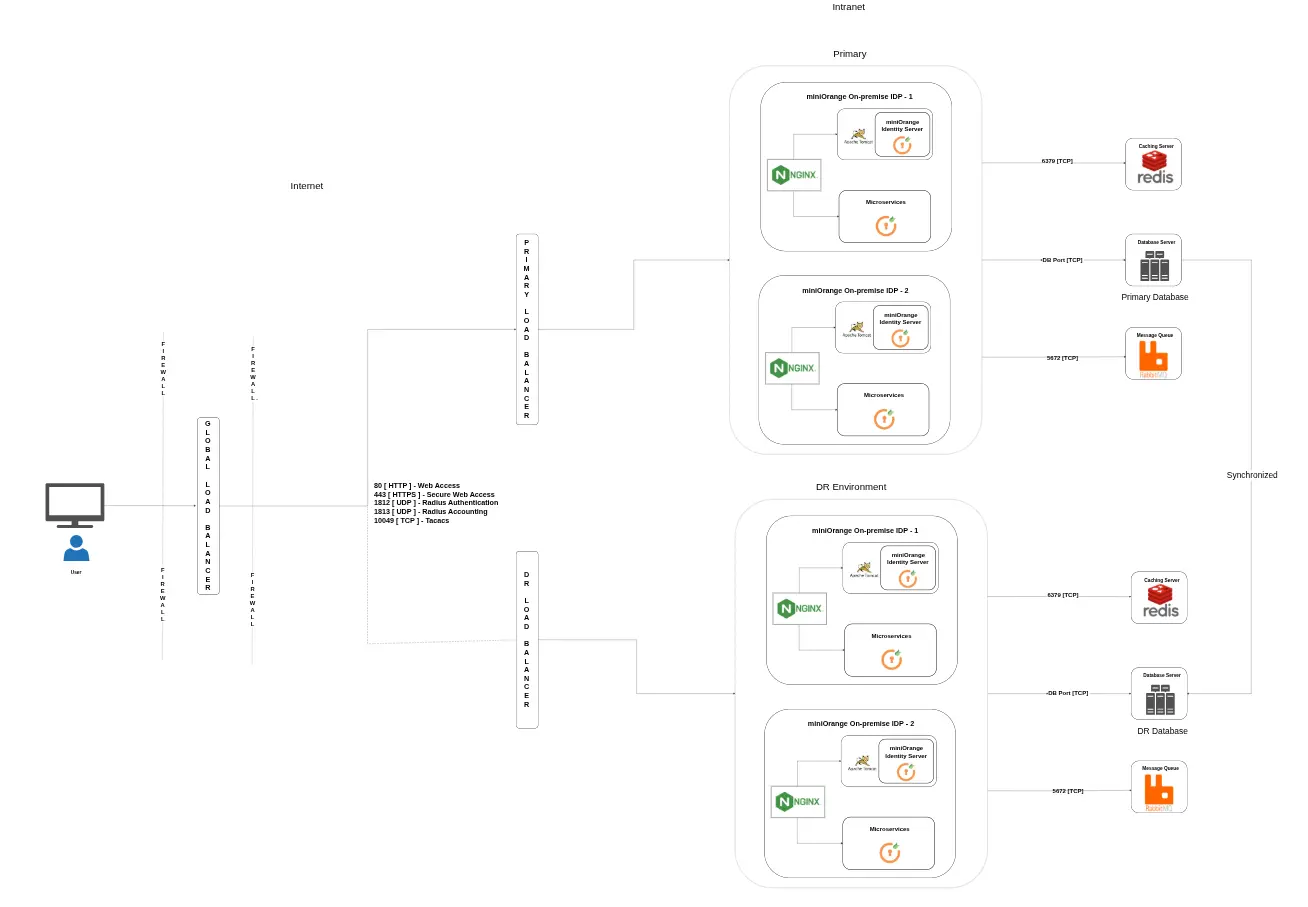
The HA + DR Architecture combines clustering and geographical redundancy for maximum resilience.
- Primary Environment:
- Runs multiple IDP nodes in HA mode behind a load balancer.
- Connected to Redis caching, a primary database, and RabbitMQ message queue for high-speed processing.
- DR Environment:
- Contains an identical setup, synchronized in real time.
- Redis, the database, and RabbitMQ maintain replicated data for seamless switchover.
- Global Load Balancer:
- Routes requests between the Primary and DR environments.
- Performs health checks and ensures automatic failover during outages.
- Use Case:
Best for mission-critical enterprise deployments that demand high availability, disaster recovery, and geo-resilience across multiple data centers.