Hello there!
Need Help? We are right here!

Need Help? We are right here!
Search Results:
×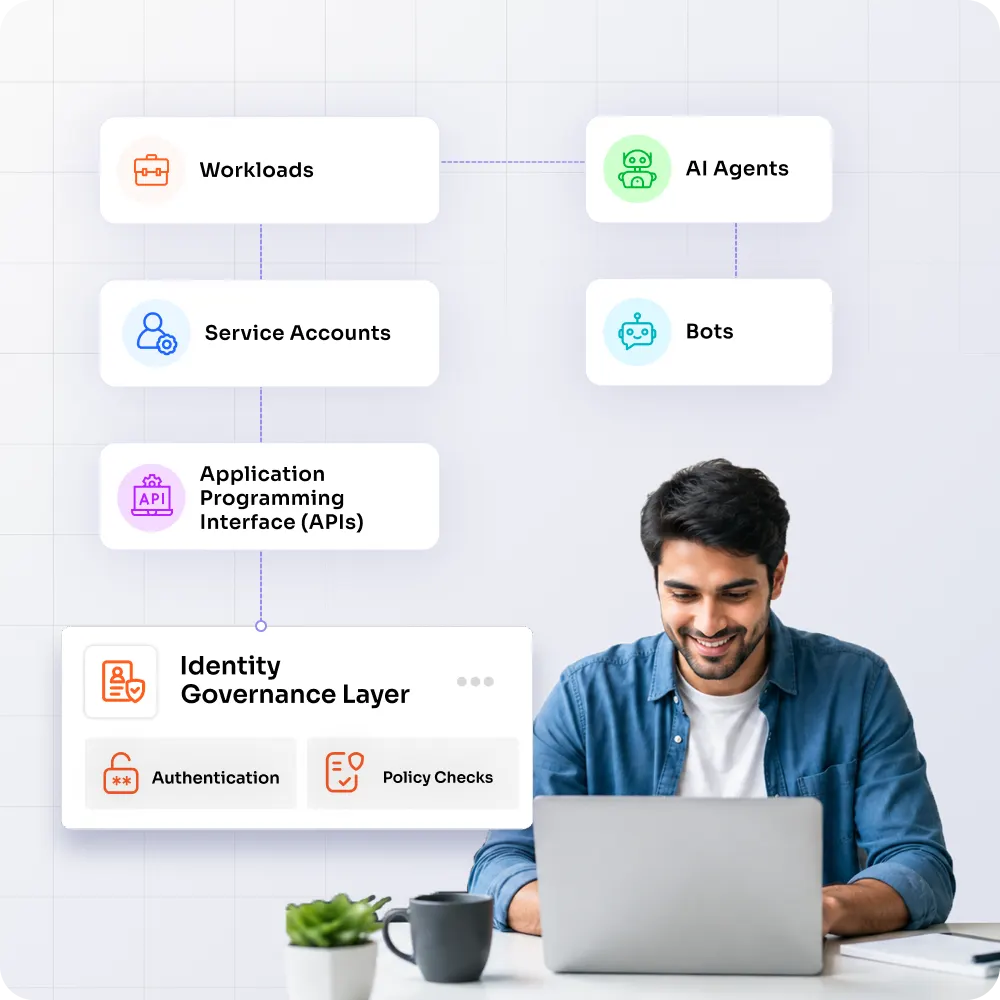
Non-human identities are digital identities used by applications, services, workloads, APIs, bots, and AI agents to securely authenticate and interact with systems, without human intervention.
Unlike human users, these identities:
Operate continuously without human intervention.
Scale rapidly across cloud and on-premises environments.
Lack ownership, visibility, and governance, increasing security risks.
This makes them powerful, but also a significant security blind spot.
Non-human identities are expanding faster than security teams can track or control. Without centralized governance, they create hidden, persistent attack paths across your environment.

Non-human identities often outnumber human users, growing uncontrollably across systems. This rapid proliferation makes it difficult to maintain an accurate inventory or enforce consistent policies.

Over-provisioned access expands your attack surface and increases breach impact. Without least-privilege enforcement, a single compromised identity can expose critical systems.

Many identities exist without clear ownership, accountability, or governance. This leads to unmanaged access, delayed remediation, and unclear responsibility during incidents.

The uncontrolled proliferation of authentication tokens like service accounts, API keys, and SSH keys across your organization leads to vulnerabilities. It needs proper rotation and vaulting.

Security teams lack a centralized inventory of identities and their access, limiting their visibility. This makes it difficult to detect misuse, enforce policies, or respond to threats in time.

Unused identities continue to retain access long after they should be decommissioned. These inactive accounts create silent entry points for attackers that often go unmonitored.

AI agents and automation tools deployed outside official IT oversight create hidden risks. Without monitoring and policy enforcement, they can access sensitive systems and data.
Discover, secure, and govern all non-human identities across your enterprise from a single control plane.
Understand the core capabilities of NHI management - from discovery to decommissioning.

Discover and inventory all non-human identities across cloud, on-premise, and hybrid environments. Maintain an updated, unified view of workloads, service accounts, bots, and AI agents.

Secure identities using standards such as OAuth, OIDC, certificates, JWTs, and token-based authentication. Ensure every access request is verified with strong, machine-first authentication mechanisms.

Enforce least-privilege access using RBAC, ABAC, and policy-based controls. Dynamically restrict access based on context, roles, and real-time risk signals.

Automate provisioning, updates, credential rotation, and secure decommissioning of identities. Reduce manual overhead while ensuring identities do not outlive their intended purpose.

Eliminate risks associated with static credentials, hardcoded secrets, and unmanaged tokens. Securely store, rotate, and manage secrets across applications and infrastructure.

Continuously validate who owns each identity and whether its access is still justified. Enforce periodic reviews to eliminate excessive privileges and ensure accountability.
Control access. Eliminate risk. Govern at scale.
Comprehend every NHI, so you can enforce the right identity management solution for them.
Application-level identities used to access systems, databases, and services. Often highly privileged and long-lived, making them a prime target if left unmanaged.
Digital identities assigned to devices, servers, and infrastructure using certificates or keys. If compromised, attackers can impersonate trusted systems and bypass security.

Identities used by cloud workloads, containers, and microservices to interact with resources. Their dynamic nature and short lifecycle make misconfigurations easy to exploit.

Automation identities that execute repetitive, rule-based business processes. They often hold broad access to critical systems, allowing attackers to manipulate them.
Autonomous identities that interact with enterprise tools, APIs, and data to perform tasks or make decisions. With wide-range access and minimal oversight, they can be influenced to execute unintended actions or expose data.
Identities used by APIs to authenticate and authorize communication between applications, services, and third-party platforms. If improperly managed, attackers can abuse API identities to gain unauthorized access, expose sensitive data, or disrupt services.
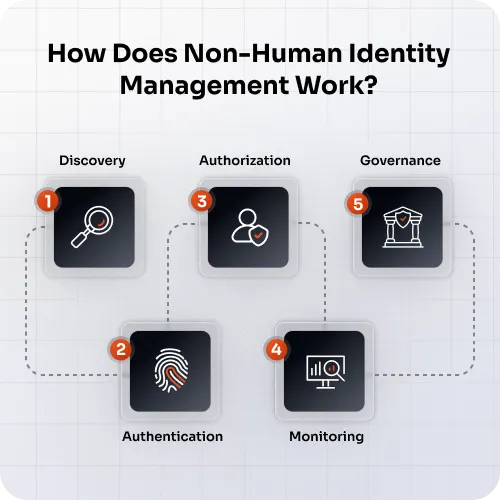
1. Discover Identities: Identify and inventory all non-human identities across cloud, on-premises, and hybrid environments.
2. Authenticate Identities: Establish strong, machine-first authentication using tokens, certificates, and modern protocols. Ensure every identity is verified before accessing any system or resource.
3. Apply Access Policies: Enforce least-privilege access using centralized, policy-based authorization controls. Limit what each identity can access based on role, context, and risk.
4. Monitor Activity: Continuously track identity behavior, access patterns, and usage across systems. Easily detect anomalies, misuse, or policy violations in real-time.
5. Govern Lifecycle: Manage the full lifecycle of identities, from provisioning and credential rotation to decommissioning. Ensure identities are removed or updated as soon as they are no longer needed.
See how you can secure, govern, and scale machine identities across modern enterprises.
Service accounts often hold excessive privileges and lack ownership, making them high-risk entry points. Implement centralized governance and enforce least-privilege access.
Workloads and containers dynamically scale, making identity tracking and control difficult. Apply identity-based access with automated provisioning and policy enforcement.
Certificates and machine identities are hard to manage at scale, leading to expiry risks and outages. To counter this, automate lifecycle management.
APIs are frequently exposed with weak authentication and long-lived tokens. Secure API communication using strong authentication, token controls, and policy-based authorization.
Bots often operate with broad access and minimal oversight, increasing operational and security risks. Define strict access boundaries and monitor bot activity for controlled automation.
AI agents can access sensitive data and systems without clear restrictions or visibility. Establish identity governance for AI agents with defined permissions, auditability, and policy controls.
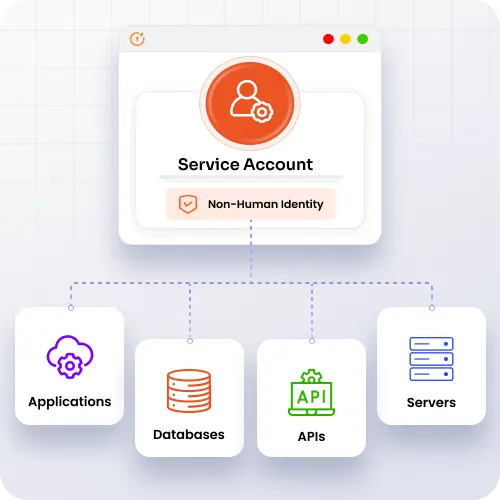
Manage both human and non-human identities in a single platform.
Extend proven IAM controls to modern machine identities.
Apply consistent policies across applications, APIs, and workloads.
Secure emerging AI agents alongside traditional systems.