

Adaptive security is a cybersecurity approach that continuously monitors users, devices, networks, and security events to identify risks and adjust defenses in real time. Unlike static security models that rely on fixed rules and periodic updates, adaptive security responds to changes in behavior, context, and threat levels as they occur.
It continuously evaluates security risks, detects unusual or suspicious activity, and adapts security controls based on the situation. For example, if a user attempts to access sensitive resources from an unfamiliar location or device, an adaptive security system can increase authentication requirements, restrict access, or block the activity.
The goal of adaptive security is to create a security environment that can continuously learn from new threats and respond to them. It combines continuous monitoring, risk assessment, threat detection, automated response, and dynamic policy enforcement to protect systems as security conditions change.
Why Is Traditional Security Not Enough for Today's Threats?
Static or traditional security tactics are based on fixed rules, predefined policies, and periodic policy reviews. They cannot keep up with the alarming rate of cybersecurity attacks today.
Key reasons why static security is being replaced with a modern approach are:
- Dynamic Infrastructure: APIs, cloud computing, IoT devices, remote access, and more change security perimeters daily, making static policies outdated.
- Emerging Threats: Cybercriminals are continuously developing novel techniques, and static security systems cannot keep up with the pace.
- Integration Challenges: Businesses are continuously integrating new technologies into their systems, such as APIs, third-party apps, and more. Static security is likely to struggle to adapt to these new technologies, leaving security loopholes.
- Delayed Responses: Static security reacts only after an incident, resulting in greater damage and a longer breach window.
An adaptive security approach addresses this gap by continuously assessing new information and adjusting security controls as risk changes.
How Does Adaptive Security Work?
At its core, an adaptive security model operates as a continuous, closed loop rather than a one-time process.
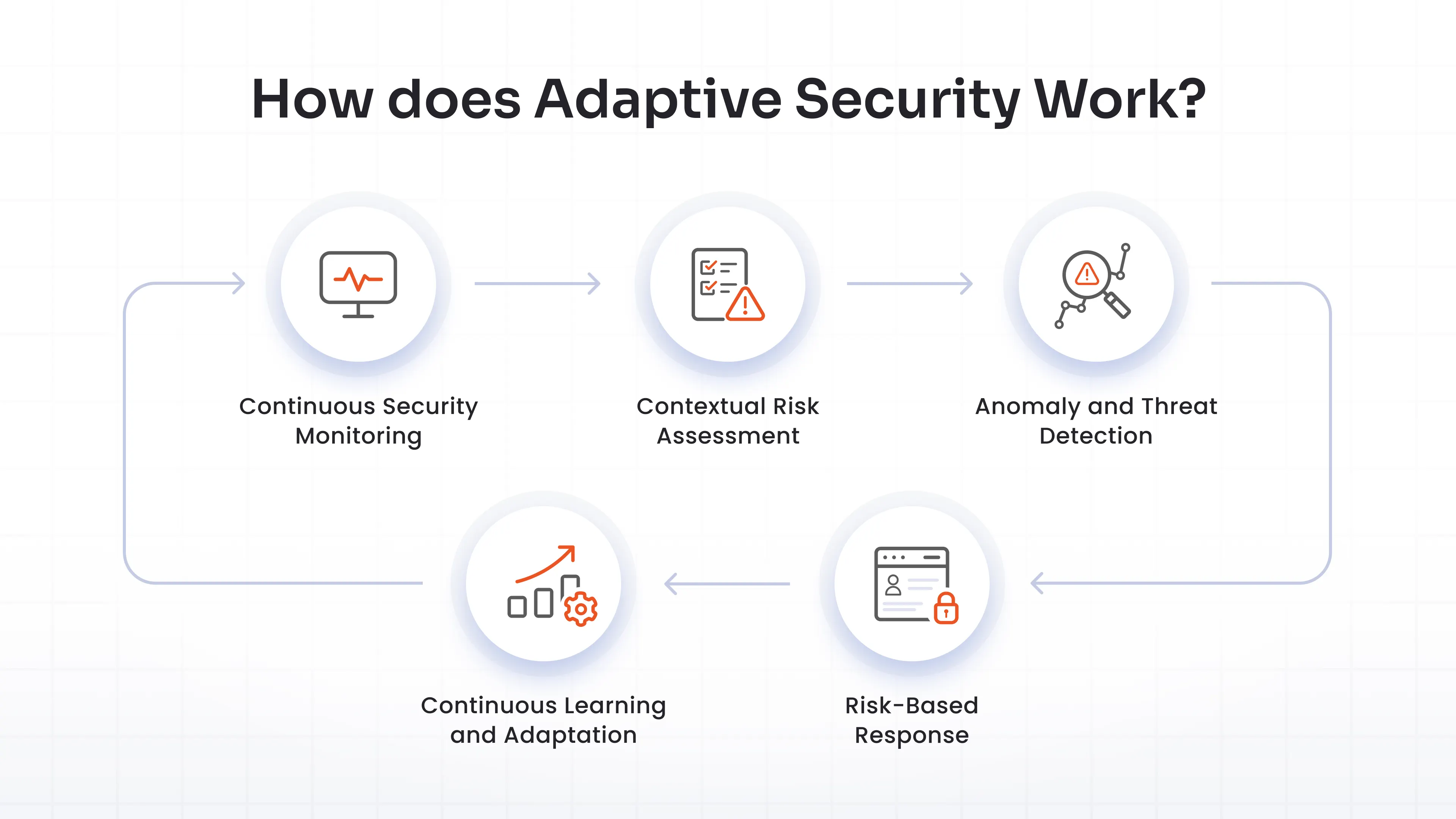
Continuous Security Monitoring
You continuously collect security signals from relevant parts of your environment. Depending on the implementation, these signals can include activity across users, devices, applications, networks, cloud workloads, and other security layers. In the end, you maintain enough visibility to identify meaningful changes in behavior or risk.
Contextual Risk Assessment
You then evaluate those signals in context. For instance, are there any logins from unknown devices or unusual locations and times?
Contextual risk assessment helps you decide whether a request looks normal, suspicious, or high risk.
Anomaly and Threat Detection
Behavioral analytics and anomaly detection help identify activity that differs from expected patterns.
This helps when you do not have a predefined rule for every possible attack. Instead of matching events to a known signature, you check whether the behavior itself looks unusual.
Risk-Based Response
Depending on the technology and policy, your security systems can block access, ask for stronger authentication, or restrict activity. The response should match the level of risk rather than treating every event the same way.
Continuous Learning and Adaptation
You review what happened and how effective the response was. Based on that, you can refine policies, detection logic, and response processes as the environment and threat landscape change.
What Technologies Enable Adaptive Security?
There are multiple technologies that can enable different capabilities of adaptive security. We have listed them below. You do not need all of them. Choose the ones that support the capabilities you need.
| Technology / Capability | Role in Adaptive Security |
|---|---|
| AI & Machine Learning | Analyzes massive datasets to identify patterns, anomalies, and emerging threats in real time. |
| UEBA (User & Entity Behavior Analytics) | Establishes baseline behavior for users and devices to detect suspicious deviations. |
| Threat Intelligence | Feeds global threat data into your system to provide current context on active attack vectors. |
| XDR (Extended Detection & Response) | Correlates security signals across endpoints, networks, servers, and cloud workloads. |
| SOAR (Security Orchestration, Automation & Response) | Automates incident response workflows to contain threats instantly without human delay. |
| Risk & Context Analysis | Evaluates situational signals (location, IP, time, device state) to calculate real-time risk scores. |
| IAM / Adaptive MFA | Dynamically changes access and authentication requirements based on current risk levels. |
What Are the Benefits of Adaptive Security?
Switching to an adaptive security framework brings measurable adaptive security benefits to your organization.
1. Faster Threat Detection and Response
Continuous monitoring helps you catch suspicious activity early, short-circuiting attacks before major damage occurs. The response is much faster than a human security team.
2. Risk-Based Security Decisions
Manage every risk based on context. You can apply strong controls where risk is high without slowing down trusted users performing routine tasks.
3. Reduced Attack Impact
Automated containment restricts suspicious accounts or devices immediately, limiting the blast radius of a breach.
4. Better Security Operations Efficiency
A lot of the security team’s work, like reviewing alerts, can be repetitive. Automation can take on appropriate detection and response actions, reducing overhead for your security team.
5. Support for Modern IT Environments
Adaptive cybersecurity protects hybrid networks, cloud workloads, and remote teams. It focuses on changing context and risk rather than relying only on a fixed perimeter.
Where Is Adaptive Security Used?
These adaptive security use cases show where a risk-based, context-aware approach can make a practical difference.
Adaptive MFA and Identity Security
An adaptive MFA solution alters authentication requirements based on the context of every login attempt. It evaluates signals such as user behavior, device, IP address, location, and time to determine whether a login needs additional verification.
For example, an employee logging in from their corporate laptop at their office will get access. However, that same employee will receive an MFA prompt when they attempt a login from an unknown foreign IP address at 3:00 AM.
Cloud and Application Security
Cloud environments expand and contract constantly. If a third-party device or service is integrated, the system scans for vulnerabilities, monitors for unauthorized access, and updates policies in real time.
If a cloud service displays abnormal data extraction behavior, your policies automatically throttle traffic or revoke access tokens.
Network and Endpoint Security
Adaptive network security is applied to VPN, Wi-Fi, and cloud solutions to establish secure remote access. These are monitored for any weird activities or behavior patterns, and real-time protections are implemented.
For adaptive mobile security, AI-based solutions check apps, device integrity, and user behavior. In case any anomaly is spotted, the entire device is either wiped clean or locked down.
Threat Detection and Response
Adaptive security also supports security operations teams as they detect and respond to threats.
Behavioral analytics can identify unusual activity with context added by threat intelligence. Automated response can then execute predefined actions based on the assessed risk.
How to Implement Adaptive Security in Your Organization?
Businesses can use adaptive cybersecurity regardless of their size, industry, or the type of cybersecurity threats they face. Adaptive security architecture can grow and evolve as per the business’s policies and processes.
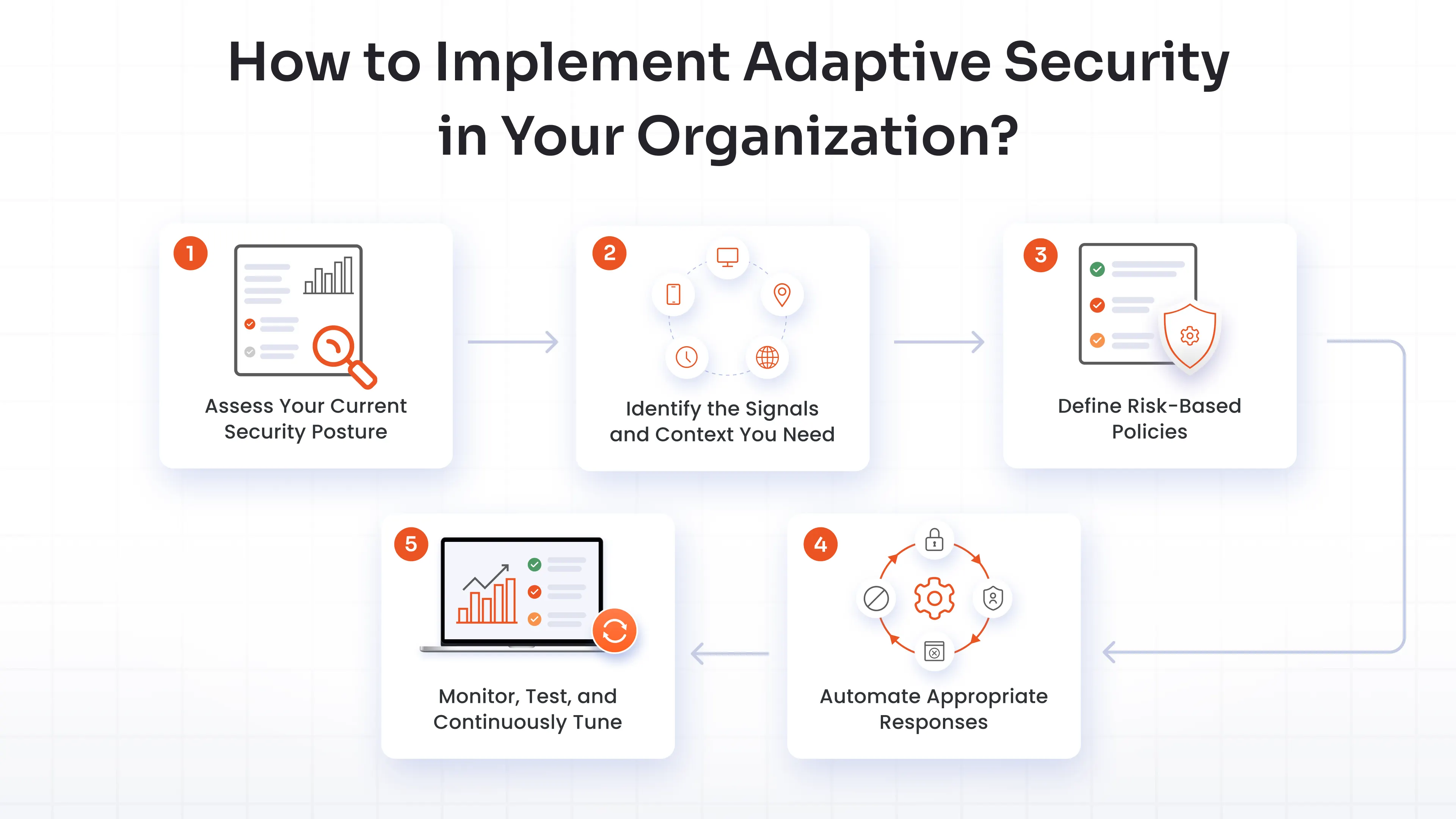
These are the steps to follow while using adaptive security:
1. Assess Your Current Security Posture
Audit your existing digital assets, user roles, applications, and security tools. Map out your most critical risks and data paths.
2. Identify the Signals and Context You Need
Determine which telemetry matters most for your organization, such as device health, IP reputation, geographic location, user role, and access timing.
3. Define Risk-Based Policies
Establish clear access rules. Decide what risk thresholds require step-up authentication, reduced access privileges, or immediate access blocks. You can implement these policies with the miniOrange MFA solution.
4. Automate Appropriate Responses
Set up automated workflows for high-confidence threats. Enable automatic session termination, device isolation, or risk-driven authentication prompts.
5. Monitor, Test, and Continuously Tune
Regularly review alert accuracy and false positive rates. Update your risk scoring models as your business scales and threat vectors evolve.
What Are the Challenges of Implementing Adaptive Security?
While adaptive defenses offer unmatched protection, implementation comes with practical hurdles you must manage:
- Integration Complexity: Connecting legacy architecture with modern security tools requires planning and API support.
- Data Collection and Quality: Adaptive engines rely on accurate telemetry. Poor data quality or fragmented logs lead to inaccurate risk assessments.
- False Positives and Alert Fatigue: Overly sensitive policies can lock out legitimate users, frustrating employees and burdening support teams.
- Initial Investment and Skills: Implementing automated orchestration tools requires initial financial resources and skilled cybersecurity experts.
- Continuous Policy Tuning: Threat landscapes change quickly. Your security teams must continually audit and tune risk models to keep policies aligned with operational needs.
How miniOrange Supports Adaptive Security
miniOrange specializes in Identity and Access Management (IAM) solutions, and it offers a comprehensive suite of adaptive security solutions, including Adaptive MFA and risk-based authentication, developed to deliver context-driven safety for enterprises.
With miniOrange, you can implement context-aware access policies that evaluate real-time signals, such as user location, IP address, device state, time of access, and behavioral patterns. When risk levels rise, miniOrange dynamically triggers step-up authentication using MFA methods, including Push Notifications, Authenticator Apps, OTPs, and Hardware Keys.
Know about the 15+ MFA methods offered by miniOrange, and set up a free MFA trial today!
Conclusion
Adaptive security is not simply a technical upgrade but a fundamental shift in how organizations approach cybersecurity.
By integrating context-based authentication, adaptive security continuously evaluates user behavior, device posture, and access patterns to ensure only legitimate users gain entry, significantly reducing the risk of unauthorized access.
Through continuous monitoring, AI-driven analytics, and automated response, adaptive security transcends the limitations of static reactive defense models, offering protection that is as dynamic as the threats themselves.
As attack surfaces expand and cybercriminals evolve their tactics, adaptive security empowers organizations to protect websites from hackers, ensuring agility, resilience, and proactive defense against ever-changing cyber threats.
Get in touch with us to upgrade your security standards now.
FAQs
Is adaptive security a security product?
No. Adaptive security is an approach or framework for making security decisions based on changing risk and context. You can implement it using different technologies and capabilities depending on your security needs.
Does adaptive security require artificial intelligence?
No. AI and machine learning can support adaptive security by identifying patterns, anomalies, and potential threats, but they are not required for every adaptive security implementation. The technologies you use depend on your environment and available signals.
What Is Adaptive MFA, and How Does It Relate to Adaptive Security?
Adaptive MFA is an identity-focused application of adaptive security. It evaluates signals such as device, location, IP address, time, and user behavior and can apply stronger authentication when risk increases.
Can Adaptive Security Protect Cloud and Remote Work Environments?
Yes. Adaptive security can support distributed environments by using changing context and risk signals instead of relying only on a fixed network perimeter. The specific protections depend on the technologies and controls you deploy.
What Technologies Are Used in Adaptive Security?
Common enabling technologies include AI and machine learning, UEBA, threat intelligence, XDR, SOAR, risk analysis, and IAM capabilities such as adaptive MFA. You do not need to deploy all of them.
Do you need to deploy every adaptive security technology?
No. You do not need every technology to adopt an adaptive security approach. Start with the capabilities that address your highest-priority risks, then expand your security controls as your environment evolves.
Leave a Comment