

The traditional network perimeter was designed for an environment where employees, applications, devices, and data largely operated within a controlled corporate network. That environment has changed. Cloud applications, remote work, third-party access, APIs, and machine-to-machine communication have made it difficult to define a single boundary around enterprise resources.
As a result, security decisions increasingly need to focus on identity. Every request to access an application, system, or piece of data can be evaluated according to who or what is making the request, what it needs to access, and whether that access is appropriate.
This is the foundation of identity-centric security, where identity becomes a central control point for authentication, authorization, governance, and threat detection.
What Is Identity-Centric Security?
Identity-centric security is a cybersecurity approach that places identity at the center of access decisions instead of relying primarily on network location. The identity may belong to an employee, administrator, contractor, application, service account, workload, or AI agent. Regardless of the type, the security model evaluates whether that identity should be trusted, what it should be allowed to access, and under what conditions.
An identity-centric security model therefore goes further than authentication. Verifying that someone is an employee does not automatically mean that the person should have access to every application or resource. Access also needs to reflect job responsibilities, privilege levels, resource sensitivity, device and behavioral context, and changes in the user's role.
This approach allows security policies to follow identities across cloud, on-premise, hybrid, and remote environments. A user's access can remain subject to the same principles whether the request originates from the corporate office, a home network, or a direct connection to a SaaS application.
Why Has Identity Become the New Security Perimeter?
The Network No Longer Defines Access
Cloud applications, remote work, third-party access, and distributed infrastructure mean users can reach business resources without passing through a traditional corporate network. As a result, network location alone is no longer enough to determine whether an access request should be trusted.
Credentials Have Become a Direct Attack Path
When attackers obtain legitimate credentials, they can potentially access applications and resources while appearing to be legitimate users. This makes authentication, authorization, and continuous identity monitoring important parts of the security layer rather than controls that simply happen at the network edge.
Access Is No Longer Limited to Human Users
Employees are only one category of identity in a modern enterprise. Service accounts, applications, APIs, workloads, and AI agents can also authenticate and access resources. Each creates an access relationship that needs to be governed, monitored, and eventually revoked.
Identity Can Follow Access Across Environments
A network boundary may change depending on where a user or workload operates, but the identity requesting access remains relevant across environments. This allows organizations to apply consistent authentication, authorization, and privilege policies.
Security Needs to Follow the Request, Not Just the Network
The key shift is from asking whether a connection comes from a trusted environment to evaluating whether the identity should access a particular resource under the circumstances. That makes identity a more useful control point for modern access decisions while allowing network and endpoint controls to remain part of the broader security architecture.
Identity-Centric Security vs. Perimeter-Based Security
The difference becomes clearer when the two approaches are considered side by side.
| Security consideration | Perimeter-based security | Identity-centric security |
|---|---|---|
| Primary trust signal | Network location and network controls | Identity, permissions, and context |
| Access model | Trust is strongly influenced by network entry | Access is evaluated at the resource level |
| Authentication | Often establishes access to the trusted environment | Remains central to individual access decisions |
| Authorization | Can become broad after network access | Applied according to specific permissions |
| Scope | Primarily focused on users and devices entering the network | Includes users, machines, applications, and AI agents |
| Privilege | Access can remain persistent | Access is aligned with least-privilege requirements |
| Monitoring | Focuses heavily on network and endpoint activity | Connects activity with identity and access |
This does not mean organizations should abandon firewalls, network segmentation, endpoint protection, or other established controls. These technologies continue to play important roles. The difference is that identity-centric security adds an identity layer that can make decisions where traditional network boundaries are no longer sufficient.
How Identity-Centric Security Works
Identity-centric security connects several stages of the access lifecycle rather than treating authentication as the end of the security process.
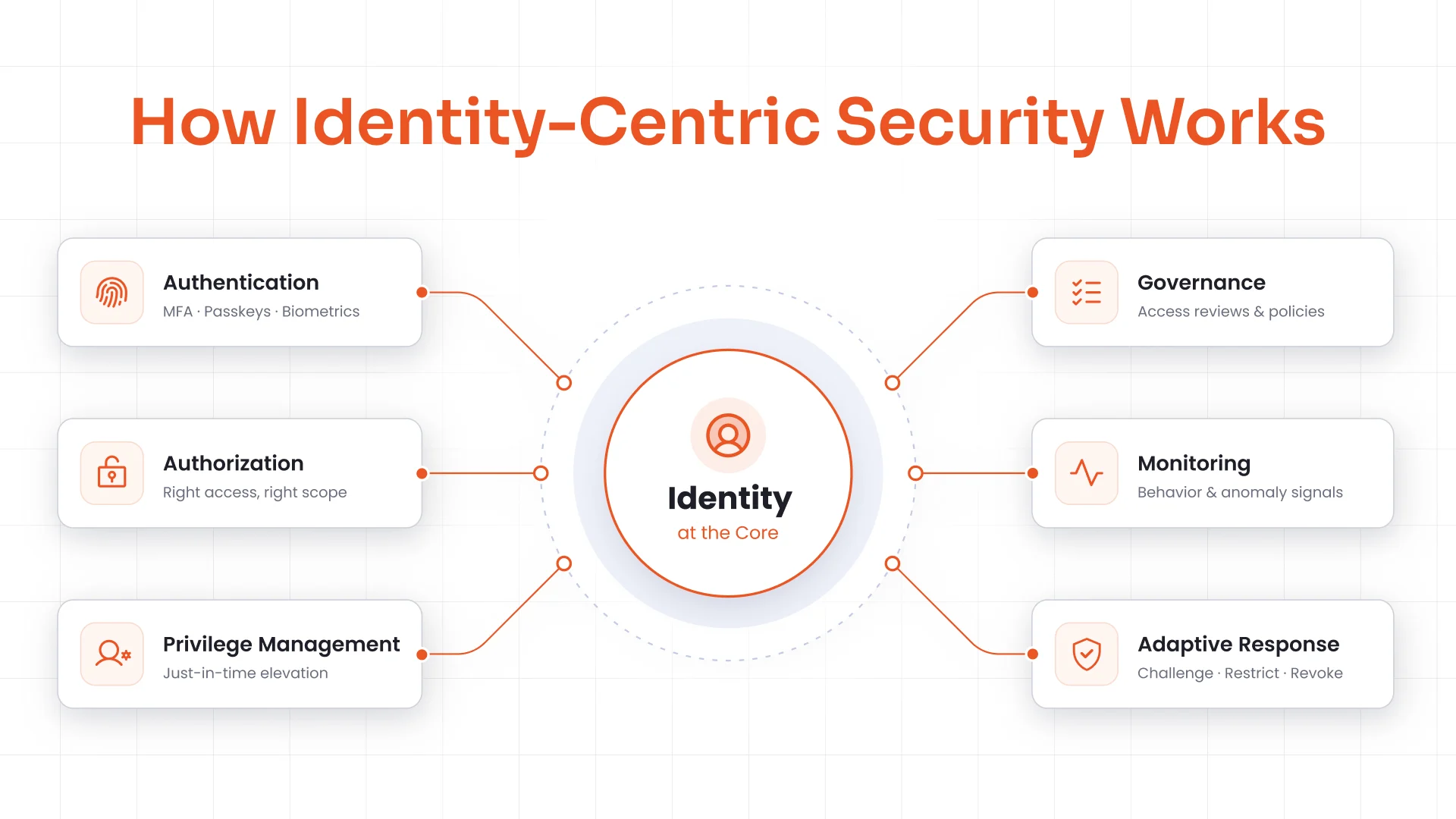
When an access request is made, the first consideration is the identity behind it. Authentication mechanisms such as MFA, passkeys, biometrics, or other strong authentication methods can establish confidence that the identity is legitimate. The next question is whether that identity should have access to the requested application, system, data, or API.
Authorization policies then determine the scope of access. A user may be permitted to view a particular application without being allowed to modify sensitive records within it. An administrator may receive elevated privileges only for a specific task. A service account may be restricted to a defined set of APIs.
The process continues after access has been granted. Identity activity can be monitored for unusual behavior, privilege changes, suspicious authentication patterns, or other indicators of compromise. If the context changes, access can be challenged, restricted, or revoked.
This creates an identity-centric security architecture in which authentication, authorization, governance, privilege management, and monitoring work together rather than operating as isolated controls.
The Core Components of an Identity-Centric Security Architecture
Centralized authentication and SSO
Authentication is the foundation because every access decision depends on establishing which identity is making the request. Single Sign-On can centralize authentication across applications while giving security teams a consistent place to apply access policies.
MFA adds another layer of verification, while adaptive authentication can introduce additional checks when factors such as device, location, or behavior indicate increased risk. This combination reduces dependence on passwords while making authentication more closely connected to the context of each access request.
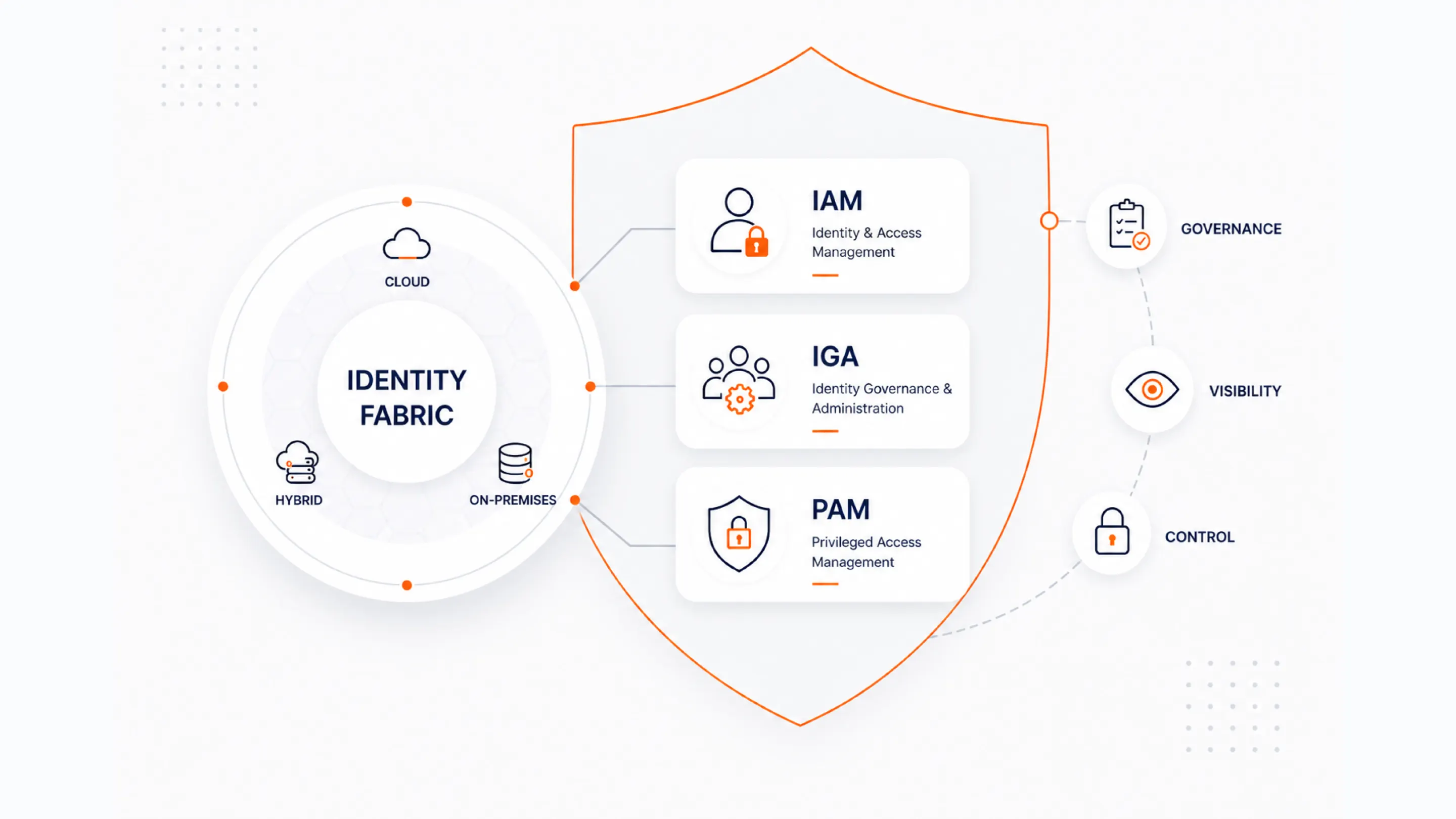
Identity Governance and Administration
Authentication answers who the user is, but it does not determine whether the user's access remains appropriate over time. Employees change roles, move between departments, take on new responsibilities, or leave the organization. Without lifecycle controls, permissions can remain attached to identities long after the original business requirement has disappeared.
Identity Governance and Administration addresses this problem through capabilities such as automated provisioning and deprovisioning, access certification, entitlement management, and separation-of-duties controls. It keeps access connected to the identity lifecycle rather than allowing permissions to accumulate indefinitely.
Privileged Access Management
Privileged identities require additional controls because their permissions can affect critical infrastructure, applications, and sensitive information. A compromised administrator account can provide an attacker with substantially more opportunity than a standard employee account.
PAM helps reduce this exposure by controlling privileged credentials, limiting standing access, and supporting mechanisms such as credential vaulting and just-in-time elevation. Instead of treating administrative access as permanently available, organizations can make elevated privileges dependent on an approved requirement.
Identity Threat Detection and Response
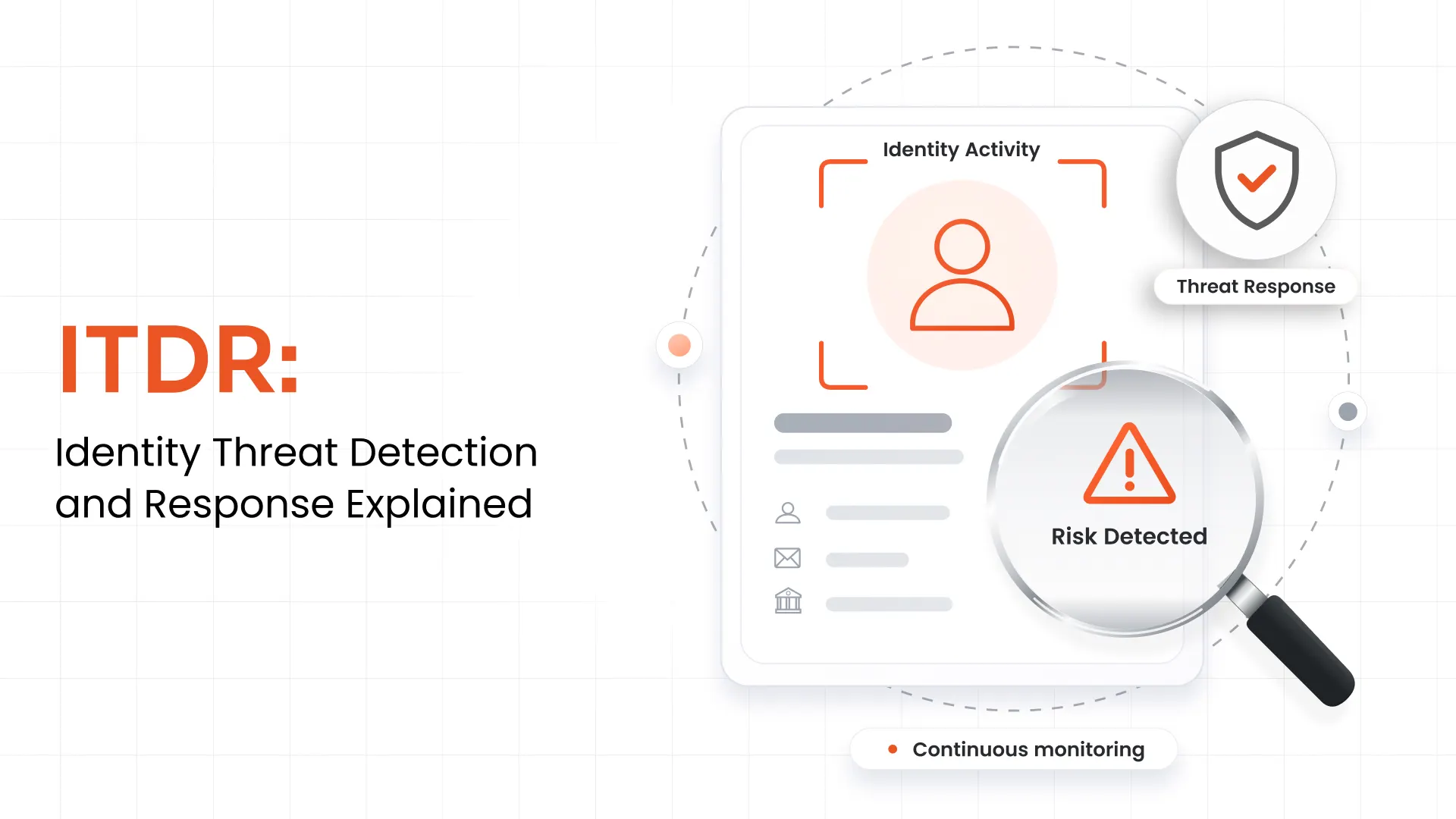
Identity management establishes what an identity should be able to access. Identity Threat Detection and Response helps determine whether that access is being misused.
This distinction becomes important when an attacker gains legitimate credentials. The authentication event itself may not appear suspicious because the correct username, password, or authentication factor was used. Identity-aware monitoring can provide additional context by examining unusual access patterns, privilege changes, authentication behavior, and other indicators that suggest the account may have been compromised.
Non-human identity governance
Identity-centric security also needs to account for identities that do not belong to people. Service accounts, API credentials, applications, workloads, containers, and AI agents can all authenticate to enterprise resources and perform actions.
These identities require many of the same controls applied to human identities, including ownership, defined permissions, lifecycle management, monitoring, and revocation. Without these controls, credentials can remain active even after the application or process that originally required them is no longer in use.
Why Least Privilege Is Central to Identity-Centric Security
Least privilege becomes especially important when identity is the primary basis for access decisions. The objective is not simply to determine whether an identity is legitimate, but to limit what that identity can do after authentication succeeds.
Consider a developer who needs access to a production environment for a specific maintenance task. A broad access model might leave the developer with permanent production privileges because those permissions may be useful again in the future. A least-privilege approach would instead provide only the permissions required for the task and limit their duration where appropriate.
The distinction matters during a compromise. If an attacker obtains the developer's credentials, persistent administrative access creates a larger attack surface. Restricting permissions reduces the number of resources that the compromised identity can reach and limits the potential impact of the incident.
Least privilege therefore connects identity security with breach containment. The objective is not to assume that authentication will always prevent compromise, but to ensure that a compromised identity does not automatically become a path to everything else.
Identity-Centric Security and Zero Trust
Identity-centric security is closely aligned with Zero Trust because both approaches challenge the assumption that access should be trusted simply because it originates from an approved environment.
Zero Trust provides the broader security philosophy of verifying access and continuously evaluating trust rather than granting implicit access based on location. Identity-centric security provides one of the primary mechanisms for putting that philosophy into practice.
For example, an organization implementing Zero Trust may require stronger authentication for sensitive resources, restrict access according to user roles, apply least privilege to administrative accounts, and continuously evaluate identity activity. These controls all depend on understanding the identity involved in the request.
Identity therefore becomes an important connecting layer between authentication, authorization, access governance, and security monitoring.
What Is Identity-Centric Security for SaaS?
The question of what is identity-centric security for SaaS becomes particularly relevant as organizations continue to distribute business applications across multiple cloud platforms.
In a SaaS environment, users often access applications directly over the internet rather than through a corporate network. An organization may have separate applications for finance, human resources, collaboration, customer management, development, and other business functions, each with its own permissions and access requirements.
This creates identity-related challenges. A user may retain access after changing roles, a contractor may have permissions that exceed the original business requirement, or an employee may accumulate accounts across applications without centralized oversight.
Identity-centric controls can bring consistency to this environment. SSO can centralize authentication, MFA can strengthen account security, lifecycle automation can connect application access with employee status, and governance can provide visibility into who has access to which resources.
For SaaS-heavy organizations, this makes identity one of the most practical layers for controlling access across applications that do not share the same underlying infrastructure.
Securing Machine Identities and AI Agents
The growth of machine identities introduces another dimension to identity-centric security. Applications and workloads increasingly communicate without human intervention, while AI agents are beginning to perform tasks that involve accessing enterprise applications, APIs, and data.
The security challenge is that these identities can sometimes receive persistent credentials and permissions without the same lifecycle discipline applied to employees. A service account created for an application may remain active for years, while an API credential may continue providing access even after the original use case has changed.
AI agents make this challenge more complex because they can perform actions across multiple systems. An agent may need permission to retrieve information from one application, send data to another, and initiate an action through an API. Each permission should therefore be explicitly defined rather than allowing the agent broad access simply because it is considered part of a trusted application environment.
An identity-centric approach provides a framework for managing these identities through ownership, authentication, scoped authorization, lifecycle controls, monitoring, and revocation. The same principle applies whether the identity belongs to a person, application, workload, or AI agent.
How to Build an Identity-Centric Security Strategy
Organizations do not necessarily need to replace their existing security architecture to adopt an identity-centric security model. The transition can begin by connecting identity more closely with the controls already used across the environment.
1. Build an identity inventory. Identify employees, contractors, administrators, service accounts, applications, API credentials, workloads, and other identities that can access enterprise resources. A complete inventory provides the foundation for understanding the actual access surface.
2. Centralize authentication. Establish consistent authentication policies across applications through SSO and centralized identity controls. This reduces fragmented login mechanisms and gives security teams greater visibility into authentication activity.
3. Strengthen authentication. Introduce MFA and stronger passwordless or phishing-resistant methods where appropriate. Adaptive policies can add additional verification when access context indicates increased risk.
4. Establish granular authorization. Define permissions according to actual business requirements instead of relying on broad access based solely on organizational role or network location.
5. Reduce standing privilege. Apply least privilege to standard and privileged identities, and use temporary elevation where users need additional access for specific tasks.
6. Connect access to the identity lifecycle. Automate provisioning and deprovisioning and conduct regular access reviews so permissions change when responsibilities change.
7. Monitor identity activity. Combine identity data with security monitoring to identify suspicious authentication, privilege escalation, unusual access patterns, and potential account compromise.
8. Extend governance to non-human identities. Apply ownership, authorization, lifecycle management, and monitoring to service accounts, applications, workloads, and AI agents.
What Organizations Gain From an Identity-Centric Approach
The business value of identity-centric security extends across security, IT, compliance, and user experience.
For security teams, it provides a stronger connection between an access event and the identity responsible for that activity. Instead of seeing only a network connection or endpoint event, teams can investigate which identity accessed a resource, what permissions were associated with that identity, and whether the activity matched expected behavior.
For IT teams, centralized authentication and automated lifecycle management can reduce repetitive access administration. When access changes can be tied to employee roles and lifecycle events, teams have fewer manual processes to maintain.
Compliance teams also benefit from stronger visibility into authentication, access reviews, privilege management, and identity lifecycle events. Rather than treating access evidence as something assembled for an audit, organizations can make those controls part of ongoing identity operations.
Most importantly, the approach can reduce the impact of compromised credentials. Strong authentication can make credential theft harder, while authorization and least privilege limit what a compromised identity can reach.
Choosing Identity-Centric Access Management Software
When evaluating identity-centric access management software, organizations should look beyond authentication features and assess how the solution manages the full relationship between identities and resources.
| Capability | What to evaluate |
|---|---|
| Authentication | SSO, MFA, passwordless and phishing-resistant authentication |
| Authorization | Granular policies and least-privilege controls |
| Governance | Provisioning, deprovisioning, access reviews, and entitlements |
| Privileged access | Credential management, elevation, and privileged sessions |
| Threat detection | Identity-aware monitoring and response |
| Non-human identities | Controls for service accounts, applications, workloads, and agents |
| Deployment | Cloud, hybrid, and on-premises requirements |
| Integration | SaaS, directories, legacy applications, and infrastructure |
The most effective approach depends on the organization's existing applications, identity providers, infrastructure, compliance requirements, and deployment model. The objective is to establish consistent identity controls without creating another collection of disconnected security systems.
Identity-Centric Security With miniOrange
miniOrange brings identity controls together across authentication, governance, privileged access, and application access, helping organizations apply consistent identity policies across modern and legacy environments.
Strengthen Authentication
Use Single Sign-On and Adaptive MFA to centralize authentication across cloud, on-premises, and legacy applications. Organizations can apply stronger authentication policies while giving users a more consistent way to access the resources they need.
Govern the Identity Lifecycle
Identity Governance and Administration connects access with employee roles and lifecycle changes through provisioning, deprovisioning, access certification, and entitlement management. This helps reduce unnecessary access as responsibilities change.
Control Privileged Access
Privileged Access Management protects high-impact identities with capabilities such as credential vaulting and just-in-time access. These controls help reduce persistent administrative privileges and provide greater control over sensitive systems.
Extend Access Across Applications
Unified Login Management supports authentication across web, mobile, and legacy applications, allowing organizations to apply identity controls even where older applications remain part of the environment.
With these capabilities, organizations can establish an identity-centric security model that connects authentication, access governance, privilege management, and application access without forcing every part of the environment into the same deployment model.
Identity-Centric Security is the Present and Future
The modern enterprise operates across cloud services, SaaS applications, remote environments, legacy systems, APIs, and increasingly autonomous workloads. In this environment, network location alone cannot provide enough context for every access decision.
Identity provides a more consistent foundation because it remains connected to the entity requesting access. By combining strong authentication with authorization, least privilege, governance, privileged access controls, and identity-aware monitoring, organizations can build security policies around the identities actually interacting with their resources.
That is the shift behind identity-centric security: moving security decisions closer to the identity, the access request, and the resource being protected.
FAQs
Is identity-centric security the same as Zero Trust?
No. Zero Trust is a broader security approach based on explicit verification and authorization. Identity-centric security focuses specifically on making identity a central part of those security decisions.
Does identity-centric security replace network security?
No. Firewalls, network segmentation, endpoint security, and other network controls remain important. Identity-centric security addresses the access decisions that network location alone cannot adequately determine.
Why is identity-centric security important for SaaS?
SaaS applications are often accessed directly over the internet, which reduces the usefulness of traditional network boundaries as the primary trust mechanism. Identity controls provide a consistent way to authenticate users, authorize access, and manage application permissions.
Does identity-centric security cover non-human identities?
Yes. A complete identity-centric security model should include service accounts, applications, API credentials, workloads, and AI agents alongside human identities.
How does least privilege support identity-centric security?
Least privilege limits the resources and actions available to an identity. If an account is compromised, those restrictions can reduce the number of systems and resources that the attacker can access.
What should organizations do first?
Start by identifying the identities and access relationships already present in the environment. From there, organizations can strengthen authentication, centralize access policies, establish lifecycle governance, and progressively reduce unnecessary privilege.
Leave a Comment