
No single product gives you an identity fabric. That's the part most vendor pitches skip.
Most enterprises didn't set out to build a fragmented identity stack. It happened one tool at a time: a directory service here, a PAM vault there, an IGA platform bolted on for the audit, a CIAM system for customers that nobody connected to the workforce IAM. Each layer solved a real problem in isolation. Together, they produced a stack that's powerful in parts and inconsistent everywhere else. Identity fabric is the architectural response to that fragmentation.
Quick Answer
Identity fabric is an architectural approach that unifies identity and access management across every system, environment, and identity type in an organization, such as human, machine, and AI agent, under one consistent governance layer, instead of leaving each tool to enforce its own rules.
Key facts:
- Gartner named identity the operational fabric of the enterprise at its 2026 IAM Summit and now publishes ten identity fabric principles
- Analyst firms describe the same underlying pattern under different names: Identity Fabric (KuppingerCole), IVIP (Gartner), and ISPM (Forrester)
- Gartner has projected that identity fabric immunity principles could prevent 85 percent of new attacks and reduce the financial impact of breaches by 80 percent by 2027
- It's a mesh that connects existing tools, not a single product that replaces them
What Is an Identity Fabric?
An identity fabric is the architectural approach that unifies identity and access management across all systems, environments, and identity types in an organization.
It describes how an enterprise stitches together directory services, identity governance, privileged access management, and access controls so that every user, device, and AI agent is provisioned, authenticated, monitored, and deprovisioned through consistent policy, rather than whatever rules each individual tool happens to enforce on its own.
In practice, think of it less as a product and more as connective tissue. It's the mesh that lets your directory, your PAM vault, your IGA platform, and your CIAM system all agree on who someone is, what they're allowed to do, and whether that access is still appropriate, without each system maintaining its own disconnected version of the truth.
Why Identity Fabric Matters Now
Gartner has stopped calling identity a supporting control.
At its 2026 IAM Summit, Gartner was direct: identity is no longer a supporting control; it is the operational fabric of the enterprise itself. The firm now publishes ten identity fabric principles, including converged identity, continuous monitoring, and least privilege as the default state rather than an aspiration.
Fragmentation itself has become the exposure.
Each identity layer- directory, PAM, IGA, CIAM- was added to solve its own problem and came with its own tooling, data model, and operational scope. The result is a stack that's strong in parts and inconsistent in aggregate, and attackers exploit exactly that inconsistency: the account that's governed in one system and invisible in another.
AI agents don't fit the old model at all.
Traditional IAM was designed around the joiner-mover-leaver lifecycle of human employees inside a directory the enterprise fully controls. That model breaks down fast when the "employee" is a service account, an API integration, or an autonomous AI agent that provisions itself. Identity fabric treats human and non-human identities as equal citizens in one governance layer instead of a bolt-on afterthought.
The stakes of getting this wrong are quantified.
Gartner projected that identity fabric immunity principles could prevent 85 percent of new attacks and reduce the financial impact of breaches by 80 percent. Whatever the precise figure ends up being in practice, the direction is unambiguous: fragmented identity architecture is a measurable and growing liability.
Frontline reality, not whiteboard architecture, is the real test.
When identity fragmentation slows a machine operator trying to log in at 5 a.m., the architecture is failing exactly where it matters. Identity fabric work gets judged on the shop floor and the help desk queue, not the security architect's slide deck.
Identity Fabric vs. a Traditional IAM Stack
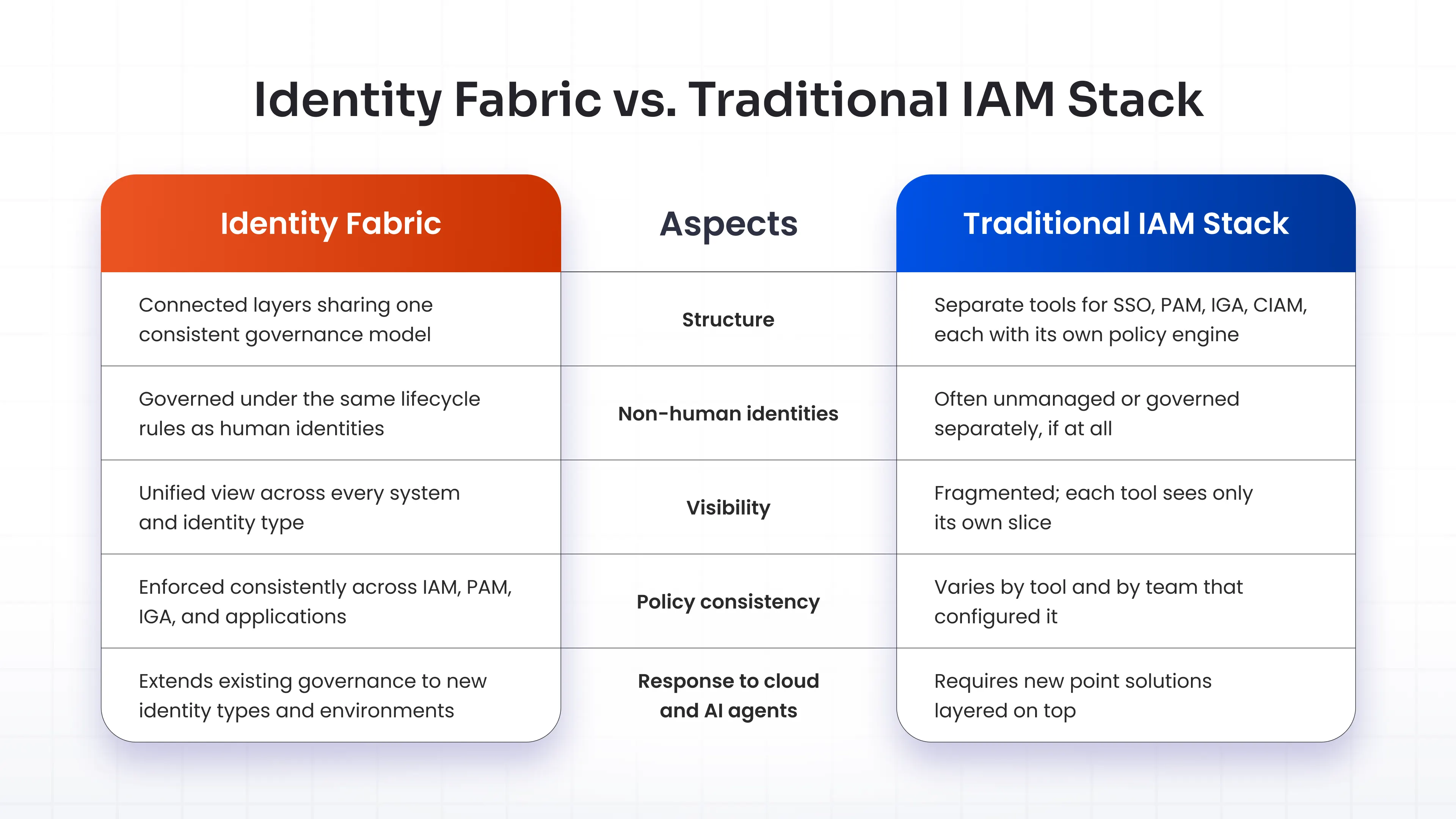
An identity fabric doesn't necessarily mean fewer tools. It means those tools stop operating as islands.
Core Layers of an Identity Fabric
1. Identity sources. HR systems, directory services, cloud IAM (AWS, GCP), SaaS OAuth grants, all the places identity data originates.
2. Governance layer. IGA policies, access certification, and Segregation of Duties enforcement applied consistently across every source, not just the ones that happen to integrate easily.
3. Authentication and access layer. SSO and Adaptive MFA enforcing consistent login policy regardless of which application sits underneath.
4. Privileged access layer. PAM providing just-in-time elevation and vaulting for the highest-risk identities, human and machine alike.
5. Continuous monitoring and posture layer. The read layer that continuously tracks every identity, entitlement, and system, surfacing drift and risk without necessarily owning the systems of record itself.
6. Policy orchestration. The connective layer that makes every other principle enforceable at scale, rather than each tool interpreting policy independently.
How to Build Toward an Identity Fabric
1. Map what you already have before buying anything new. Most organizations are surprised by how much identity infrastructure already exists in silos; the fabric starts by connecting it, not replacing it wholesale.
2. Start with policy orchestration, not tool consolidation. A consistent policy layer across existing tools delivers most of the value before a single platform gets swapped out.
3. Bring non-human identities into scope from day one. Service accounts, API keys, and AI agents need the same provisioning, monitoring, and deprovisioning discipline as employees, not a separate, looser standard.
4. Prioritize continuous monitoring over point-in-time reviews. An identity fabric's value comes from knowing drift as it happens, not finding it during next quarter's access review.
5. Treat frontline usability as a success metric. If fabric-driven governance slows down a legitimate user's ability to get work done, that's a design failure, not an acceptable tradeoff for security.
6. Extend gradually to new environments. Cloud, legacy on-premises, and AI-driven operations all need to sit under the same governance model eventually, but a phased rollout beats a forced big-bang migration.
Business Benefits of Identity Fabric
1. A single, coherent audit trail. Instead of reconciling logs across five disconnected tools, auditors and security teams get one consistent view of who did what, as whom.
2. Reduced identity-based breach exposure. Consistent least-privilege enforcement closes the gaps that show up specifically at the seams between disconnected tools.
3. Faster AI adoption with less risk. You can't safely govern what AI agents can touch until non-human identity is folded into the same fabric as everything else.
4. Lower long-term tooling overhead. Policy orchestration reduces the redundant configuration work of maintaining separate rules in separate systems.
5. Better resilience against future identity types. A fabric extends to new identity categories as they emerge, instead of requiring a new point solution every time.
Who This Matters To
- CISOs and security architects get a framework for closing the exposure created by fragmented tooling, not another point product to integrate.
- IT operations teams get consistent provisioning and deprovisioning across every system, cutting the manual reconciliation work fragmented stacks create.
- Compliance teams get one coherent audit trail instead of stitching together evidence from five disconnected sources.
- Teams rolling out AI agents get a governance model that already accounts for non-human identity, instead of retrofitting one after the fact.
Identity Fabric With miniOrange
miniOrange's IAM portfolio, SSO, Adaptive MFA, IGA, PAM, ULM, and CASB, is built to operate as a connected fabric rather than a set of standalone products.
- Unified policy enforcement across Single Sign-On, MFA, and Privileged Access Management, so access decisions follow one consistent set of rules regardless of which application sits underneath.
- Identity Governance (IGA) that extends provisioning, certification, and Segregation of Duties enforcement across cloud, on-premises, and legacy applications alike.
- Non-human identity support, bringing service accounts and API-based access under the same lifecycle discipline as human employees.
- Flexible deployment architecture across cloud, hybrid, and full on-premises, so the fabric extends to legacy systems most vendors quietly stop supporting.
- 6,000+ integrations, reducing the number of blind spots any single application can introduce into the fabric.
Looking to connect fragmented identity tools into one coherent policy layer? Schedule a Demo to see how miniOrange's IAM stack fits together as a fabric.
Our Conclusion
An identity fabric isn't a rebuild. It's an admission that the tools already in place were each solving their own problem and never talking to each other, and a plan to fix that without starting from zero. Get the connective tissue right, and the fragmentation that's currently your biggest blind spot becomes your most complete source of visibility instead.
FAQs
Is identity fabric a product I can buy?
No single product delivers an identity fabric. It's an architectural approach connecting existing and new identity tools under consistent policy and governance.
How is identity fabric different from Zero Trust?
Zero Trust is the security principle: never trust, always verify. Identity fabric is the architecture that makes consistent, continuous verification possible across every system and identity type in an enterprise.
Do we need to replace our existing IAM tools to build a fabric?
Usually not entirely. Most organizations connect and orchestrate policy across what they already have first, replacing individual tools only where genuine gaps exist.
How does identity fabric handle AI agents specifically?
By treating them as identities requiring the same lifecycle governance as human accounts: an owner, scoped permissions, continuous monitoring, and a deprovisioning path, rather than an unmanaged exception.
What's the difference between Identity Fabric, IVIP, and ISPM?
They describe largely the same underlying pattern from different analyst firms: KuppingerCole's Identity Fabric, Gartner's IVIP, and Forrester's ISPM all center on a continuous, aggregated view of identity and risk across a fragmented IAM stack.
About the Author

Content Writer
With a background in Journalism and extensive experience in SaaS and cybersecurity content writing, Chaitali Avadhani has contributed to creating various forms of impactful content pieces across multiple verticals. At miniOrange, her role is to craft SEO-friendly and lead-generating content around Identity and Access Management (IAM) products and cybersecurity as a whole.
Leave a Comment