

Every time you log into a work app, buy something online, or let an AI assistant pull data from your CRM, something is checking who, or what, is on the other end. That’s digital identity working in the background.
It’s not one login or one face scan, but a full set of data that represents a person, a machine, or an AI agent inside digital systems. Cloud apps, remote work, digital banking, government portals, and autonomous AI agents have all pushed digital identity from a background IT function into something organizations have to actively manage.
This guide covers what digital identity actually means, how it works, the risk it creates, and how businesses put it to use.
What is Digital Identity?
A digital identity is how a person, device, or piece of software gets represented and recognized inside digital systems. NIST's official definition calls it the unique representation of a subject engaged in an online transaction. In plain terms, it's the data trail that proves you're you, or that a server is that server, when nobody can physically check an ID.
That's what separates it from a physical identity. A driver's license sits in your wallet. A digital identity lives across databases, tied to identifiers, credentials, and behavior patterns that get checked every time someone tries to access something.
One thing worth clearing up: you don't have just one digital identity. You probably have dozens. Your work login, your bank's mobile app, your Google account, your smart card/CAC if you work with government systems, each one is a separate digital identity, even though they all represent the same person.
And it's not only humans anymore. Servers, APIs, containers, and AI agents all carry their own digital identities now too. An AI agent pulling data from Salesforce needs to authenticate and get authorized just like an employee does, often with far less oversight.
What Makes Up a Digital Identity?
A digital identity is not just one piece of data; rather, it’s built from four layers that work together.
| Component | What it includes |
|---|---|
| Identifiers | Usernames, UUIDs, device IDs, employee IDs |
| Attributes | Name, email, government ID, phone number |
| Credentials | Passwords, passkeys, certificates, security keys |
| Behavioral signals | Device fingerprint, location, login time, risk score |
How Does Digital Identity Work?
Digital identity moves through a lifecycle every time it’s created, used, or retired.
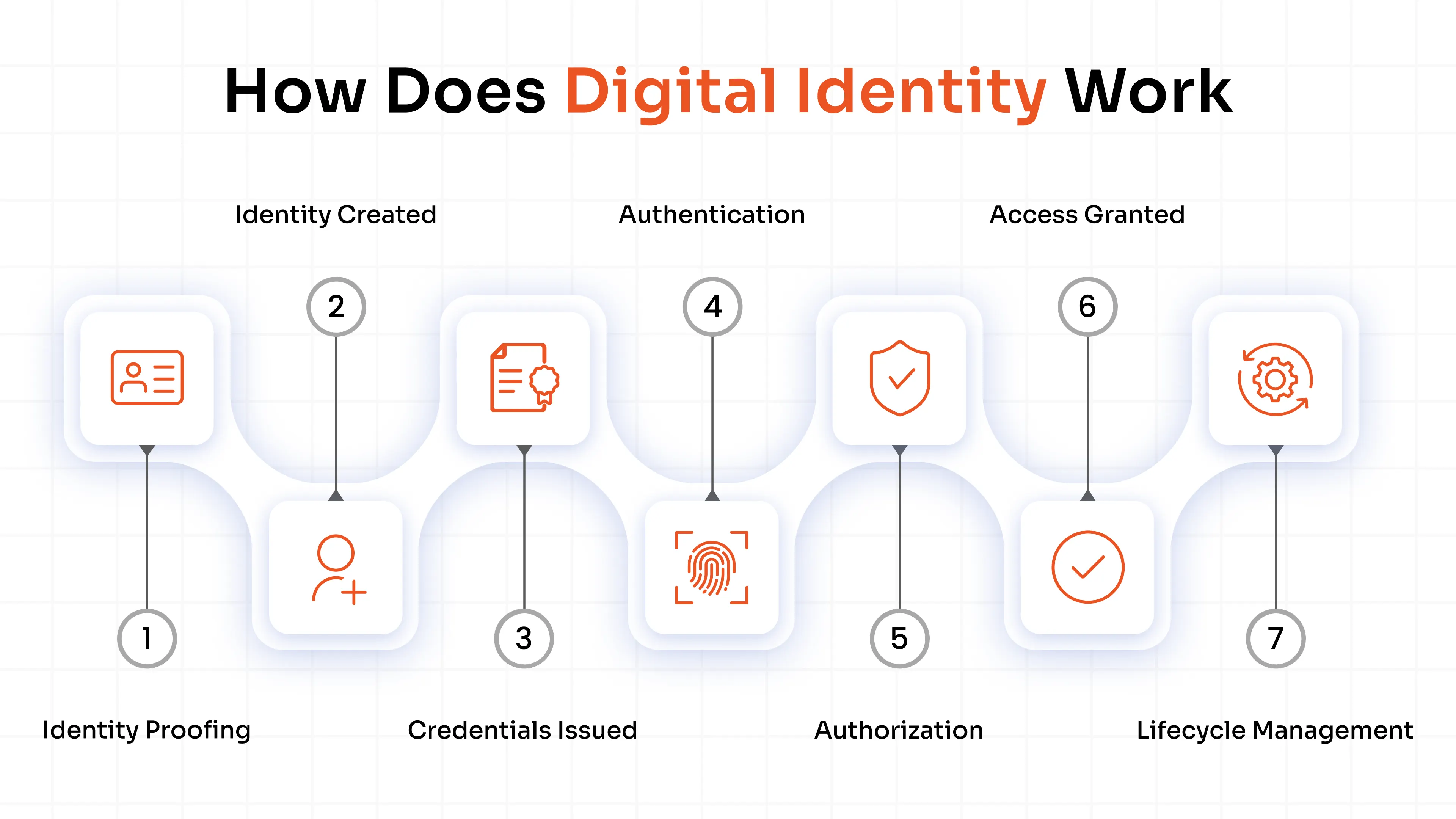
1. Identity proofing: the system checks that someone is really who they claim to be, usually via documents or biometrics, or both.
2. Identity creation: once proofed, a digital record gets created and tied to the person’s identifiers.
3. Credential issuance: they get a password, certificate, or passkey to prove it’s them next time.
4. Authentication: they present that credential and the system verifies it.
5. Authorization: the system decides what they’re allowed to do now that it knows who they are.
6. Continuous verification: modern systems don’t stop checking after login. They watch device and behavior signals throughout the session.
7. Lifecycle management: access gets updated or revoked as roles change or people leave.
Proofing establishes who someone is. Authentication confirms they still hold the credentials to prove it. Mixing those two up is common, and it’s the difference between checking someone’s badge once at the door vs. checking it every time they walk down the hall.
Most organizations combine a few digital identity verification methods rather than relying on one. Document checks compare a gov. ID against a database. Biometric verification matches a face/fingerprint scan against a stored template. OTPs and certificates add another layer on top. Verifiable credentials, a newer standard, let someone prove a claim, like being over 21, without handing over the entire document every single time.
Digital Identity vs. Digital ID VS. Identity Management
These three terms are used interchangeably. They shouldn’t be.
| Term | What it actually means |
|---|---|
| Digital identity | The full set of data representing a person or entity online |
| Digital ID | A specific credential, usually government-issued, like a national eID or mobile driver’s license |
| Digital Identity Management | The systems and processes that an organization uses to create, secure, and govern digital identities at scale |
A digital ID is one piece of a digital identity, not the whole thing. Digital identity management is the infrastructure, the IAM platforms, governance tools, and directories, that organizations use to keep identities secure across their lifecycle. Organizations manage identity management. Individuals and machines have digital identities.
Types of Digital Identity
Digital identity splits into five broad types.
- Workforce identity: employees accessing internal apps and systems.
- Customer identity (CIAM): the people buying from you or using your product.
- Partner identity: vendors and third parties who need limited, controlled access.
- Machine identity: servers, APIs, containers, and services talking to each other.
- AI agent identity: autonomous AI systems and copilots that now touch CRMs, databases, and internal tools on their own.
Most organizations manage these separately, with different tools, different owners, and different risk models. That gap is exactly where a lot of the risk in the next section comes from.
Real-World Examples of Digital Identity
Digital identity shows up everywhere, and these days they show up without anyone thinking about it as “identity” directly.
| Industry | Example |
|---|---|
| Banking | Logging into a mobile banking app |
| Healthcare | Patient accessing a portal for records and appointments |
| Education | Student logging into an LMS |
| Government | National digital ID for public services or CAC for defence services |
| Retail | Loyalty account tied to purchase history |
| Enterprise | Employee using SSO across Microsoft 365, Slack, and Salesforce |
| AI | An AI agent authenticating to pull data from a CRM |
Each of these runs on the same underlying mechanics: identities, credentials, and a system deciding whether to grant access.
Why Understanding Digital Identity is so Important
If you know what you’re doing, it does nothing but boost our security. Verified identities cut the guesswork out of who’s actually accessing your systems. And that’s important given 22% of the breaches in the 2025 Verizon DBIR started with stolen or abused credentials.
It also helps reduce registration and access friction and gives smoother access to employees and customers. Single sign-on (SSO), passwordless authentication, etc., mean people stop fighting with passwords to reach the tools they need.
Fraud detection and prevention improve because behavioral and biometric checks catch account takeover attempts that a password alone would miss.
Compliance also gets easier. Frameworks like NIST 800-63 and GDPR expect organizations to know who’s accessing what and to prove it during an audit.
Operational efficiency goes up when provisioning and deprovisioning run automatically instead of eating the IT team’s week every time someone joins or leaves.
And it sets up AI properly. AI agents have started acting on behalf of employees, and a clear digital identity is what keeps that access accountable instead of invisible.
Common Digital Identity Risks
Digital identity creates convenience. It also creates a bigger attack surface when it's not managed well.
| Risk | What happens | How digital identity identifies |
|---|---|---|
| Identity theft | Credentials get stolen or reused | Multi-factor authentication (MFA) |
| Phishing | Attackers trick users into handing over passwords | Passkeys, phishing-resistant MFA |
| Privilege abuse | Users or accounts hold more access than they need | Privileged access management (PAM) |
| Shadow IT/Shadow identities | Unknown or orphaned accounts nobody’s tracking | Identity governance (IGA) |
| Over-privileged AI agents | AI systems given broad access with little oversight | AI-specific IAM controls |
That last row is new territory for most security teams. AI agents don't take vacations, don't get flagged for unusual login times the way a person does, and often get provisioned with more access than anyone bothered to scope down.
Technologies That Power Digital Identity
A handful of technologies do most of the heavy lifting behind digital identity, grouped by what they actually do.
Authentication and Access
Single sign-on, multi-factor authentication, passwordless authentication, and passkeys confirm who's asking and let them in.
Federation and Protocols
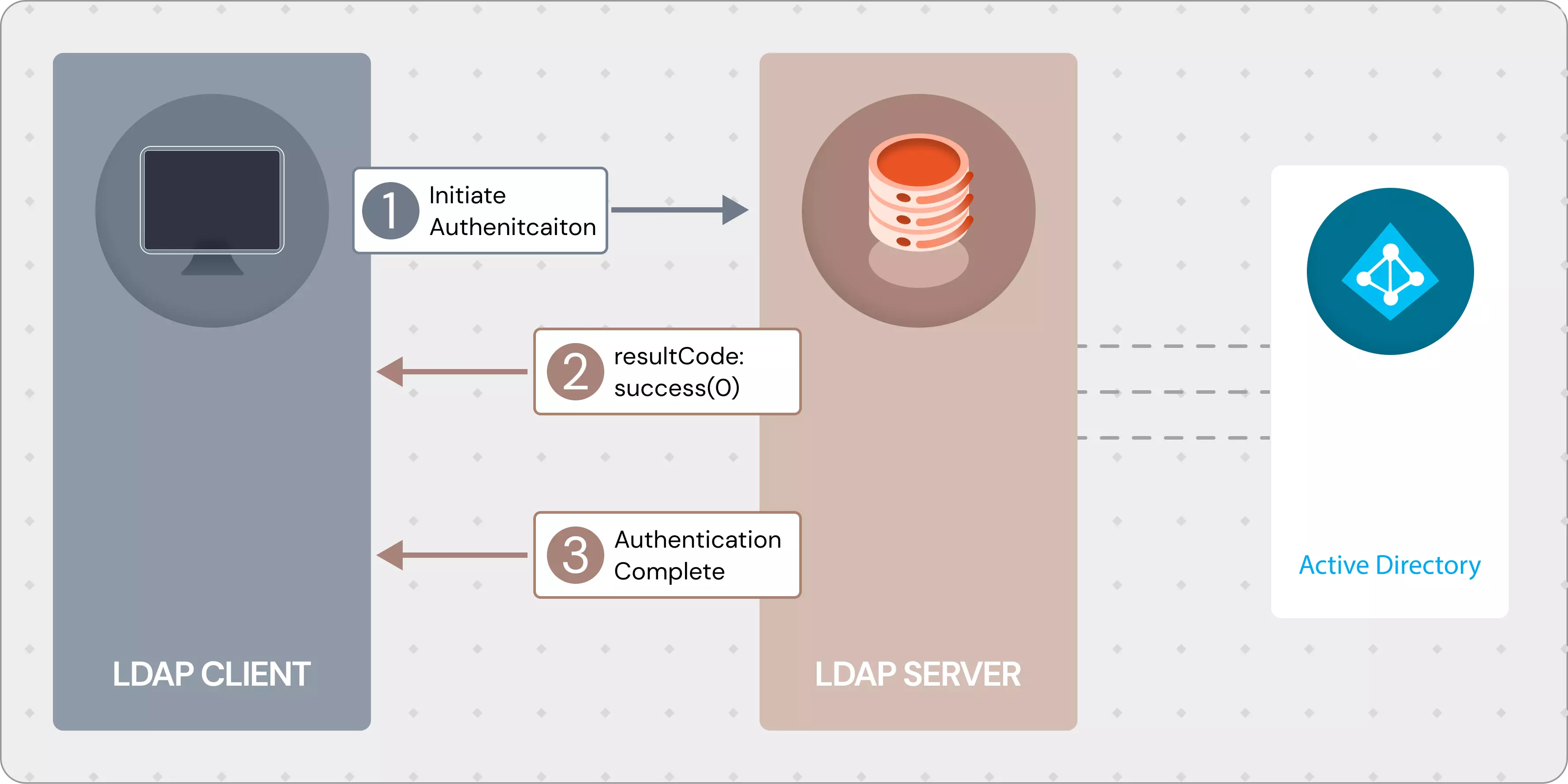
OAuth, OpenID Connect, and SAML let identities move across systems without forcing a new login every time. LDAP and Kerberos handle authentication inside a directory itself, a different job, and one that often gets confused with the federation protocols above.
Governance and Privilege
Identity governance and privileged access management control what an identity can do once it's in and catch it when access piles up past what's actually needed.
Directory and Credentials
Directory services store identity records. Verifiable credentials, a newer W3C standard, let someone prove a claim cryptographically without handing over the underlying document.
Digital Identity Frameworks & Standards
A handful of standards define how digital identity gets implemented properly. Worth knowing, even at a glance.
- NIST 800-63: US guidelines for identity proofing, authentication, and credential lifecycle management, with defined assurance levels.
- eIDAS 2.0: EU regulation requiring cross-border interoperability, including a European Digital Identity Wallet.
- ISO/IEC 18013: Global standard for mobile driver's licenses and remote identity verification.
- W3C Verifiable Credentials: A standard for cryptographically provable claims that don't require handing over full documents.
- FIDO2: Passwordless authentication standard behind most modern passkeys.
None of these are optional reading for anyone building identity infrastructure in a regulated industry. They're the baseline everyone else gets measured against.
Best Practices for Putting Digital Identity to Work
Getting digital identity right comes down to a handful of practices, applied consistently, more than any single tool.
- Inventory every identity you have, human, machine, and AI, before trying to secure any of them.
- Centralize authentication instead of letting every app handle its own login.
- Enforce MFA everywhere, not just on the systems that feel sensitive.
- Move toward passwordless authentication where you can.
- Apply least privilege by default, and review access regularly instead of assuming it's still correct.
- Automate provisioning and deprovisioning so access changes the moment a role does.
- Monitor continuously. A login is a moment. Risk is ongoing.
- Extend identity governance to AI agents now, before they're running unsupervised across your systems.
Conclusion
Digital identity used to be a background function IT handled quietly. It isn't anymore.
Cloud apps, remote work, customer expectations, and AI agents acting independently inside your systems have turned it into one of the most important security decisions an organization makes. Get it right, and access is fast, secure, and auditable. Get it wrong, and you've got stolen credentials, shadow accounts, and AI agents holding more access than anyone signed off on.
The organizations implement a comprehensive digital identity solution that treat workforce, customer, partner, machine, and AI identity as one connected system, and build their access strategy around all of it at once.
FAQs
What is digital identity?
A digital identity is the set of data, identifiers, credentials, and attributes that represents a person, device, or AI agent inside digital systems.
What is an example of digital identity?
A work email tied to an SSO login, a mobile banking profile, or an AI agent's service account is a digital identity.
What is digital identity verification?
It's the process of confirming that a digital identity belongs to the person or entity claiming it, usually through document checks, biometrics, or both.
How is digital identity protected?
Through MFA, passwordless authentication, encryption, continuous monitoring, and least-privilege access controls.
Can AI agents have digital identities?
Yes. AI agents get their own identifiers and credentials and need the same authentication and authorization checks as human users, arguably more given how fast they can act.
What is digital identity management?
It's the set of systems and processes organizations use to create, secure, and govern digital identities across their entire lifecycle.
Leave a Comment
1 Comment
Pelorus Technologies
Throughout this article, digital identity, its importance, and its role in security are explained clearly and insightfully. For an understanding of modern authentication and identity management concepts, this is a great resource.