

Every bank, hospital, and government contractor can see where AI could save time. The harder question is whether the organization can allow sensitive data to enter an external AI environment. That question can stop a promising AI project before it reaches production.
On-premise AI addresses that concern by running AI inference, and sometimes fine-tuning, on infrastructure controlled by the organization. This can keep prompts, context, and outputs within the organization's network boundary while giving security and compliance teams greater control over how AI processes enterprise data.
But running AI in-house is not automatically the right answer. It introduces GPU costs, infrastructure requirements, model management, and ongoing operational responsibility. The decision should depend on data sensitivity, regulatory requirements, network restrictions, and whether a private cloud or other private AI deployment can satisfy the same requirements.
What Is On-Premise AI?
On-premise AI is an AI deployment model where inference runs on infrastructure controlled by the organization instead of through a public AI API. Organizations may also run fine-tuning locally when their use case requires adapting a model to proprietary or domain-specific information.
A typical self-hosted LLM deployment can run on GPUs within an organization's data center, while highly restricted environments may operate completely air-gapped infrastructure. The defining factor is not simply physical location. It is the degree of control the organization has over the environment processing its AI workloads.
This distinction matters because several deployment approaches can provide some level of isolation without being equivalent to on-premises AI. A dedicated model instance in a private cloud, for example, can offer stronger isolation than a shared public API while still relying on external infrastructure.
For regulated organizations, the practical question is therefore whether the AI environment provides sufficient control over data processing, access, retention, infrastructure, and auditing.
Why Are Regulated Enterprises Bringing AI In-House?
The case for on-premises AI usually begins with the data rather than the model. Organizations handling financial information, patient records, intellectual property, legal documents, source code, or government information may face restrictions on where that information can be processed.
Sensitive Data Requires a Tighter AI Boundary
A public AI service can provide strong security controls, but using it still means enterprise information enters an environment operated by another provider. For low-risk use cases, that arrangement may be acceptable. For highly sensitive workloads, security teams may require a stronger boundary.
An on-premise AI deployment can keep prompts, retrieved context, and generated responses within infrastructure controlled by the organization. This gives security teams greater visibility into the systems handling sensitive information and reduces dependence on an external processing environment.
Data Residency and Sovereignty Influence AI Deployment
AI data residency becomes important when regulations, contracts, or internal policies restrict where information can be stored or processed. Organizations operating across jurisdictions may need to establish that particular categories of information remain within an approved geographic or legal boundary.
On-premises infrastructure can simplify this requirement because the organization controls where the AI workload operates. This does not make an AI deployment compliant by default, but it can remove some of the external processing and transfer questions associated with third-party AI services.
Sovereign AI takes this concept further by considering not only data location, but also control over infrastructure, models, operations, technology suppliers, and jurisdiction.
Model Training Is Not the Same as Data Processing
A provider's statement that it does not train models on customer data addresses model training, but it does not necessarily mean that the data never enters an external processing environment.
For organizations handling proprietary source code, unreleased financial results, patient records, or confidential legal information, that distinction can influence the risk assessment. Keeping the model and data within an organization-controlled environment provides a more direct technical boundary.
This is one reason private AI deployment can become attractive even when an external provider offers contractual restrictions around data retention and model training.
Auditability Becomes More Important as AI Enters Production
Regulated enterprises need to understand more than whether an AI tool was used. They may need to establish who invoked the system, what information it accessed, which model processed the request, and what the system returned.
An on-premises environment can provide greater control over these records because the organization operates the infrastructure and can integrate AI activity with its existing monitoring and security architecture.
That makes logging and attribution part of the AI design rather than an afterthought.
On-Premise AI vs. Private Cloud vs. Public AI
The three deployment approaches differ mainly in how much control the organization retains and how much operational responsibility it assumes.
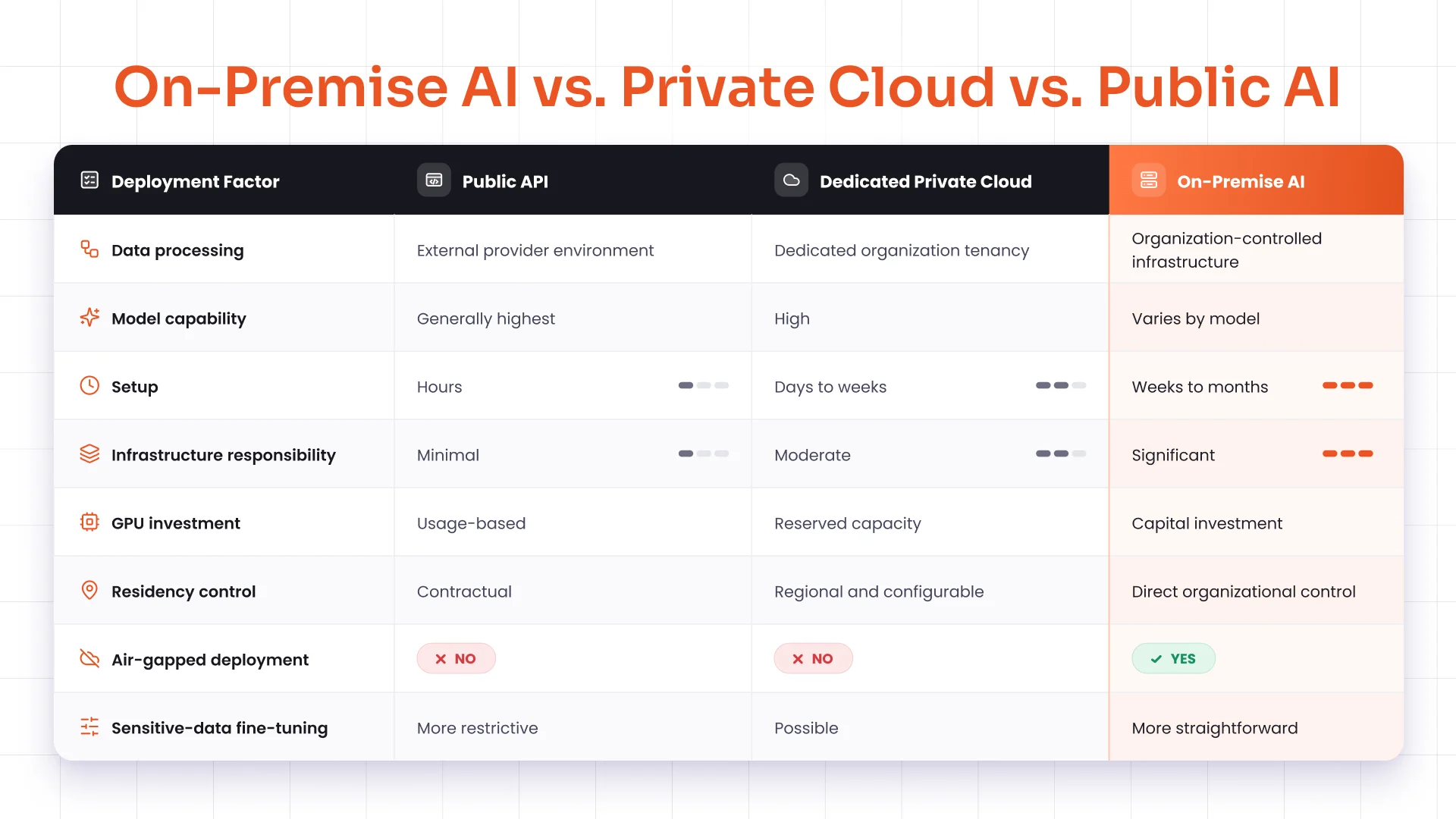
A dedicated private cloud can be the better choice when the organization needs isolation, regional deployment, and contractual controls without taking responsibility for the entire AI infrastructure stack.
On-premise AI becomes more relevant when the workload requires an air-gapped environment, direct infrastructure control, strict residency requirements, or a level of data sensitivity that does not clear the organization's external-provider risk assessment.
The important distinction is that on-premises is not automatically more appropriate simply because an organization is regulated. The deployment needs to match the actual requirements of the workload.
When Does On-Premise AI Make Sense?
The strongest business case appears when external processing creates a constraint that infrastructure control can actually solve.
Air-gapped environments: Organizations operating disconnected or highly restricted networks may not be able to send prompts or enterprise data to external AI services. A self-hosted LLM can provide AI capabilities without changing the network architecture.
Highly sensitive information: Some workloads involve information that organizations are unwilling to expose to an external processing environment even when contractual protections are available. In those cases, keeping inference inside the organization's boundary can reduce the associated risk.
Strict residency requirements: When data must remain within a defined jurisdiction or infrastructure boundary, on-premise deployment can provide direct control over where inference occurs.
Internal risk policies: An organization's security policy may impose requirements that are stricter than the minimum regulatory obligation. On-premise AI can satisfy those requirements when private cloud or hosted alternatives do not pass internal review.
Workloads requiring predictable infrastructure control: Organizations with specific requirements around infrastructure, network architecture, model placement, or operational isolation may prefer to operate the AI environment themselves.
These scenarios do not mean every workload should run on-premises. Low-risk applications can often use hosted AI, while other regulated workloads may fit a dedicated private cloud environment.
What Do Enterprises Give Up With On-Premise AI?
Greater control comes with greater responsibility. Organizations considering an on-premise AI deployment need to account for three operational tradeoffs.
Frontier Model Capability
The most capable frontier models are not always available for local deployment. Open-weight models have become useful for retrieval, summarization, classification, and domain-specific workloads, but capability can still vary considerably between locally deployable models and the most advanced hosted systems.
The right comparison should therefore be based on the workload. An enterprise RAG application may not require the same model capabilities as a complex reasoning system, and a smaller model may provide sufficient performance for a narrower domain.
Model Updates and Lifecycle Management
Hosted AI services can incorporate model improvements without requiring the customer to manage the underlying upgrade process. With on-premise AI, the organization decides when models are updated and must evaluate new versions before introducing them into production.
That requires model testing, version management, performance monitoring, and rollback processes. The organization gains control over model changes, but it also takes responsibility for managing them.
Infrastructure and Operating Costs
Running AI locally requires more than acquiring GPUs. Teams need to manage capacity, inference performance, networking, storage, monitoring, model serving, and availability.
The economics also depend on utilization. An organization with consistently high AI workloads may be able to justify dedicated infrastructure, while low utilization can make a hosted service more economical.
For this reason, the right comparison is not simply cloud pricing versus GPU purchase price. It is the total cost of operating the AI workload.
How Should Enterprises Secure On-Premise AI?
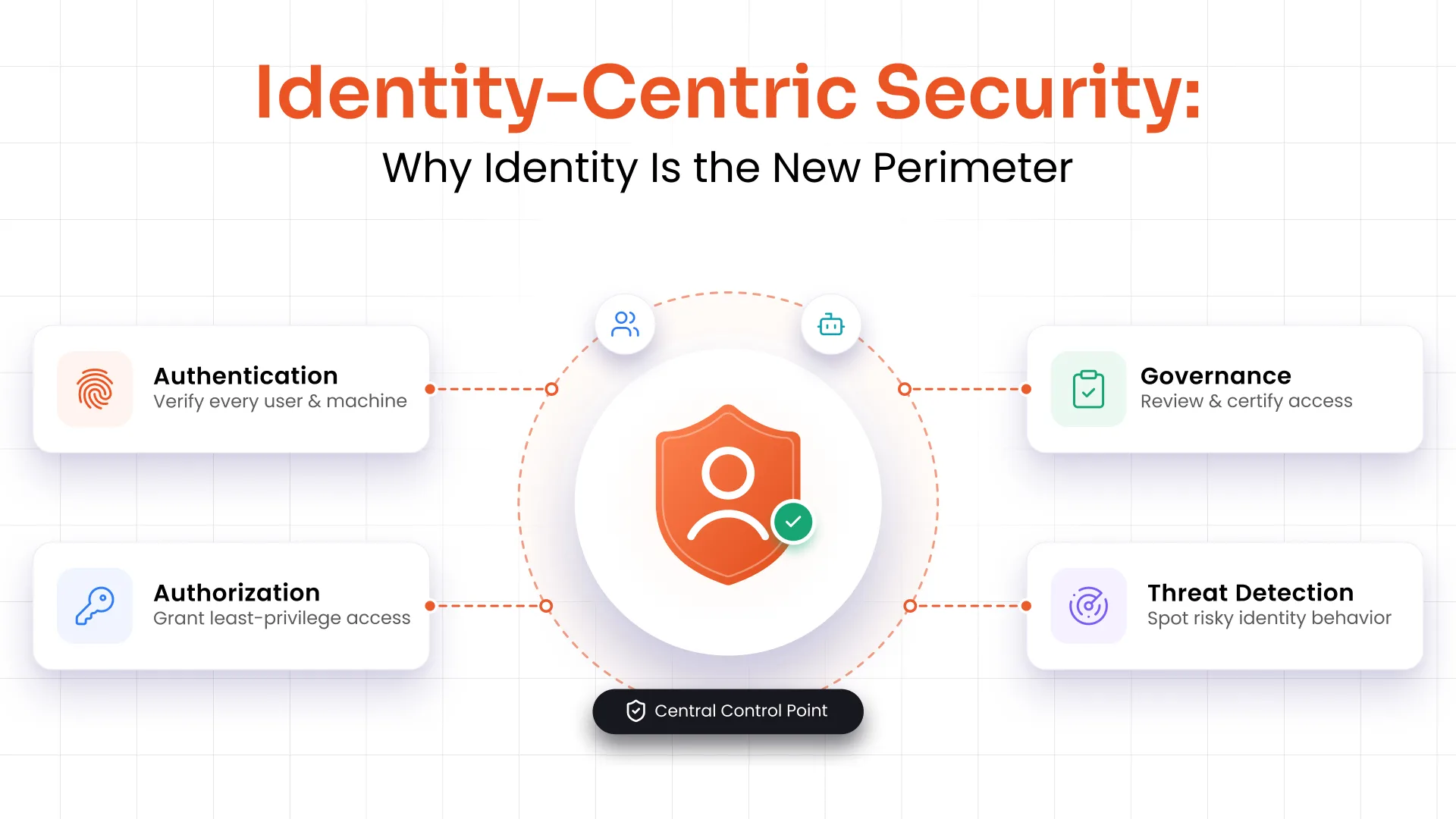
Keeping AI inside the network does not eliminate identity and access risks. An internal model can still expose sensitive information if users, applications, or AI agents have excessive permissions.
Security needs to extend from the person or application requesting inference to the data, tools, and systems the AI can reach.
Authenticate Every Human and Machine Identity
Human users should access AI applications through established identity systems such as SSO. Applications and AI agents should use credentials associated with identifiable non-human identities (NHIs).
This creates accountability across human and machine-driven AI activity. Security teams can determine which user, application, or agent initiated an interaction rather than treating every request as an anonymous internal call.
Authorize Access According to Data Classification
Authentication establishes identity, but authorization determines what that identity can access.
AI applications should not receive unrestricted access simply because the model itself is approved. Policies should determine which users and agents can retrieve particular categories of information, including HR, Legal, finance, engineering, or customer data.
This establishes least privilege around the information an AI system can process.
Protect Prompts and Responses With DLP
Data Loss Prevention should operate on both sides of the AI interaction. Sensitive information can enter through a prompt, but a model can also return information that the requesting identity should not receive.
DLP controls can help identify, restrict, or mask sensitive information before it reaches the model and protect sensitive content in generated responses. This becomes especially important when AI applications use RAG to retrieve information from enterprise repositories.
Control Models, Agents, and AI Tools
Enterprise AI environments may contain multiple models, applications, and AI agents. Governance should determine which identities can invoke which models and which agents can access particular tools or data sources.
Each AI agent should have its own identity rather than relying on shared service accounts. This allows organizations to apply individual permissions, monitor activity, and revoke access without affecting unrelated agents.
Secure the MCP Layer
AI agents increasingly rely on tools and external systems to perform tasks. When Model Context Protocol servers connect an agent to applications and data sources, those connections become part of the security boundary.
MCP access should therefore use authentication, authorization, identity-based scoping, and monitoring consistent with other enterprise integrations. Hosting the model internally does not automatically secure the tools the model can invoke.
What Should an On-Premise AI Governance Model Control?
AI governance becomes more practical when policies are tied directly to the systems and data involved.
| Governance question | Control to establish |
|---|---|
| Who can use AI? | Human and non-human identity, authentication, and authorization |
| What can AI access? | Data classification, least privilege, and access policies |
| Which models can process data? | Approved model inventory and workload restrictions |
| What can agents reach? | Tool, application, MCP, and data-source permissions |
| What happened during an interaction? | Identity-linked logging and monitoring |
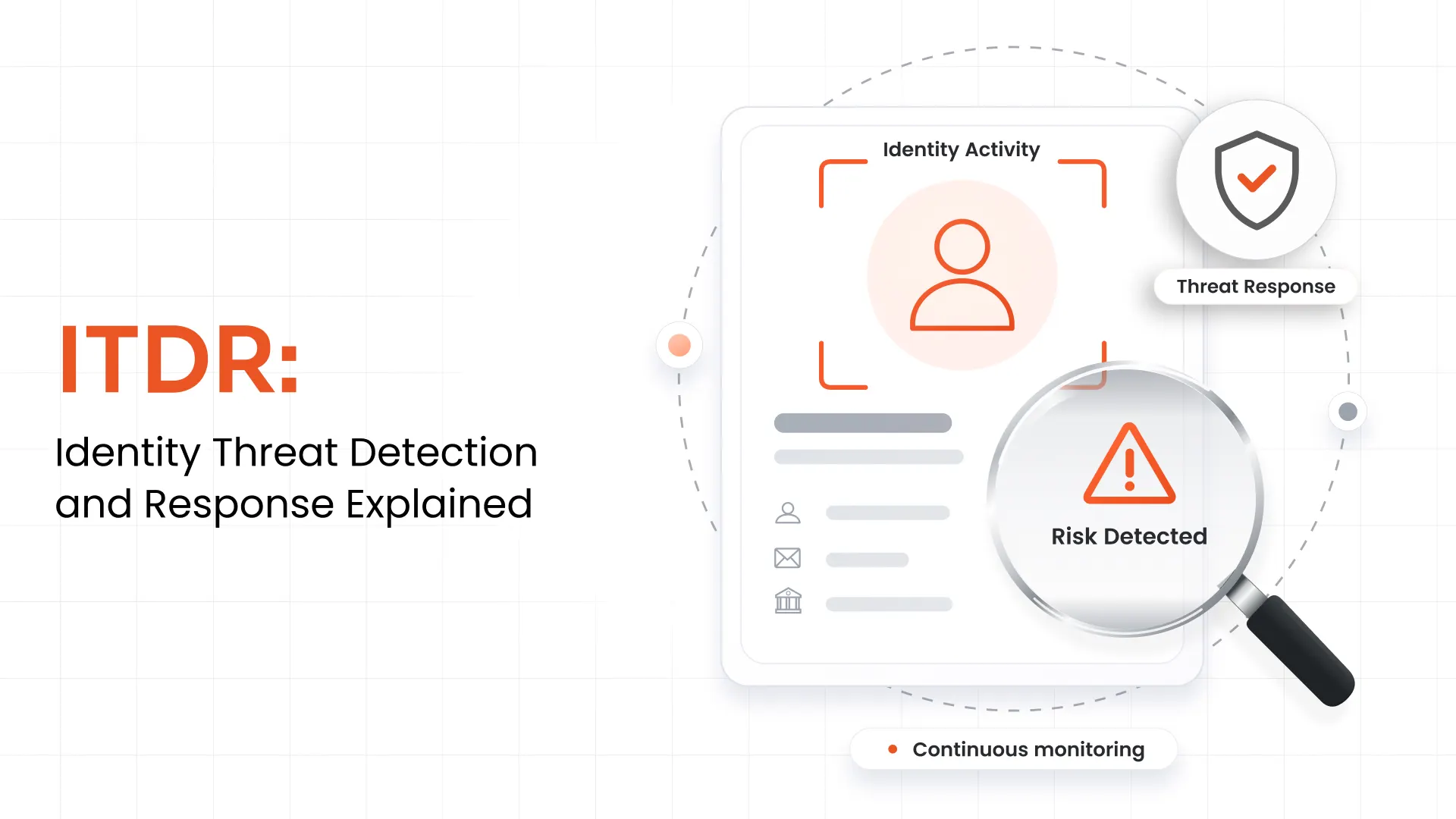
The objective is to make AI activity attributable and enforceable. Organizations should be able to identify the identity behind an interaction, understand which data the AI could access, determine which model and tools were involved, and investigate the resulting activity.
This governance model applies whether AI runs on-premises or through a private cloud. The deployment location changes the infrastructure boundary, but it does not replace the need for identity security, authorization, DLP, or monitoring.
On-Premise AI Best Practices
A practical implementation should begin with the workload rather than the infrastructure.
1. Classify the data first. Determine which workloads contain sensitive, regulated, proprietary, or restricted information before choosing where the AI should run.
2. Evaluate the model against the actual use case. Test retrieval quality, accuracy, latency, reasoning, and domain performance instead of assuming a locally deployed model will meet production requirements.
3. Treat the AI endpoint as a production service. Apply authentication, authorization, monitoring, availability planning, and incident response from the beginning.
4. Give every AI agent an individual identity. Shared credentials weaken attribution and make least-privilege access difficult to enforce.
5. Enforce restrictions through policy. If a model should not access a category of information, enforce that restriction through identity, authorization, and data controls rather than relying on instructions in a prompt.
How Can miniOrange.ai Support Governed AI Deployments?
miniOrange.ai can support organizations that need to combine private AI deployment with identity, data protection, and AI agent security controls.
Private AI deployment can keep AI processing within infrastructure controlled by the organization, helping address requirements around sensitive data and AI data residency.
Domain AI solutions include Dhanvantari AI for healthcare, Chanakya AI for finance, and Accounting AI for domain-specific workloads where business context and data sensitivity matter.
Agentic AI security provides governance and observability for AI agents, including controls around model access and authentication and authorization.
PII protection helps identify and mask personal information in AI prompts and responses, supporting privacy requirements such as GDPR and DPDP.
MCP security extends governance to the Model Context Protocol servers that allow AI agents to connect with tools and enterprise data sources.
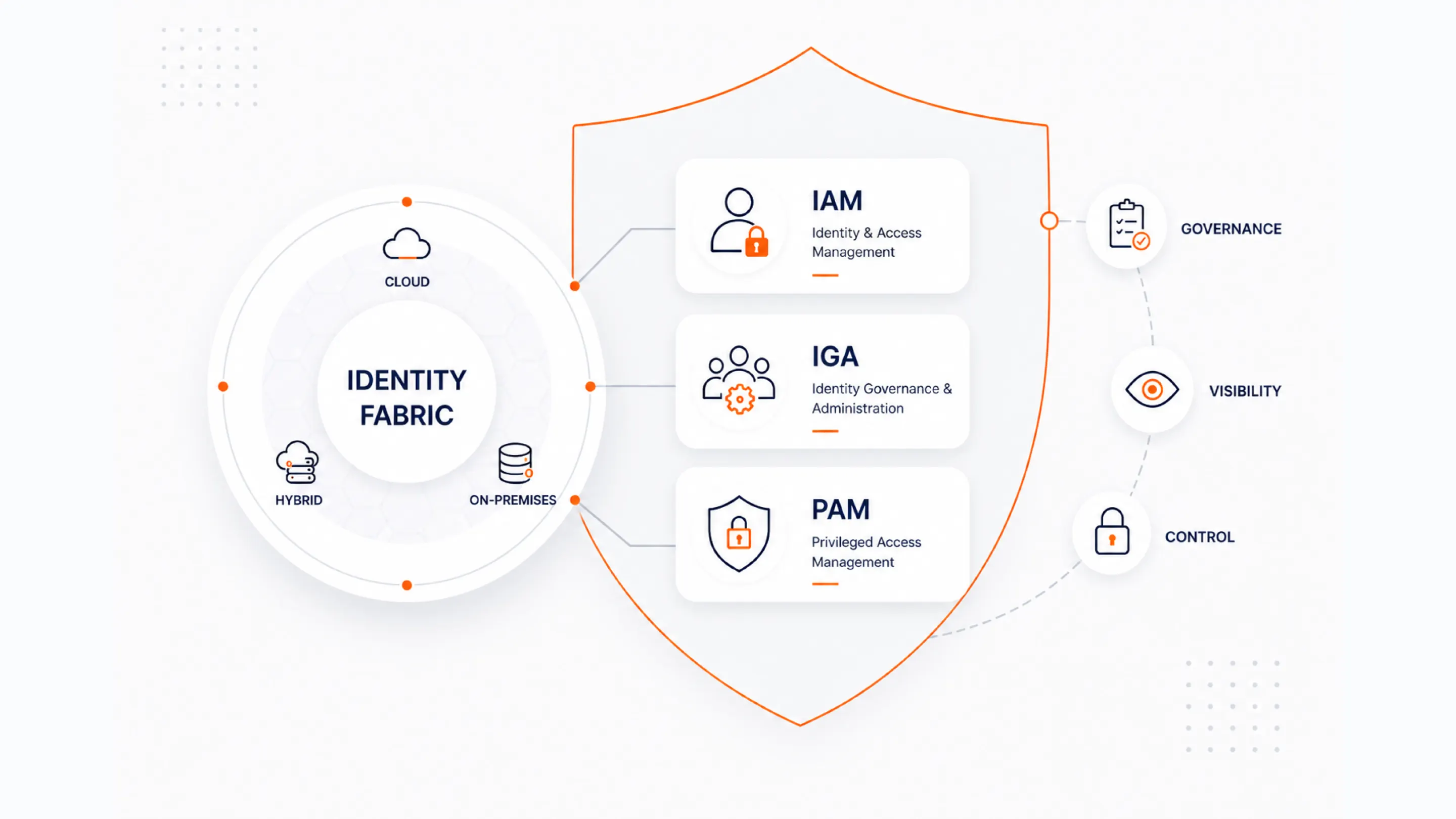
Identity integration connects AI access with existing SSO, groups, and access policies so organizations can apply established identity controls to AI users, applications, and agents.
Making the Right AI Deployment Decision
On-premise AI is ultimately a decision about how much control an organization needs over its AI infrastructure, data, and processing environment.
For regulated enterprises, that control can remove important barriers to AI adoption when sensitive information, residency requirements, air-gapped networks, or internal risk policies make external processing difficult to approve. But the infrastructure decision is only one part of the architecture. AI still needs identity, authorization, DLP, agent security, model governance, and monitoring.
The strongest deployment strategy is therefore not to put every AI workload on-premises. It is to classify the data, evaluate the risk, select the appropriate deployment model, and then enforce security controls around everything the AI can access.
FAQs
What is on-premise AI?
On-premise AI runs AI inference, and sometimes fine-tuning, on infrastructure controlled by an organization. It can keep prompts, context, and outputs within the organization's defined network boundary.
Is on-premise AI required for GDPR or DPDP compliance?
No. GDPR and DPDP do not universally require AI systems to run on-premises. Organizations can use third-party processing when applicable legal, contractual, transfer, and security requirements are satisfied. On-premise AI can reduce external processing and transfer considerations, but it is not automatically a compliance requirement.
Are on-premise AI models as capable as hosted models?
Not always. Frontier hosted models generally provide the highest capability for complex reasoning, while open-weight models can perform well for retrieval, summarization, classification, and domain-specific enterprise workloads.
Is a dedicated private cloud enough for regulated AI?
For many workloads, yes. A dedicated private cloud environment can provide isolation, regional deployment, retention controls, and security without requiring the organization to operate its own AI infrastructure. Air-gapped environments and strict internal requirements may still require on-premise deployment.
How can organizations control what an on-premise AI model can access?
Organizations should authenticate users, applications, and AI agents, then enforce authorization based on data classification and least privilege. DLP should protect prompts and responses, while model, tool, MCP, and data-source access should be governed through policy.
Does running AI on-premises make it secure by default?
No. On-premise deployment provides greater control over infrastructure and data location, but security still depends on identity, authorization, DLP, model governance, monitoring, and access controls.
Leave a Comment