
Decentralized identity has spent years as a blockchain-adjacent concept most enterprises filed under "interesting, not urgent." That's changing fast. Between eIDAS 2.0 in the EU, rising credential fraud, and a market growing at a CAGR north of 50 percent, decentralized identity is moving from whitepaper to procurement conversation.
In simplest terms, decentralized identity is an identity model where individuals hold and control their own verifiable credentials, instead of relying on a central authority to store and vouch for their identity every time it's checked.
Key facts:
- The decentralized identity market is valued at roughly $7.4 billion in 2026, growing at a CAGR that exceeds 50 percent through the decade
- Large enterprises captured 67 percent of market revenue in 2025, and the dominant pattern is weaving decentralized identifiers into existing IAM stacks, not replacing them
- Every EU member state is required to deploy a digital identity wallet under eIDAS 2.0 by the end of 2026
- The core building blocks are Decentralized Identifiers (DIDs), Verifiable Credentials (VCs), and increasingly, Zero-Knowledge Proofs (ZKPs)
What Is Decentralized Identity?
Decentralized identity is a model where a person or organization owns and controls their own identity credentials, rather than a bank, government agency, or employer being the sole source of truth every time that identity needs to be verified.
It's built on three components:
- Decentralized Identifier (a unique, cryptographically verifiable ID not tied to any central registry)
- A Verifiable Credential (a tamper-evident digital claim, like a diploma or a driver's license, issued by a trusted authority)
- Digital wallet where the individual holds and presents those credentials.
In practice, this means proving you're over 21 without handing over your full driver's license, or proving you hold a valid professional certification without the verifier having to call the issuing body. The credential itself carries cryptographic proof of its authenticity.
Why Decentralized Identity Matters Now
Regulation is forcing the issue, not just inviting it. Every EU member state must deploy a digital identity wallet under eIDAS 2.0 by the end of 2026. Organizations serving EU markets that haven't started their assessment are already behind schedule, not early.
The market is growing faster than almost any other identity category. Estimates vary by analyst firm, but the pattern is consistent: from roughly $2.5–4.9 billion in 2025 to somewhere between $6.8–7.4 billion in 2026, with CAGR projections ranging from 50 to nearly 80% through the early 2030s. However you slice the exact number, this is one of the fastest-growing corners of identity management.
Enterprises aren't waiting for a greenfield rebuild. Large enterprises captured 67 percent of decentralized identity market revenue in 2025, and the dominant adoption pattern is weaving DIDs and verifiable credentials into existing IAM stacks, adding decentralized capability to specific workflows while OAuth and SAML keep handling internal access management. This is augmentation, not replacement.
Credential stuffing keeps getting more expensive to ignore. Traditional identity verification depends on centralized databases that are themselves breach targets. A decentralized credential that can't be forged or centrally stolen removes an entire category of fraud vector.
AI-driven identity verification is raising the stakes on both sides. As deepfakes and synthetic identity fraud get cheaper to produce, cryptographically verifiable credentials become one of the few verification methods that don't depend on a human (or an AI) simply believing what they're shown.
Decentralized Identity vs. Federated vs. Centralized Identity
| Comparison Criteria | Centralized Identity | Federated Identity | Decentralized Identity |
|---|---|---|---|
| Who holds the identity | A single central authority (e.g., a company directory) | Shared across trusted partners via SSO | The individual, in their own wallet |
| Verification model | Verifier checks directly with the central authority | Verifier trusts an identity provider's assertion | Verifier checks cryptographic proof, no central call-out needed |
| Single point of failure | Yes, the central database | Reduced, but still tied to the identity provider | Minimized; no central database to breach |
| Best fit | Internal workforce identity | Cross-organization SSO (e.g., "Sign in with Google") | Credentials that need to be portable and independently verifiable (licenses, certifications, age verification) |
| Enterprise adoption pattern | Standard for internal IAM | Standard for B2B and consumer SSO | Additive layer for specific high-trust workflows |
Decentralized identity isn't competing to replace Single Sign-On for internal workforce access. It solves a different problem: proving something is true without a live callback to whoever issued it.
Core Technologies Behind Decentralized Identity
1. Decentralized Identifiers (DIDs). A globally unique identifier that doesn't depend on any centralized registry, verifiable through cryptography rather than a lookup.
2. Verifiable Credentials (VCs). Digitally signed claims, such as a degree, a license, or an employment record, that can be independently verified without contacting the issuer directly.
3. Digital wallets. The user-controlled application where credentials are stored and selectively presented.
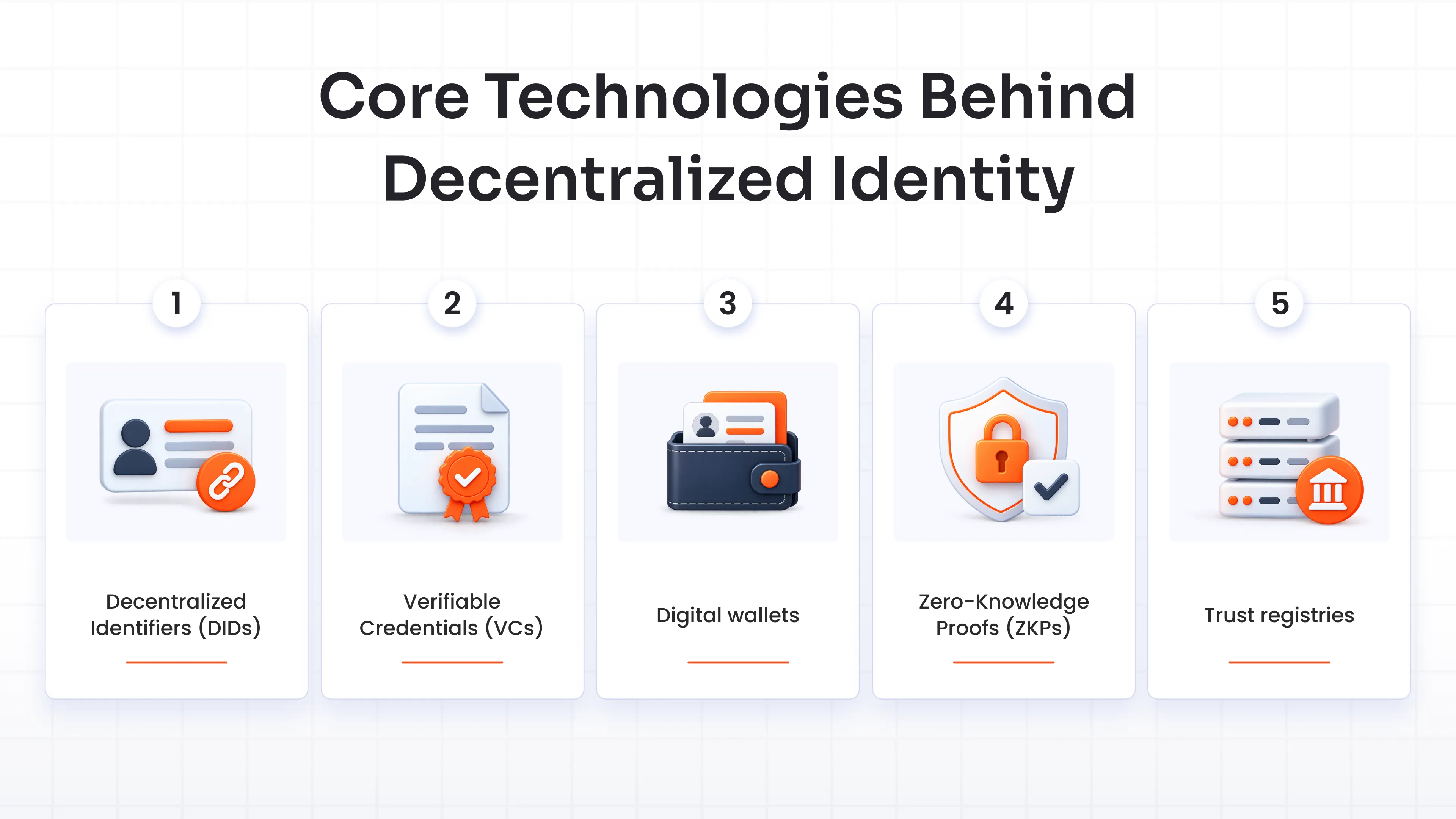
4. Zero-Knowledge Proofs (ZKPs). A cryptographic method for proving a claim is true (like "I'm over 18") without revealing the underlying data (your actual birth date). The ZKP sector reached $28 billion in total value locked in 2025, reflecting rapidly growing enterprise interest, not just blockchain-native use cases.
5. Trust registries. Systems that let verifiers confirm which issuers are legitimate, the connective tissue that keeps a decentralized system from becoming a free-for-all.
How to Implement Decentralized Identity
Step 1: Start with a specific, high-value credential, not a platform rebuild. Employee certifications, age verification, or vendor credentialing are common entry points precisely because they're bounded and low-risk.
Step 2: Assess eIDAS 2.0 exposure if you operate in or serve the EU. The wallet mandate has a hard deadline, and readiness assessments take longer than most teams expect.
Step 3: Integrate with existing IAM; don't replace it. The dominant enterprise pattern keeps OAuth/SAML for internal access and adds DIDs and VCs for external, portable credentialing use cases.
Step 4: Choose standards-based tooling. W3C DID and Verifiable Credentials specifications are the interoperability backbone; proprietary formats create the same vendor lock-in decentralized identity is supposed to avoid.
Step 5: Plan for trust registry participation. A verifiable credential is only as useful as a verifier's ability to confirm the issuer is legitimate.
Step 6: Pilot with a bounded use case before scaling. Contractor credentialing or customer age verification are far easier starting points than an enterprise-wide identity overhaul.
Business Benefits of Decentralized Identities
1. Reduced fraud exposure. Cryptographically verifiable credentials can't be centrally breached or easily forged the way a scanned ID document can.
2. Lower verification overhead. No live call-back to an issuing authority means faster, cheaper verification at scale.
3. Regulatory readiness. eIDAS 2.0 compliance isn't optional for organizations serving EU markets, and early movers avoid the scramble.
4. Better data minimization. Zero-knowledge proofs let organizations verify a claim without collecting or storing the underlying personal data, reducing breach liability.
5. Faster onboarding costs. The World Bank has reported SME onboarding costs dropping 30–50 percent where low-code verifiable-credential flows replace manual document verification.
Use Cases by Industry
- Financial services: Instant KYC verification using reusable, cryptographically verified identity credentials instead of repeated manual document checks.
- Healthcare: Verifying practitioner licenses and credentials across institutions without a phone call to every licensing board.
- Government and public services: eIDAS 2.0-driven digital identity wallets for citizen services across the EU.
- HR and workforce: Verifying degrees, certifications, and prior employment without relying on a background check vendor's centralized database.
- E-commerce and age-gated services: Age verification without collecting or storing a full government ID.
Decentralized Identity With miniOrange
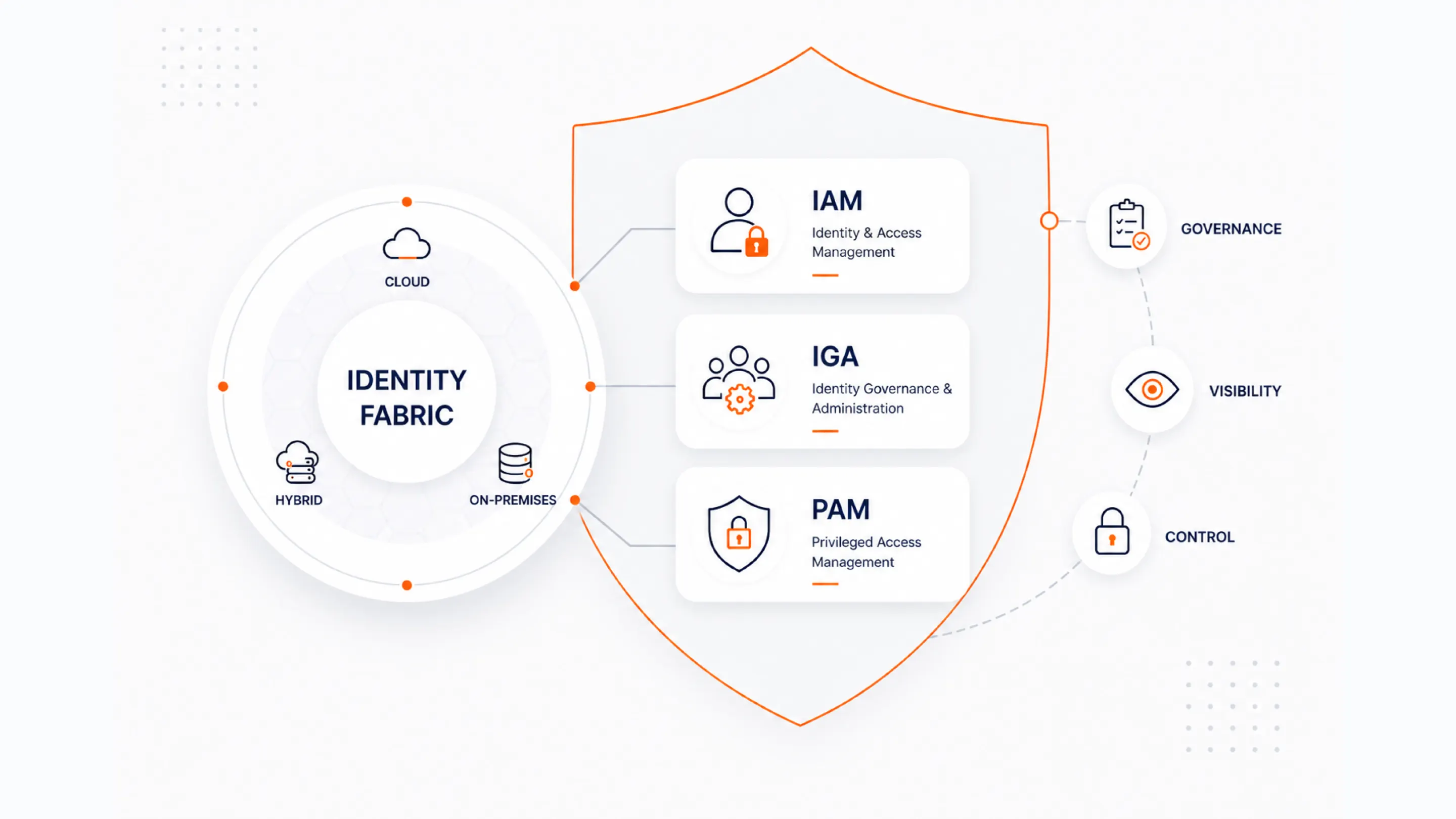
miniOrange supports decentralized identity as an extension of its existing identity fabric, not a separate platform bolted on afterward.
- Verifiable credential issuance and verification that integrates with existing IAM, IGA, and CIAM workflows rather than requiring a parallel identity stack.
- Standards-based DID support, so credentials stay portable and interoperable instead of locking customers into a proprietary format.
- Flexible deployment, cloud, hybrid, or on-premises, for organizations with data residency or regulatory constraints that rule out a purely cloud-native approach.
- Integration with miniOrange's broader IAM and CIAM suite, so decentralized credentials can feed directly into existing access control and customer identity workflows.
Assessing your eIDAS 2.0 exposure or exploring verifiable credentials for a specific workflow? Schedule a Demo to talk through where miniOrange fits.
Final Thoughts
Decentralized identity isn't asking enterprises to tear down what they've built. It's asking them to stop treating every identity claim as something that has to be verified by calling someone up. That's a narrower ask than it sounds, and it's exactly why the market is moving as fast as it is.
FAQs
Is decentralized identity the same as blockchain identity?
Not necessarily. Many decentralized identity implementations use blockchain for the trust registry layer, but the core concepts, DIDs and Verifiable Credentials, don't require a blockchain to function.
Does decentralized identity replace SSO or IAM?
No. Enterprises overwhelmingly integrate decentralized identity alongside existing IAM, using it for portable, externally verifiable credentials rather than internal workforce access.
What is eIDAS 2.0 and does it apply to us?
eIDAS 2.0 is the EU regulation requiring member states to offer a digital identity wallet to citizens by the end of 2026. If your organization serves EU customers or operates in the EU, it's worth an assessment regardless of where you're headquartered.
What's a Zero-Knowledge Proof, in plain terms?
A way to prove a fact is true, like being over a certain age, without revealing the underlying data that proves it. The verifier gets a yes or no, not your birth date.
Is decentralized identity ready for enterprise use today?
For bounded, specific use cases, yes. Credentialing, age verification, and KYC workflows are already in production. A full enterprise-wide shift is a longer horizon and, for most organizations, not the right first step anyway.
Leave a Comment