
Shadow AI refers to the use of artificial intelligence tools, applications, models, or AI-powered features without the organization's required IT approval, security review, or governance.
It is often associated with employees using personal accounts for tools such as ChatGPT or Gemini. However, Shadow AI extends well beyond public AI chatbots. It can include AI browser extensions, coding assistants, meeting transcription tools, document summarizers, AI features built into approved SaaS applications, and third-party AI integrations.
The defining concern is not simply whether an AI application has been approved. It is whether the organization knows what data is being sent to the AI system, how that data is being processed, and what controls are protecting it.
Shadow AI Is Not Always an Unapproved Application
One of the reasons Shadow AI is difficult to manage is that the AI capability may already exist inside an application the organization has approved.
An organization may approve a CRM, collaboration platform, productivity application, or project management tool. The vendor can later introduce an AI assistant for summarization, search, content generation, analytics, or automation. The application remains approved, but its data processing may have changed.
This means an organization cannot manage Shadow AI only by maintaining a list of approved and unapproved applications. Security teams also need visibility into the AI features and data flows associated with those applications.
What Counts as Shadow AI?
Shadow AI can appear in several forms across an organization. Employees may use personal AI accounts for business tasks, paste confidential information into public AI chatbots, upload internal documents for analysis, or install browser extensions that send webpage content to external AI services.
It can also involve developers using AI coding assistants with proprietary source code, employees connecting AI applications to business systems through OAuth, or teams using AI features inside approved SaaS applications without understanding how those features process company information.
These different scenarios have one thing in common: AI is being used without sufficient organizational visibility or control over the associated data.
Why Is Shadow AI a Data Security Risk?
AI tools are designed to generate useful outputs from the information users provide. This creates a natural incentive for employees to give AI systems detailed business context.
The more relevant the input, the more useful the output can become. That input, however, may contain information that was never intended to leave the organization's controlled environment.
An employee asking an AI tool to summarize a customer escalation could paste the entire conversation into the prompt. A sales employee could provide customer information to generate a proposal. A developer troubleshooting an application could submit proprietary source code to identify a bug.
In each case, the employee may not consider the action to be data exfiltration. From a security perspective, however, sensitive information has entered another processing environment.
Shadow AI Can Expose Sensitive Business Information
The information submitted to AI tools can include personally identifiable information, customer records, financial information, employee data, contracts, source code, product specifications, business strategies, internal communications, credentials, API keys, security configurations, and intellectual property.
When this information enters an external AI service, security teams may have limited visibility into how it is processed and what controls apply to it.
This creates an AI data leakage risk that traditional data protection programs may not have been designed to address.
Shadow AI Creates a Visibility Gap
Traditional security programs generally provide controls around established data stores and transfer channels. Shadow AI can introduce another path through which information leaves the organization's controlled environment.
An employee can copy information from an approved business application and paste it directly into an AI chatbot. There may be no email attachment, USB transfer, or conventional file movement for security teams to investigate.
The security question therefore changes from determining whether a sensitive file left the organization to determining whether sensitive information became part of an AI interaction.
How Do Employees Leak Data Into AI Tools?
Shadow AI data leakage can happen through ordinary workplace activities. Employees do not necessarily need to install sophisticated software or deliberately bypass security controls. Common productivity workflows can be enough to expose sensitive information.
1. Copying and Pasting Sensitive Data Into AI Prompts
One of the simplest ways employees expose information through Shadow AI is by copying business data directly into an AI prompt.
An employee might paste a customer support conversation and ask the AI tool to summarize it. A sales employee might provide customer information to generate a proposal. A developer might submit proprietary code to identify a programming error.
The information becomes part of the AI request even though the employee may never create or transfer a traditional file. This makes prompt data leakage particularly challenging for conventional DLP systems that are primarily focused on files and established transfer channels.
2. Uploading Company Documents to AI Tools
AI tools can analyze documents, spreadsheets, presentations, PDFs, and other files. This makes them useful for summarization, extraction, rewriting, and analysis, but it also creates another route for data leakage.
Employees may upload customer reports, contracts, financial spreadsheets, internal presentations, business plans, HR documents, or technical specifications to complete routine tasks.
The risk is not simply that an employee uploaded a document. The concern is that sensitive information contained within that document is being processed by an AI service outside the organization's established data controls.
3. Using Personal AI Accounts for Work
Personal AI accounts can create a significant Shadow AI visibility problem because they may sit outside the organization's identity, security, and monitoring infrastructure.
An employee may use a personal account because it is convenient, already available, or provides a feature that is not enabled in the organization's approved AI environment.
The security team may then have limited visibility into what information was submitted, which account submitted it, which AI service processed it, or what retention and security controls apply to that interaction.
The reference material similarly identifies personal AI accounts as one of the recurring pathways through which workplace data can enter unmanaged AI environments.
4. Connecting AI Tools to Business Applications
AI applications become significantly more powerful when connected to business systems. Employees may authorize an AI application to access CRM systems, collaboration tools, cloud storage, project management platforms, or development environments.
These connections can use OAuth permissions or other credentials. If an AI application receives broad permissions, the potential exposure is no longer limited to information that an employee manually pastes into a prompt. The integration itself can create a persistent path to business data.
This makes AI integrations an important part of AI data security and access governance.
5. Using AI Features Inside Approved Applications
Shadow AI can also appear inside software that has already passed procurement and security review.
A SaaS application may introduce an AI assistant for summarization, search, writing, analytics, or automation. Employees may begin using that feature without realizing that the application's data processing has changed or that information may be sent to another AI service.
Organizations therefore need to consider AI functionality when evaluating applications, rather than treating application approval as the end of the security review.
Shadow AI vs. Shadow IT: What Is the Difference?
Shadow AI and Shadow IT are closely related, but the security problem is not exactly the same.
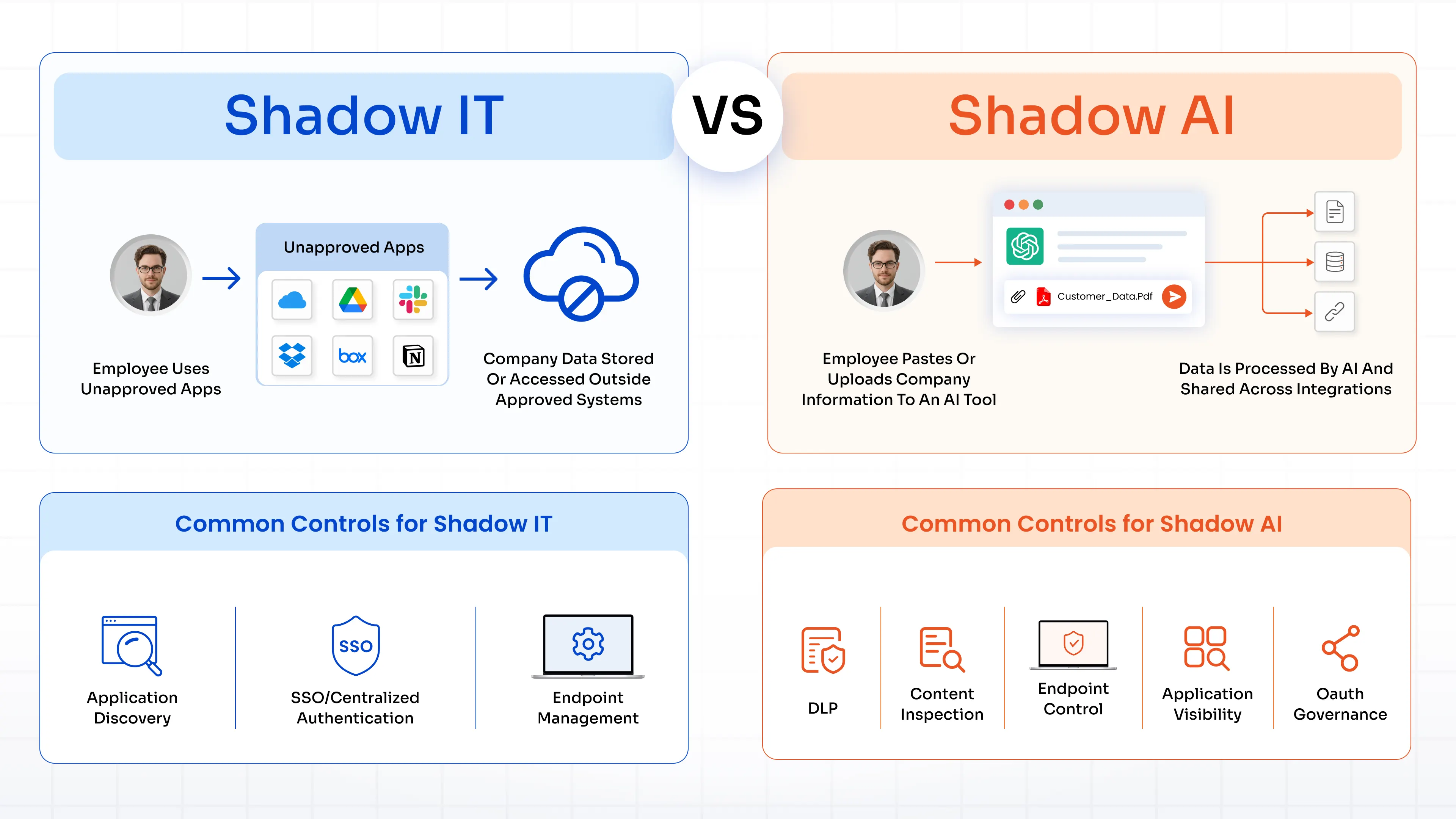
Shadow IT is primarily concerned with what technology employees are using. Shadow AI also requires organizations to understand what information employees are sending into that technology and how AI systems are processing it.
This distinction becomes especially important when AI functionality is built into an application that security teams have already approved.
Why Does Traditional DLP Struggle With Shadow AI?
Traditional Data Loss Prevention remains an important part of data security, but many conventional DLP approaches were designed around established data transfer channels such as email attachments, USB devices, file uploads, cloud storage, and network transfers.
Shadow AI introduces another type of data movement: information submitted as part of an AI interaction.
AI Data Can Leave as Text
An employee can copy thousands of characters of customer information into an AI prompt without creating a separate file.
The sensitive information simply becomes part of the request sent to the web application. File-focused DLP controls may therefore have limited visibility into the information being submitted.
This is one reason generative AI data loss prevention needs to account for text entered directly into web applications, not just traditional file transfers.
AI Services Use Normal Web Traffic
AI applications generally communicate over standard web protocols. Blocking every AI service is also impractical for organizations that legitimately use AI for productivity, research, customer service, or software development.
The security challenge is therefore not simply identifying whether the destination is an AI service. Organizations need to determine whether sensitive information is being sent to that destination.
AI Tools and Features Keep Expanding
Organizations cannot rely on a static blocklist to manage Shadow AI.
New AI applications continue to appear, while existing SaaS products introduce AI-powered capabilities. Employees may also use browser extensions, coding assistants, plugins, or integrations that security teams did not know existed.
As a result, DLP for AI needs to focus on data and behavior instead of relying only on application names or domains.
How to Prevent Shadow AI Data Leakage
Preventing Shadow AI requires more than blocking a few popular AI websites. Organizations need visibility into AI usage, an understanding of the data being shared, and controls that can act before sensitive information leaves the environment.
A practical Shadow AI security strategy should address four areas: discovery, data classification, enforcement, and governed AI access.
1. Discover Shadow AI Usage
Start by identifying the AI tools and AI-enabled services being used across the organization.
Security teams should examine endpoint applications, browser extensions, SaaS applications, cloud services, OAuth integrations, developer environments, and AI-enabled features within approved applications.
The objective is to understand the organization's actual AI footprint rather than relying only on what IT has formally approved.
2. Classify Sensitive Data
Not every interaction with an AI tool creates the same level of risk.
A prompt containing publicly available information is fundamentally different from one containing customer PII, financial records, source code, credentials, or confidential business information.
A strong AI data protection strategy therefore needs data classification. Organizations should identify categories such as PII, PHI, PCI data, financial information, credentials, source code, intellectual property, customer information, and confidential business information.
Once sensitive information is classified, DLP policies can determine which types of information employees can and cannot submit to AI services.
3. Inspect Data Before It Leaves
The most effective point for preventing AI data leakage is often before sensitive information is transmitted.
For browser-based AI tools, this may require visibility into clipboard activity, text entered into web forms, file uploads, web traffic, and sensitive content being shared with applications.
This allows organizations to apply Shadow AI DLP based on the content being transferred rather than simply blocking the entire AI service.
4. Apply Context-Based Policies
Not every AI interaction needs to be blocked. Organizations can apply different controls depending on the sensitivity of the information and the destination.
For example, public information submitted to an approved AI tool may be allowed, while confidential information submitted to the same tool may require a warning or additional control. Customer PII sent to an external AI service may be blocked entirely.
This approach allows security teams to support legitimate AI usage while reducing unnecessary data exposure.
5. Govern AI Integrations and Non-Human Identities
AI applications often rely on OAuth tokens, API keys, service accounts, and other machine credentials.
These should be treated as Non-Human Identities (NHIs) and governed accordingly. Organizations should know who owns an integration, what permissions it has, which data it can access, how long its credentials remain valid, and when the integration was last reviewed.
This prevents an AI integration from becoming a persistent and unmanaged route into corporate data.
6. Provide an Approved AI Environment
Blocking AI without providing an alternative can push employees toward personal accounts and unmanaged tools.
A better approach is to establish sanctioned AI tools with clearly defined controls. An AI usage policy should explain which AI tools employees can use, what information they can submit, what information is prohibited, which integrations are permitted, and how sensitive information should be handled.
Providing an approved path makes it easier for employees to use AI productively while giving security teams the visibility and controls they need.
Shadow AI Security Best Practices
Build Policies Around Data
AI policies should focus on the sensitivity of information rather than relying only on a list of AI vendors. A rule that prohibits employees from submitting customer PII to external AI services remains relevant even when a new AI platform or feature appears.
Use Data Classification to Drive Enforcement
Organizations should classify sensitive information before determining what AI interactions should be allowed. This allows security teams to distinguish between low-risk AI usage and interactions involving regulated, confidential, or proprietary information.
Monitor AI Usage Continuously
Shadow AI changes as employees discover new tools and vendors introduce new AI features. Organizations therefore need ongoing visibility into AI applications, integrations, and associated data flows rather than relying on a one-time assessment.
Use Graduated Controls
Organizations can use warnings, restrictions, redaction, or blocking depending on the sensitivity of the information and the risk associated with the destination. This allows security teams to reduce unnecessary disruption while still protecting critical data.
Review AI Integrations Regularly
OAuth grants, API keys, service accounts, and AI integrations should be reviewed regularly to determine what systems they can access and whether that access is still required.
Train Employees on Safe AI Usage
Employees should understand why confidential information, credentials, customer data, proprietary source code, and other sensitive information should not be submitted to unapproved AI tools.
Training is especially important because many Shadow AI incidents can result from convenience and a lack of awareness rather than deliberate attempts to bypass security.
Maintain Audit Trails
Security teams should maintain appropriate records of policy violations, blocked transfers, warnings, and sensitive data movement. These records can support incident investigations, security reviews, and compliance requirements.
How Does miniOrange Help Prevent Shadow AI Data Leakage?
miniOrange addresses Shadow AI through its broader Data Loss Prevention capabilities, allowing organizations to control sensitive information across endpoints, web activity, applications, and cloud environments.
Control Copy-Paste and Web-Based Data Transfers
Endpoint DLP controls can monitor and restrict clipboard activity and web-based data movement, helping organizations prevent sensitive information from being copied into unauthorized applications.
Identify Sensitive Data Before It Is Shared
Content-aware DLP can identify sensitive information such as PII, PHI, PCI data, financial information, intellectual property, and other confidential content.
This allows organizations to create policies based on what the employee is sharing rather than relying only on the application they are using.
Protect Source Code From AI Tools
Developers can unintentionally expose proprietary source code while using AI coding assistants.
DLP controls can restrict sensitive source code from being copied or shared with unauthorized AI tools while allowing developers to continue using approved development workflows.
Discover Unsanctioned Cloud Applications
CASB capabilities can provide visibility into cloud applications being used across the organization, helping security teams identify Shadow IT and applications that may introduce additional AI-related data flows.
Bring AI Usage Into the Existing DLP Strategy
Shadow AI should not become a separate security blind spot.
By bringing AI-related data movement into the organization's existing DLP framework, security teams can apply the same principles of discovery, classification, policy enforcement, monitoring, and auditing to AI interactions.
Ready to protect sensitive data from Shadow AI? Schedule a Demo
Making AI Adoption Safer With DLP
Shadow AI is not simply about employees using unauthorized chatbots. It is about sensitive company data entering AI systems without the visibility, governance, and controls that should protect it.
Organizations need to understand which AI tools are being used, what information employees are submitting, where that information is going, and which controls can act before sensitive data leaves the environment.
A strong Shadow AI strategy brings AI usage into the organization's broader data protection framework. By combining AI discovery, data classification, content inspection, endpoint controls, integration governance, employee awareness, and DLP enforcement, organizations can support productive AI adoption while reducing the risk of accidental data leakage.
FAQs
Is Shadow AI illegal?
Shadow AI itself is not inherently illegal. The compliance risk depends on what data is being processed, where it is sent, applicable privacy requirements, contractual obligations, and whether appropriate security controls are in place.
Can Shadow AI affect regulatory compliance?
Yes. Submitting personal, financial, health, or other regulated information to an AI service without appropriate safeguards can create privacy, security, contractual, or regulatory compliance concerns.
What is an AI usage policy?
An AI usage policy defines how employees can use AI tools for work. It typically covers approved AI services, prohibited data types, document and source-code handling, acceptable use, and procedures for reporting potential data exposure.
Does Shadow AI only involve generative AI tools?
No. Shadow AI can include AI-powered search, coding assistants, transcription services, browser extensions, document analysis tools, AI agents, and AI features embedded within business applications. The concern is uncontrolled AI usage and data processing, not one specific type of AI.
Can Shadow AI create third-party vendor risk?
Yes. An AI service can become another third party processing organizational or customer information. Organizations may need to assess its security controls, data processing terms, retention practices, access controls, and contractual commitments before allowing sensitive information to be processed.
What should an organization do after discovering Shadow AI usage?
The organization should determine which AI tool was used, what information was shared, who had access to it, and whether the information remains accessible. Security teams can then determine whether containment, investigation, notification, policy changes, or employee guidance is required based on their incident response procedures.
Leave a Comment