

Endpoint visibility is the ability to identify connected devices, understand their activity and health, and assess their security posture. Without it, IT teams struggle to determine which endpoints access business resources, identify security weaknesses, and investigate operational problems.
Remote employees, personal phones, contractors, cloud-connected systems, and specialized equipment expand the endpoint landscape. Meanwhile, management, identity, and security tools often operate separately, leaving critical information disconnected. These blind spots create an endpoint visibility gap that can affect security, compliance, and employee productivity.
Closing that gap requires coordinated discovery, monitoring, security assessment, and access control.
What Does Endpoint Visibility Actually Cover?
An entry in an asset inventory does not guarantee adequate visibility. IT teams need multiple signals to understand what is connected, how it is performing, and what risks it may present.
- Asset inventory: Ownership, operating systems, assigned users, and lifecycle status.
- Device health: Availability, responsiveness, and performance indicators.
- Security posture: Patch status, configuration compliance, and available protection mechanisms.
- Application activity: Application availability and performance, where telemetry supports monitoring.
- Network connectivity: Connections to business services and potentially suspicious communication patterns.
- Access context: Users, applications, and resources associated with endpoint activity.
These signals serve different purposes. Unified endpoint management (UEM) manages supported endpoints, while endpoint security, identity systems, and network monitoring provide complementary information. Effective endpoint discovery helps identify assets that may be missing from established records.
The objective is to connect these signals so IT teams can identify problems, assess their impact, and respond appropriately.
Where Endpoint Visibility Breaks Down
Visibility gaps often develop gradually as organizations introduce new equipment, applications, and access methods without updating their discovery and monitoring processes.
1. Personal and Contractor Devices
Employees may access corporate email, collaboration platforms, and cloud applications from personal phones or computers. Contractors and business partners may use their own equipment without enrolling it in the organization's management platform.
The risk: IT may have limited information about patch status, ownership, device compliance, and the safeguards protecting corporate data. Without clear BYOD visibility, personal equipment can access business resources without sufficient oversight.
2. Remote and Offline Endpoints
Remote work takes equipment beyond office networks. Some endpoints remain disconnected for extended periods, while others stop reporting because of agent failures, operating system changes, or connectivity issues.
The risk: Security teams may struggle to establish current health status or distinguish a temporarily disconnected endpoint from a retired asset. Remote endpoint management can help manage supported systems outside the corporate network, but reporting gaps still require investigation.
3. Legacy, IoT, and Specialized Equipment
Warehouse scanners, point-of-sale terminals, conference room systems, connected sensors, and operational technology equipment may not support conventional endpoint agents or standard UEM enrollment.
The risk: These systems can communicate with business applications or networks without appearing in conventional management inventories. Network discovery and specialized monitoring may be necessary to establish coverage.
4. Disconnected Security and Management Tools
Asset management, patching, identity logs, endpoint security, and network monitoring may each maintain separate records. Without effective integration, investigators lack the context needed to connect events across systems.
The risk: A suspicious login, unusual endpoint activity, and unexpected network traffic may appear unrelated even when they belong to the same incident. Endpoint telemetry becomes more useful when relevant signals can be correlated across tools.
5. Limited Insight Into Endpoint Performance
An endpoint can satisfy basic compliance checks while employees experience slow startup, application crashes, connectivity problems, or repeated disruptions.
The risk: IT teams may focus on security status while overlooking operational problems that reduce productivity and increase support demands. Device health monitoring helps surface performance issues that basic inventory records cannot explain.
The underlying issue is incomplete context. An inventory can establish which assets have been recorded, but additional telemetry is needed to understand their current activity, security, and performance.
How Endpoint Visibility Gaps Increase Security and Business Risk
Incomplete endpoint visibility affects security operations, incident response, and everyday IT performance.
Threat detection loses context. An identity system may flag an unusual login, but investigators might lack the endpoint evidence needed to determine whether malicious software executed, credentials were misused, or sensitive information was accessed.
Lateral movement becomes harder to investigate. Attackers who compromise one system may attempt to reach additional resources. When endpoint and network activity cannot be correlated, reconstructing the sequence of events becomes more difficult.
Vulnerability remediation becomes inconsistent. IT teams cannot reliably coordinate updates or verify remediation across assets that remain unidentified, disconnected, or outside their management tools.
Incident response takes longer. Investigators may need to reconcile inventories, establish ownership, and determine which systems are affected before implementing containment measures.
Compliance evidence becomes harder to maintain. Incomplete records and inconsistent monitoring can complicate efforts to demonstrate how endpoints are identified, assessed, and managed against applicable requirements.
The consequences extend to employee productivity. Unresolved application and connectivity issues interrupt work, increase support costs, and make it harder to prioritize IT resources.
Endpoint Visibility vs. Endpoint Management vs. Endpoint Security
These capabilities complement one another, but each addresses a different requirement.
| Capability | Primary purpose | Typical activities |
|---|---|---|
| Endpoint visibility | Establish what is known about assets and their activity | Discovery, inventory reconciliation, health monitoring, telemetry correlation |
| Unified Endpoint Management (UEM) | Manage supported endpoints and enforce applicable policies | Enrollment, configuration, application management, updates, compliance policies |
| Endpoint security | Detect, investigate, and respond to threats | Malware detection, behavioral analysis, investigation, isolation where supported |
| Identity and access management (IAM) | Control access to applications and resources | Authentication, authorization, conditional access, access policy enforcement |
For example, network monitoring may identify an endpoint that is missing from the UEM inventory, while identity logs reveal access to a corporate application. If the endpoint supports enrollment, UEM can bring it under management. IAM can apply appropriate access restrictions through supported policies.
No single tool necessarily covers every endpoint type or security layer. Effective visibility depends on clear responsibilities and appropriate integration between systems.
Six Steps to Close the Endpoint Visibility Gap
A practical endpoint visibility strategy should turn discovery into measurable improvements in security and operational control.
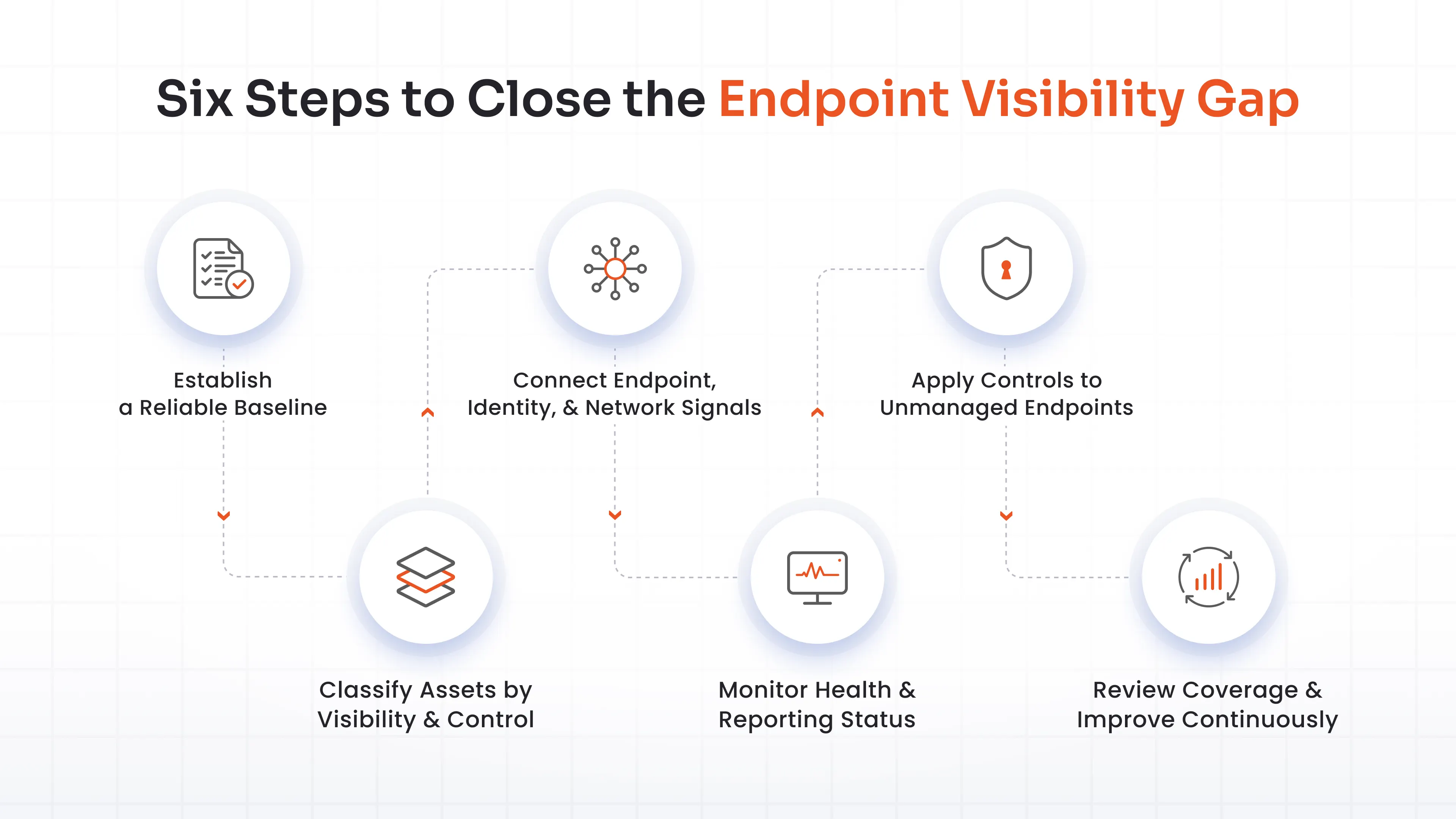
Step 1: Establish a Reliable Baseline
Consolidate records from UEM, asset management, identity, and other relevant systems. A consistent approach to device inventory management should capture available identifiers, operating systems, ownership, last-seen timestamps, and compliance information.
Investigate discrepancies carefully. Different identifiers may refer to the same physical endpoint, while an outdated record does not necessarily mean the asset is still active.
Measure: Identified assets, unexplained inventory discrepancies, and records awaiting investigation.
Step 2: Classify Assets by Visibility and Control
Group assets into three practical categories:
- Managed: Identified and enrolled in an appropriate management system.
- Visible but unmanaged: Detected through available logs or telemetry but not enrolled in UEM.
- Unknown or insufficiently observed: Ownership, status, or activity cannot be established reliably.
Assign each category an owner, an acceptable access policy, and a remediation process. This helps teams distinguish intentional exceptions from unresolved security gaps and prioritize unmanaged devices that present the greatest risk.
Step 3: Connect Endpoint, Identity, and Network Signals
Correlate available asset records with sign-in logs, network activity, and endpoint security alerts. Where supported, include relevant cloud audit data.
Combining these signals helps investigators determine whether separate events are related instead of treating every alert as an isolated problem. Integrations should also support appropriate endpoint monitoring, so relevant changes and suspicious activity are easier to investigate.
Measure: Unexplained assets, unresolved access discrepancies, and incidents lacking sufficient endpoint context.
Step 4: Monitor Health and Reporting Status
Set expected reporting intervals for managed endpoints. Generate alerts for stale records, failed agents, recurring connectivity problems, and changes in compliance status.
Where performance telemetry is available, monitor indicators such as startup time, application responsiveness, and resource utilization. These signals can help distinguish a security concern from a routine performance issue.
Measure: Stale-record counts, investigation time, recurring technical issues, and remediation completion.
Step 5: Apply Controls to Unmanaged Endpoints
Not every endpoint can or should receive full management. Define appropriate policies for personal equipment, contractors, and specialized systems.
Depending on the environment, controls may include managed work profiles, application-level data protection, conditional access, restricted permissions, and network segmentation.
For example, an organization could permit access to approved applications while restricting sensitive downloads from noncompliant endpoints, provided the relevant applications and access controls support that policy.
Step 6: Review Coverage and Improve Continuously
Review inventory discrepancies, compliance exceptions, and incident findings on a defined schedule. Investigate recurring issues instead of repeatedly addressing individual symptoms.
Track asset coverage, reporting reliability, unexplained endpoints, remediation timelines, and the percentage of noncompliant assets with assigned responses. Use consistent definitions so changes in these metrics reflect genuine improvements.
Need to connect endpoint management with access policies?
Request a miniOrange UEM demo to discuss your enrollment, compliance, and endpoint management requirements.
Endpoint Visibility Best Practices for IT Teams
Maintaining visibility requires consistent ownership and review, not just an initial discovery exercise.
- Maintain accurate asset records: Update ownership, lifecycle status, and management information when equipment is deployed, reassigned, or retired.
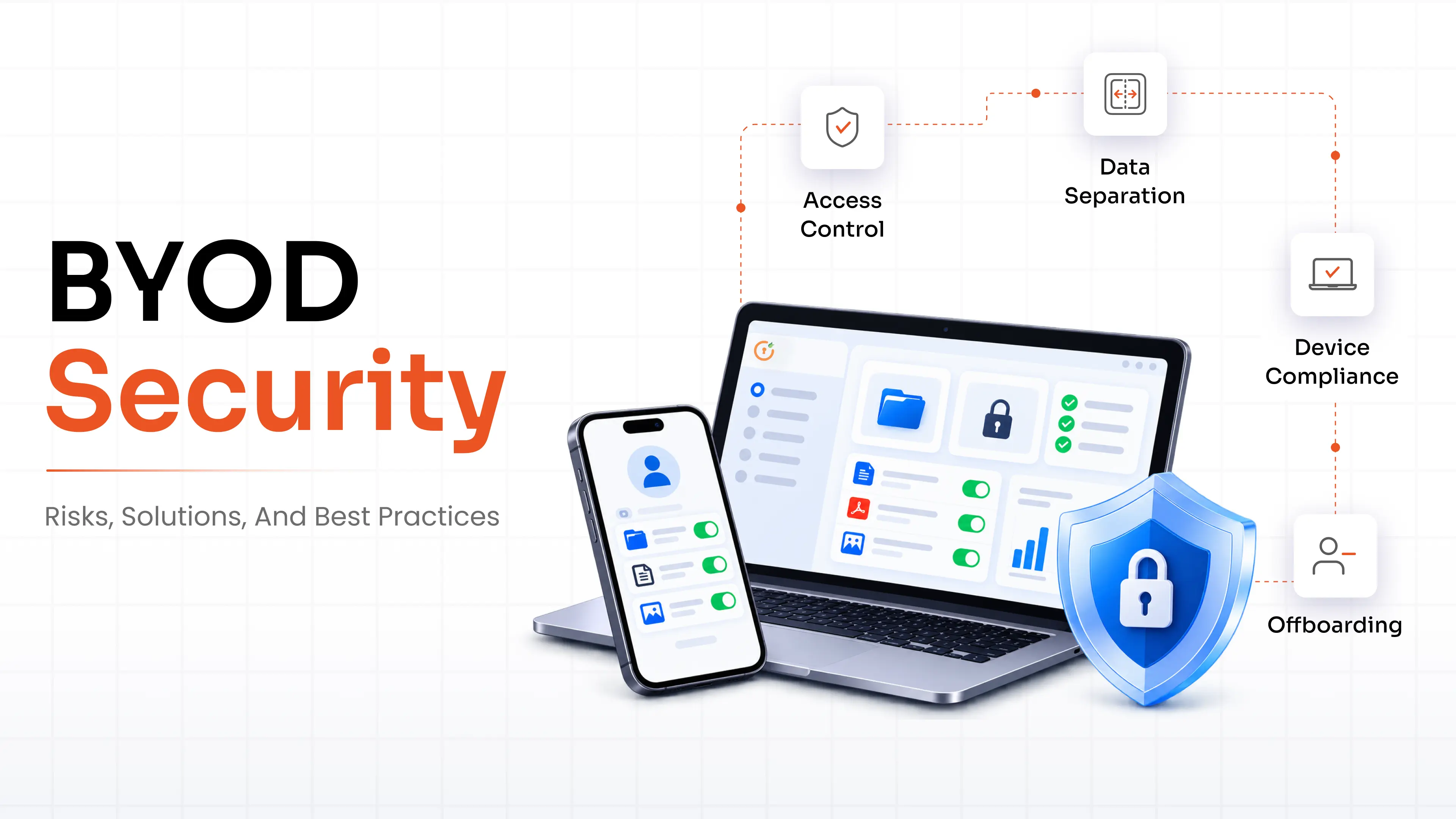
- Define BYOD requirements: Specify which applications personal equipment can access and how corporate information must be protected.
- Automate stale-record detection: Investigate missing telemetry rather than assuming an inactive record represents retired hardware.
- Assign clear responsibility: Establish who investigates, approves, restricts, or removes access for unknown assets.
- Coordinate vulnerability management: Use available inventory and security information to prioritize remediation.
- Integrate complementary tools: Connect UEM, IAM, endpoint security, and network monitoring where supported.
- Review exceptions regularly: Reassess unmanaged assets, temporary access, and systems that cannot meet standard policies.
- Include employee experience: Use available performance telemetry to identify disruptions that traditional inventory reporting may overlook.
How miniOrange UEM Supports Endpoint Management
miniOrange Unified Endpoint Management helps organizations manage supported endpoints and apply relevant policies across their environments. It can serve as the management layer in a broader endpoint visibility strategy, helping IT teams apply consistent controls to enrolled systems.
Depending on the selected product capabilities and deployment, organizations can use miniOrange UEM for endpoint enrollment and configuration, supported BYOD and work-data separation approaches, Mobile Application Management (MAM), and compliance policy enforcement. These capabilities help IT teams manage supported endpoints and protect corporate applications and data.
UEM does not automatically discover or manage every connected asset. Organizations may still need network discovery, endpoint security, or specialized IoT and operational technology tools to cover systems that conventional management cannot support. The right combination depends on the assets in scope, available telemetry, and the actions required when an endpoint presents a risk.
Have unexplained gaps between your asset inventory and actual access activity?
Contact miniOrange to discuss your UEM requirements and identify an appropriate endpoint management approach.
Conclusion: Turn Endpoint Visibility Into Action
Endpoint visibility is not simply about counting assets. It is about understanding which systems access business resources, what their security status reveals, and which controls can be applied.
Start with a reliable inventory, investigate unexplained access, and connect endpoint information with identity and security signals. Establish clear ownership, reporting expectations, and remediation procedures so that gaps do not remain unresolved.
When visibility informs operational decisions, IT teams can investigate incidents with better context, manage supported endpoints more consistently, and reduce uncertainty across their environments.
FAQs
1. What is endpoint visibility in cybersecurity?
Endpoint visibility is the ability to identify assets, monitor their available activity and health information, and assess their security posture. It helps IT and security teams identify gaps, investigate suspicious behavior, and determine appropriate controls.
2. What causes endpoint visibility gaps?
Common causes include unmanaged personal equipment, remote or offline endpoints, incomplete asset inventories, disconnected agents, unsupported IoT systems, and fragmented monitoring tools. Inconsistent ownership records and limited integration between security systems can make these gaps harder to identify.
3. How can I improve endpoint visibility?
Reconcile asset inventories with available identity and network records. Classify unmanaged endpoints, monitor reporting status, integrate relevant telemetry, assign responsibility for exceptions, and track coverage and remediation metrics over time.
4. What is the difference between endpoint visibility and UEM?
Endpoint visibility focuses on identifying assets and understanding their available status and activity. UEM provides management capabilities for supported endpoints, including enrollment, configuration, application management, and policy enforcement. Visibility identifies potential issues, while management provides tools to address them.
5. Can endpoint visibility help detect cyberattacks?
Yes. Endpoint information can help investigators assess suspicious logins, malware activity, unusual connections, and other potential indicators of compromise. Detection depends on the available telemetry, monitoring tools, integrations, and security rules.
6. How does endpoint visibility support compliance?
Accurate asset records and monitoring evidence can help organizations demonstrate how endpoints are identified, assessed, and managed. The evidence required depends on the applicable framework and the organization's obligations.
7. Does UEM provide visibility into every connected device?
Not necessarily. Coverage depends on supported operating systems, enrollment methods, endpoint capabilities, and integrations. Network monitoring, endpoint security, and specialized IoT or operational technology tools may be needed for systems that conventional UEM cannot manage.
Leave a Comment