Hello there!
Need Help? We are right here!

Need Help? We are right here!
Search Results:
×Organizations that build software rely heavily on proprietary source code as their most valuable intellectual property (IP). However, in modern development environments, developers often work across multiple tools and channels, increasing the risk of accidental or intentional code leakage.
This use case focuses on preventing unauthorized exfiltration of source code from endpoints and communication channels by enforcing Data Loss Prevention (DLP) policies across email, cloud apps, removable media, and AI tools.
The objective is to ensure that sensitive code remains within the organization’s secure environment and cannot be shared externally through unmanaged or unauthorized channels.
Organizations face a growing risk of internal data leaks, especially from developer endpoints where sensitive source code is actively created, accessed, and modified.
In modern development environments, employees often work across multiple tools and platforms, which increases the chances of accidental or intentional data exfiltration.
Key risks include:
These gaps create significant exposure to intellectual property (IP) theft, compliance violations, and competitive disadvantage.
Traditional endpoint security focuses on securing devices, not the data within them. While it can detect malware or unauthorized access, it lacks the ability to control how sensitive information, like source code, is used and shared.
In developer environments, code frequently moves across email, cloud platforms, and external devices. However, these tools:
Because of these gaps, source code can easily leave the organization through everyday workflows, without triggering any security alerts.
The solution enables organizations to enforce granular Data Loss Prevention (DLP) policies directly at the endpoint and email layer, ensuring that source code cannot be exfiltrated through any unauthorized channel.
By deploying the DLP agent across Windows devices and integrating email security controls, organizations gain full visibility and control over sensitive data movement.
Key Benefits:
1. Endpoint Deployment
The DLP agent is installed on Windows 11 developer machines to monitor user activity at the
system level.
2. Content Inspection & Classification
miniOrange DLP detects and classifies sensitive source code to enforce endpoint security policies.
3. Policy Enforcement Across Channels
Once classified, policies are enforced across multiple exfiltration vectors.
4. Real-Time Action & Alerting
When a violation is detected.
Result:
Sensitive source code remains protected across all endpoints, ensuring zero unauthorized data leakage across internal and external channels.
The DLP system enforces secure data protection across endpoints through the following steps:
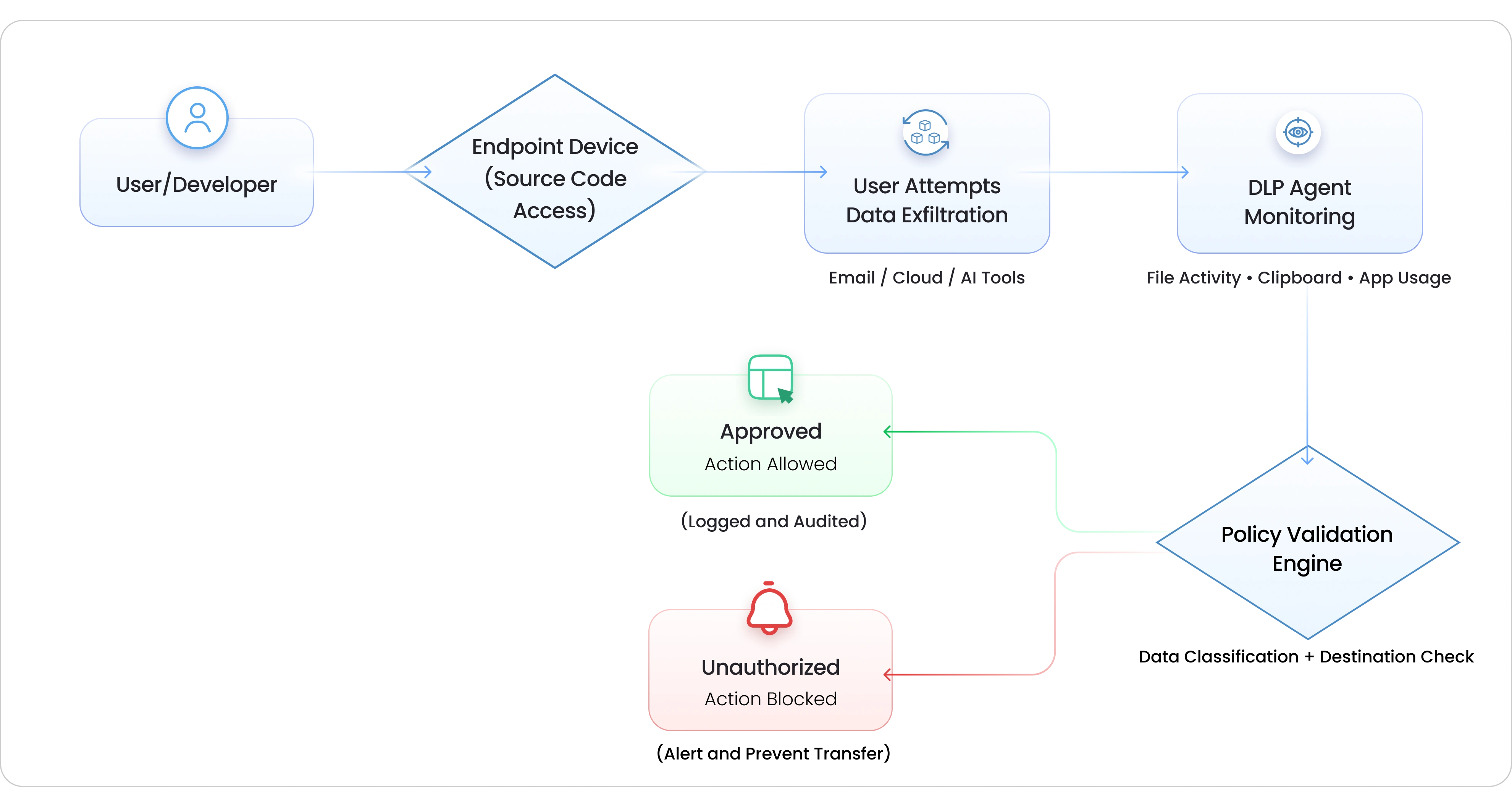
Developer Accesses Source Code
The user works on or accesses proprietary source code on the endpoint device.
This process ensures that sensitive source code remains within the organization, preventing unauthorized sharing and maintaining complete control over intellectual property across all endpoints.
Stop data leaks across endpoints, email, and AI tools with real-time DLP enforcement.
Start Free Trial Book a Demo
Security Benefits:
Operational Benefits:
Result:
Organizations gain complete visibility and control over sensitive code movement while maintaining developer productivity.
This DLP solution is ideal for organizations that need strict control over intellectual property and source code security: