
Most security teams don’t lose the fight against data breaches because they lack tools. They lose because their tools don’t talk to each other.
This is exactly the loophole that SIEM and DLP were built to close, together.
Security information and event management gives you visibility into what’s happening across your entire environment. At the same time, data loss prevention gives you the control to stop sensitive information from leaving in the first place.
Here, one watches while the other acts, and when they’re connected, your security team gets a much clearer picture of both the threat and the data at risk.
In this guide, we'll break down what SIEM actually is, how it works step by step, the different deployment models available, and why pairing it with DLP has become a practical necessity rather than a nice-to-have for IT and security teams managing sensitive data at scale.
What Is SIEM?
So what does SIEM mean in plain terms?
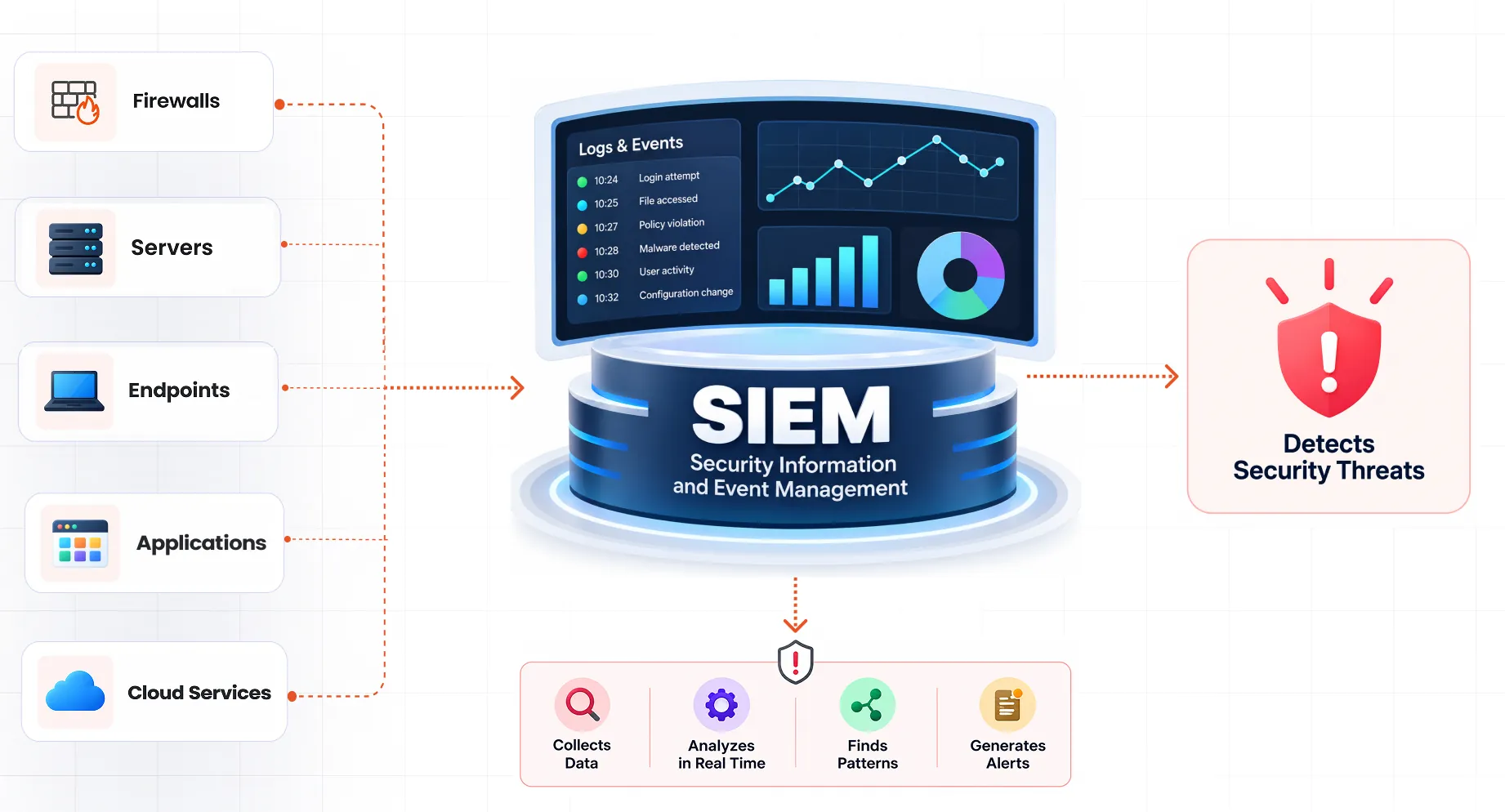
Security Information and Event Management (SIEM) is a technology that collects log and event data from across your IT environment. This can include firewalls, servers, endpoints, applications, and cloud services. The SIEM then analyzes that data in real time to spot patterns that indicate a security threat.
Types of SIEM Deployments You Should Know
Not every organization needs the same SIEM setup. The right deployment model depends on your infrastructure, budget, compliance obligations, and how much control you want over your own data.
1. Cloud
A cloud SIEM is hosted and managed by a vendor, typically delivered as a software-as-a-service model. Your team installs lightweight agents, feeds in log data, and the provider handles the underlying infrastructure, updates, and scaling.
This model is popular for its faster deployment and lower upfront costs, and it’s the fastest-growing segment of the market.
2. On-Premises
An on-premises SIEM runs entirely within your own data center. Your organization owns the hardware, manages the software license, and handles everything from installation to patching and disaster recovery.
This model appeals to organizations in regulated industries where data residency rules mean sensitive logs simply cannot leave company-controlled infrastructure.
3. Hybrid
A hybrid deployment blends both worlds, correlating events across on-premises Active Directory, cloud identity systems, endpoint telemetry, and SaaS activity from a single unified platform.
This approach uses local collectors to buffer logs during connectivity interruptions while still gaining the elastic scalability that the cloud offers. This makes it a practical fit for organizations midway through cloud migration.
4. Managed
With managed SIEM, a third-party provider operates the platform on your behalf, handling everything from tuning detection rules to monitoring alerts around the clock.
This model gives smaller IT teams access to security expertise they may not have in-house, without the cost of building a full security operations center from scratch.
5. Open Source
Open source SIEM tools such as Wazuh, Graylog Open, and Security Onion offer core log correlation, alerting, and visualization capabilities at little to no licensing cost.
Wazuh alone has more than 15,000 GitHub stars and combines SIEM and extended detection and response capabilities in a single architecture.
These tools require more hands-on configuration and technical skill to maintain, which makes them a better fit for organizations with strong in-house security engineering talent.
Key Features That Make SIEM Tools Effective
A SIEM platform is only as useful as the capabilities running underneath the dashboard. Here are the four features that separate a genuinely effective SIEM from a glorified log storage tool.
1. Data Collection
At its core, a SIEM ingests log and event data from every corner of your network. It collects data from firewalls, servers, endpoints, applications, cloud workloads, and identity systems. Comprehensive collection is what makes correlation possible in the first place.
2. Correlation and Analytics
Raw logs mean little on their own. A SIEM's correlation engine cross-references events across multiple sources to identify patterns.
These patterns could be a failed login followed by a privilege escalation followed by an unusual data transfer, which would look harmless in isolation but suspicious together.
Modern platforms increasingly layer User and Entity Behavior Analytics (UEBA) on top of correlation rules to catch threats that don't match a known signature.
3. Incident Response
When a SIEM detects a genuine threat, it needs to do more than log it quietly. Effective platforms trigger alerts, prioritize them by severity, and increasingly integrate with security orchestration and automated response tools. This helps to kick off predefined containment steps without waiting on manual intervention.
4. Compliance Reporting
Most regulated industries require audit trails proving that security events were monitored and handled appropriately.
SIEM platforms generate the reports needed for standards like PCI DSS, HIPAA, and India's Digital Personal Data Protection Act. This saves compliance teams from manually piecing together evidence during an audit.
A Step-by-Step Process on How SIEM Works
Understanding how SIEM tools function day-to-day makes it easier to see why they're considered the backbone of a security operations center.
The process generally follows four stages.
Step 1: Gather Logs From Across the Environment
The SIEM pulls in log and event data continuously from firewalls, servers, applications, endpoints, and network devices. This is the raw material every other function depends on.
Step 2: Normalize and Combine Historical + Live Data
Logs arrive in different formats depending on the source. So the SIEM standardizes them into a consistent structure.
It then blends this incoming live data with historical records, which is what allows the system to spot deviations from a device or user's normal behavior over time.
Step 3: Correlate Events to Detect Patterns of Bad Behavior
Using predefined rules, threat intelligence feeds, and behavioral baselines, the SIEM analyzes the combined dataset to identify sequences that suggest malicious activity. These threats could be lateral movement, credential abuse, or an unusual spike in outbound traffic.
Step 4: Send Alerts When Risk Is Detected
Once the system flags a genuine risk, it generates an alert, ranks it by severity, and routes it to the security team. This is often done alongside supporting context, so analysts don't have to dig through raw logs to understand what triggered it.
This cycle runs continuously, which is what allows security teams to catch threats in near real time rather than discovering them weeks later during a routine audit.
How SIEM and DLP Complement Each Other
SIEM and DLP are often mistaken for competing tools, but they're actually built to do different jobs that reinforce one another.
DLP should decide and enforce whether a data action is safe, while SIEM should collect the resulting signal for correlation, reporting, and investigation.
If both tools try to do the same job, teams end up slower and noisier.
1. DLP Enforces, SIEM Observes
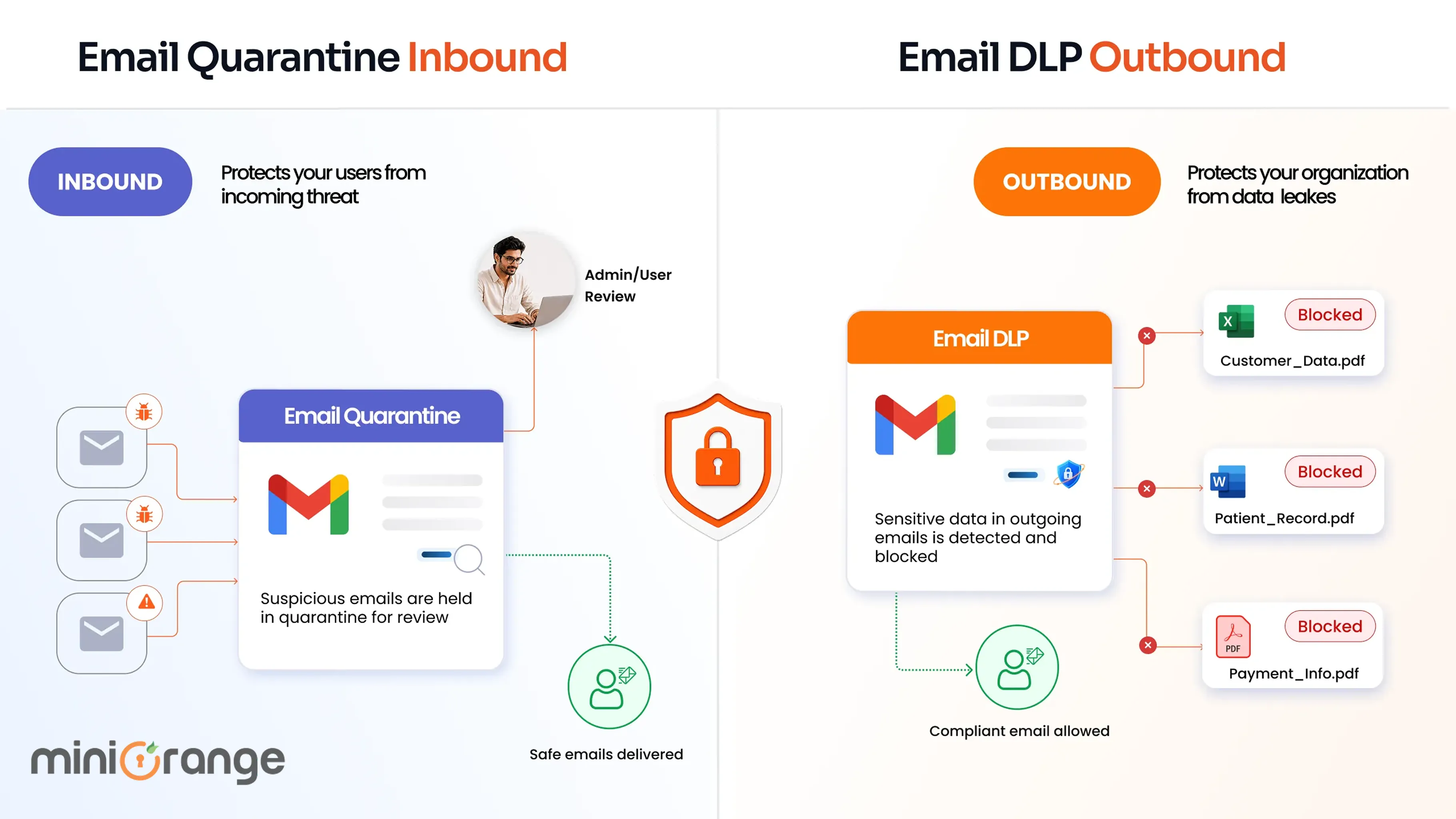
DLP solutions sit close to the data itself, blocking or flagging actions like an employee attempting to email a file containing customer records or copy sensitive data to a USB drive.
SIEM doesn't make that enforcement decision. Instead, it ingests the DLP event as a data point and correlates it against everything else happening on the network at that moment, such as whether that same user account showed unusual login activity an hour earlier.
2. Context Turns DLP Alerts Into Actionable Intelligence
A single DLP alert, viewed alone, might look like a false alarm or a genuine mistake. But when a SIEM places that alert alongside related events, like a phishing email that landed in the same user's inbox that morning, the picture changes entirely.
This is where combining SIEM and DLP pays off: it transforms isolated data protection alerts into part of a larger threat narrative that analysts can act on with confidence.
3. Faster Investigation and Root Cause Analysis
When DLP and SIEM logs live in one correlated timeline, investigators don't have to manually stitch together evidence from separate consoles.
They can trace exactly how a data exfiltration attempt unfolded, from initial compromise to the blocked or successful transfer, cutting investigation time significantly compared to piecing it together after the fact.
Why DLP and SIEM Matter for IT Teams
For IT teams stretched thin across infrastructure, compliance, and security duties, the combination of DLP and SIEM capabilities isn't about adding more tools to the stack. It's about making the tools already in place actually useful together.
1. Reduces Blind Spots Across Hybrid Environments
Most organizations today run a mix of on-premises systems, cloud applications, and remote endpoints.
SIEM and DLP, together, cover both the data layer and the infrastructure layer, closing gaps that attackers routinely exploit.
2. Cuts Down on Alert Fatigue
Alert fatigue is a documented, growing problem. SIEMs can correlate logs and analyze risks as well, like whether a privileged login is legitimate or a sign of compromise.
So, when a DLP solution provides that missing data-level context directly into the SIEM, analysts spend less time chasing noise and more time on genuine risks.
3. Strengthens Regulatory Compliance Posture
Regulations increasingly require organizations to prove not just that sensitive data was protected, but that they can demonstrate how, when, and by whom it was accessed.
A combined DLP and SIEM setup produces the audit trail regulators expect, covering both the enforcement action taken by DLP and the broader security context captured by SIEM. This makes compliance reporting far less painful during an audit cycle.
Benefits of Integration Between DLP and SIEM
Bringing these two systems together isn't just a technical nicety; it produces measurable operational gains that IT and security leaders can point to when justifying the investment.
1. Comprehensive Data Visibility
Integrating DLP and SIEM gives security teams a single, unified view of where sensitive data lives, how it moves, and who touches it. Instead of relying on separate dashboards that each tell only part of the story.
2. Centralized Event Monitoring
Running DLP and SIEM as separate tools means your team is checking two consoles just to answer one question: is this activity actually a threat?
When they're integrated, every data protection event lands in the same dashboard as your network, endpoint, and identity logs, giving analysts a single pane of glass instead of a scavenger hunt across tabs.
3. Proactive Threat Detection
By feeding DLP's data-level insights directly into SIEM's correlation engine, security teams can catch data exfiltration attempts earlier in the attack chain. This is often before sensitive information actually leaves the network, rather than discovering the loss after the fact.
Bring Your Data Under One Watchful Eye
SIEM tells you what's happening across your network. DLP makes sure your most sensitive data doesn't walk out the door while you're figuring it out. Neither one alone gives you the full story. And in a threat landscape where attackers move fast and data sprawls across cloud apps, endpoints, and email in equal measure, that gap is exactly where breaches happen.
If your team is still relying on scattered alerts, manual log reviews, or a DLP tool that operates in its own silo, it's worth seeing what a connected approach actually looks like in practice.
A modern DLP solution built to work alongside your SIEM doesn't just block risky file transfers; it feeds the context your security team needs to catch threats earlier and close investigations faster.
Ready to see it for yourself? Book a demo of our DLP solution today and find out how easy it is to give your IT and security teams the visibility and control they've been missing.
FAQs
1. What is the difference between SIEM and SOAR?
SIEM focuses on detection and visibility. It collects, normalizes, and correlates log data from across an organization to identify potential threats and answer the question "what's happening?" SOAR, or security orchestration, automation, and response, picks up from there, answering "what do we do about it?" by executing automated playbooks and orchestrating actions across security tools.
2. How does SIEM integrate with tools like DLP and DSPM?
SIEM integrates with DLP by ingesting enforcement events, such as a blocked file transfer, and correlating them with other security signals to build a fuller threat picture. DSPM adds another layer by continuously discovering and classifying sensitive data across cloud and SaaS environments.
3. Why is SIEM important?
SIEM is important because it gives organizations centralized visibility into security events that would otherwise remain scattered across dozens of disconnected systems. Without it, security teams are forced to manually review logs from each tool separately, which is slow, error-prone, and often too late to prevent damage.
4. What are the common limitations or challenges of SIEM?
The most frequently cited challenge is alert fatigue driven by false positives, since SIEMs are built to be highly sensitive and often flag activity that turns out to be harmless. Cost is another major limitation, particularly for cloud SIEMs priced by data volume, where an incident surge can trigger a corresponding billing surge at the worst possible time.
About the Author

Content Writer
With a background in Journalism and extensive experience in SaaS and cybersecurity content writing, Chaitali Avadhani has contributed to creating various forms of impactful content pieces across multiple verticals. At miniOrange, her role is to craft SEO-friendly and lead-generating content around Identity and Access Management (IAM) products and cybersecurity as a whole.
Leave a Comment