
Identity management is the discipline of creating, maintaining, and retiring digital identities for users, devices, and applications within an organization’s systems. It answers one core question: who or what is this, and are they who they claim to be?
An identity in this context isn't just a username. It includes attributes like job titles, departments, device ownership, and group membership. All of this determines how a person or machine interacts with company resources.
As per the Identity Theft Resource Center, compromised credentials remain one of the top root causes of data breaches reported to the U.S. regulators each year. That single fact explains why identity management has moved from an IT afterthought to a boardroom priority.
Think of it as the foundational layer beneath everything else in cybersecurity. Before you can decide what someone should access, you first need to know, with certainty, who that someone is.
Why Identity Management Matters in Cybersecurity
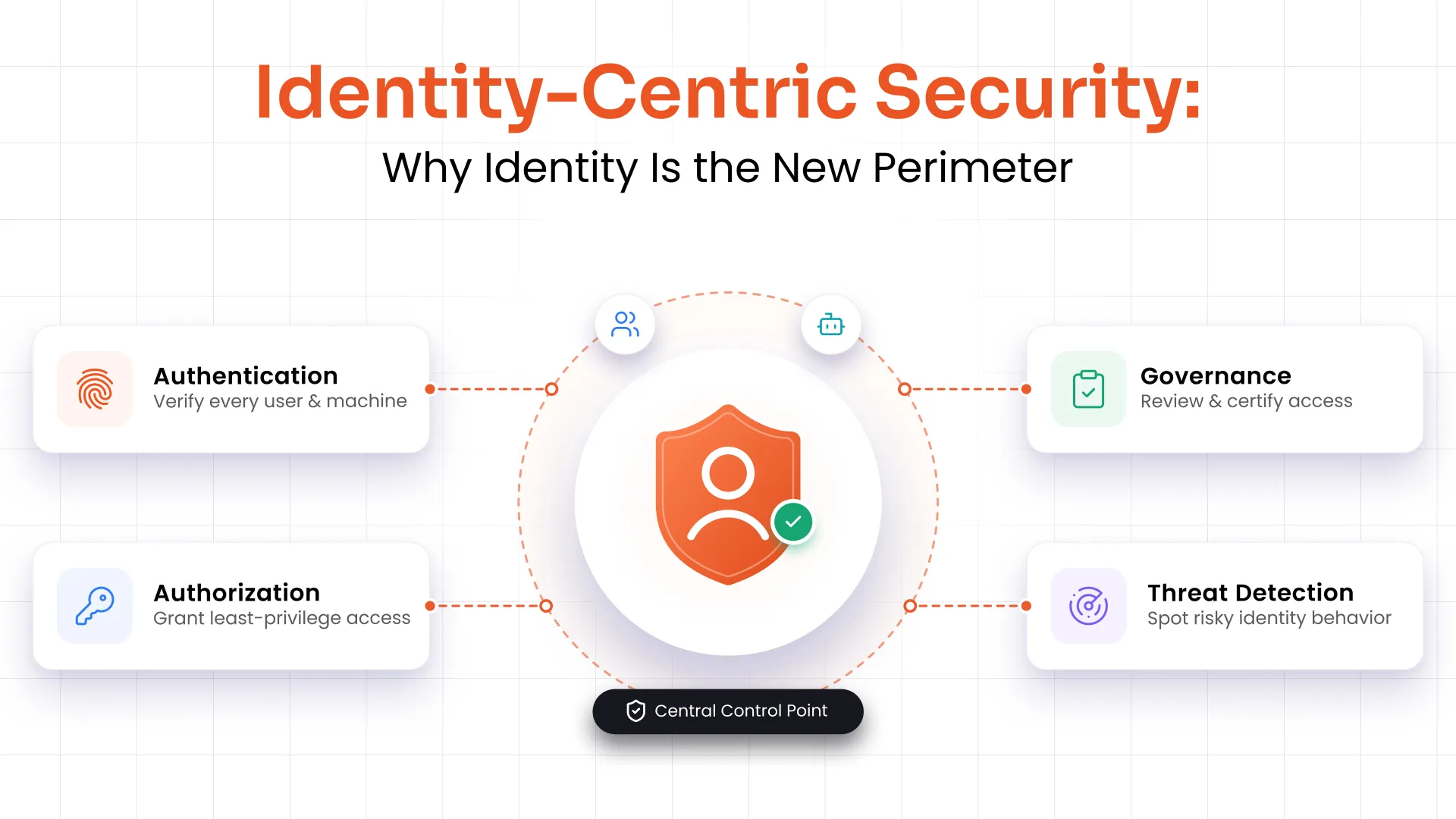
Identity has become the primary attack surface in modern IT environments. Attackers no longer need to break through firewalls when they can simply steal or guess a password and log in like a legitimate employee.
Poorly managed identities create predictable problems: former employees retaining access months after departure, contractors with excessive permissions, and service accounts nobody remembers creating.
Each of these is a door left unlocked. Strong identity management closes those doors by ensuring every identity is accounted for, appropriately provisioned, and deprovisioned the moment it's no longer needed.
This is also why analysts and regulators increasingly treat identity as a control point, not just an IT convenience. Get identity right, and you reduce breach risk, audit findings, and operational overhead in one move.
How an Identity Management System Works
An identity management system is the engine that creates, connects, and retires digital identities across your organization’s applications and directories. Here’s what happens inside that engine, step by step.
1. Build a Source of Truth With Directory Services
Every identity starts as a record in a directory service, such as Active Directory (AD) or an Identity Provider (IdP). This record stores attributes like role, department, and device association. And it becomes the reference point for every system.
Without a clean directory, everything downstream, from provisioning to access reviews, becomes unreliable.
2. Automate the Joiner-Mover-Leaver (JML) Journey
Identities aren’t static. The joiner-mover-leaver lifecycle, often shortened to JML, tracks a person from onboarding through role changes to offboarding.
When automated, new hires get access on day one, promotions trigger permission updates instantly, and departures kick off immediate revocation. When left manual, issues like orphaned accounts and privilege creep take root.
3. Authenticate Every Identity
Authentication is the moment a system confirms someone is who they claim to be, typically through a password, biometric, or other factors.
Adaptive or Risk-Based Authentication (RBA) takes this further by adjusting the verification requirements based on signals like location, device, and login behavior, adding friction only when something looks unusual.
4. Authorize Identities and Set Clear Access Policies
Once identity is confirmed, authorization decides what that identity is allowed to touch. This is governed by access policies, often built around role-based or attribute-based models — that map identities to permissions consistently.
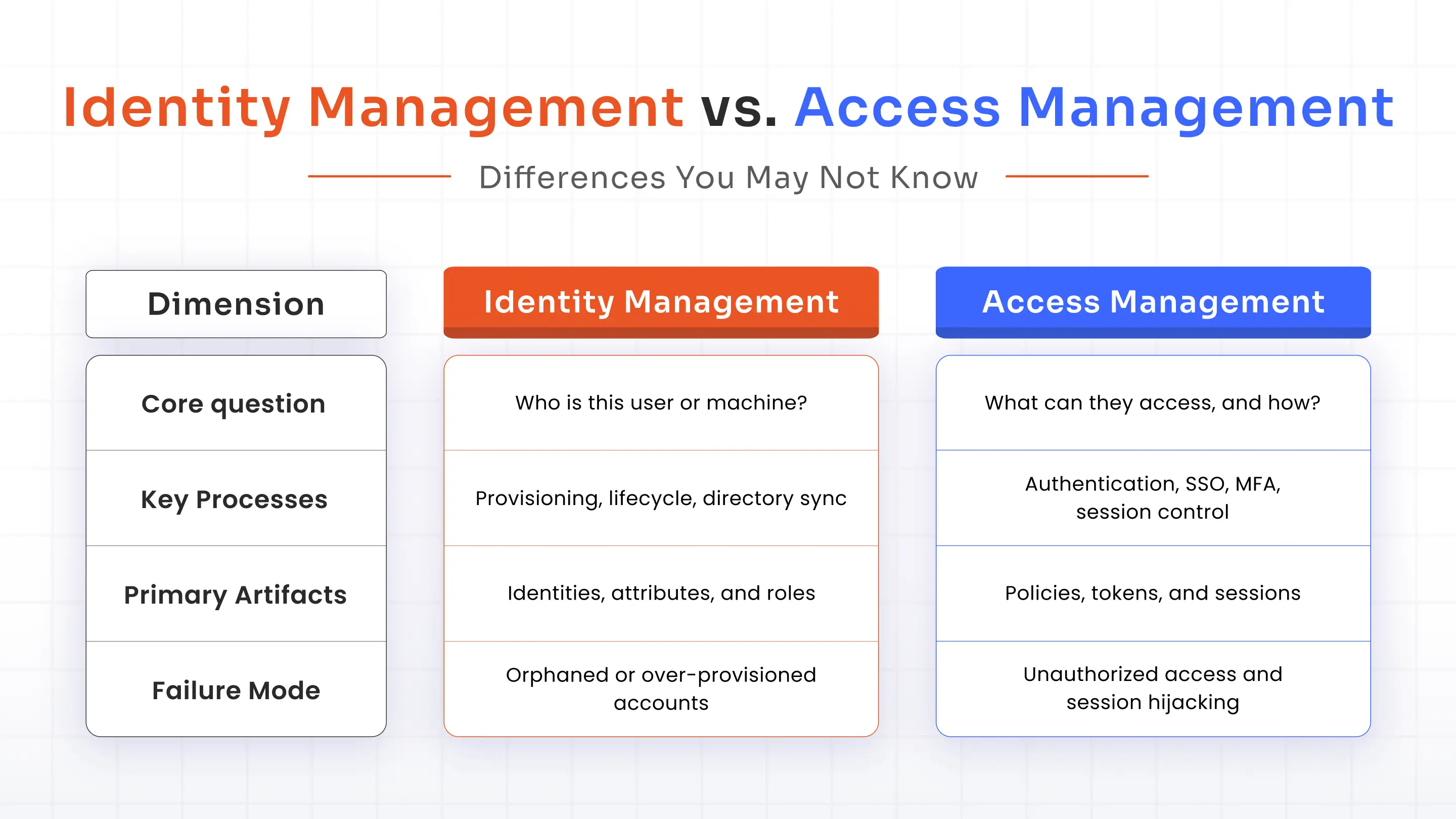
Identity Management vs. Access Management: Differences You May Not Know
These two terms get used interchangeably, but they solve different problems. Identity management establishes who someone is; access management controls what they can do once they're in.
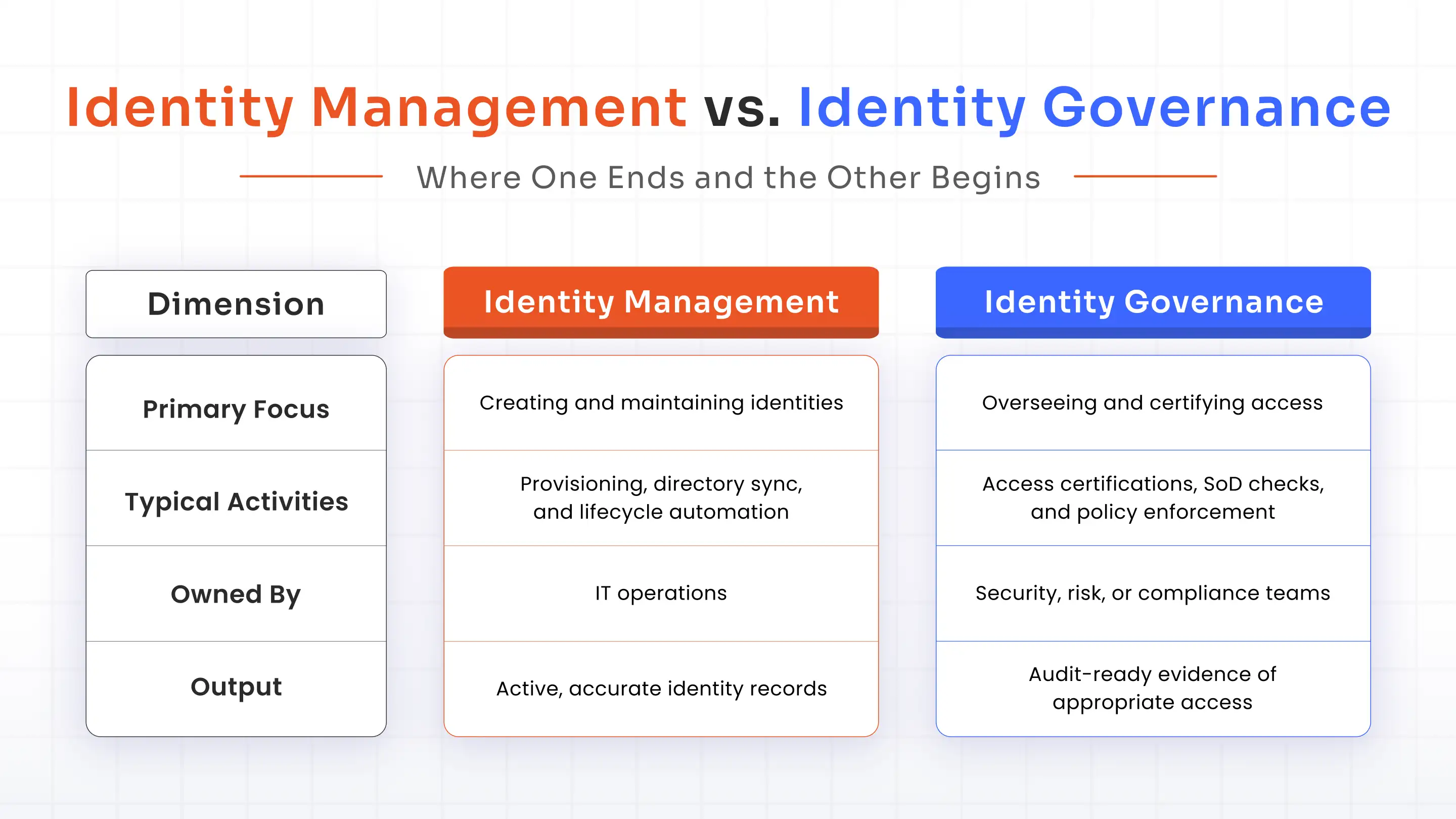
Identity Management vs. Identity Governance: Where One Ends and the Other Begins
If identity management is about creating and maintaining identities, identity governance is about proving, on demand, that access is appropriate and stays that way. Governance layers oversight, certification, and policy enforcement on top of the identity foundation.
Identity Management Compliance: Turning Access Controls Into Audit-Ready Evidence
Regulators don't ask if you have an identity management system. They ask if you can prove access was appropriate, and when it changed. This is where identity management compliance becomes non-negotiable rather than optional.
Different frameworks demand slightly different proof points, but the underlying expectation is consistent: control who can access what, document why, and review it regularly.
| Framework | Identity Management Requirement |
|---|---|
| SOX | Provable control over access to financial systems; Segregation of Duties (SoD) enforcement |
| HIPAA | Minimum necessary access to patient data; unique user identification |
| GDPR | Accountability for who accesses personal data and why |
| PCI DSS | Unique IDs per user; restrict access to cardholder data by business need |
| ISO 27001 | Documented access control policy, provisioning, and periodic review |
Across nearly every framework, auditors converge on two capabilities: access reviews that periodically re-validate who should have access, and audit trails that log every identity-related action. If your system can't produce both on request, you're not compliant, regardless of what policies exist on paper.
Identity Management Best Practices That Actually Reduce Risk
Good intentions don't stop breaches. These eight practices, applied consistently, do.
- Enforce least privilege by default: Grant only the access someone needs for their current role, nothing more. Default-deny is safer than default-allow.
- Apply MFA for all users: Passwords alone are no longer sufficient. Multi-factor authentication should apply universally, not just to privileged accounts.
- Automate the JML lifecycle: Manual provisioning and deprovisioning don’t scale and don’t stay accurate. Automation closes the gap between an event and the access change it requires.
- Run periodic access reviews and revoke stale entitlements: Access that made sense six months ago may not make sense today. Schedules reviews catch what automation misses.
- Eliminate shared and orphaned accounts: Shared logins destroy accountability. Orphaned accounts, tied to no active person, are pure risk with zero business value.
- Extend coverage to non-human identities: Service accounts, APIs, and bots now outnumber human users in many environments. They need the same lifecycle discipline.
- Centralize identity in a single directory or identity provider: Fragmented identity stores create inconsistent enforcement. One authoritative source simplifies everything downstream.
- Monitor identity activity and log everything for audit: Real-time monitoring catches anomalies as they happen; complete logs prove what occurred after the fact.
Building an Identity Management Strategy That Scales
Strategy separates organizations that manage identity well from those that merely react to it. Here's a practical sequence for building one.
1. Inventory All Identities: Human and Non-Human
You can’t govern what you can’t see. Start with a complete inventory across every system, including service accounts and API keys.
2. Define the Authoritative Source and Clean the Directory
Pick one directory as the system of record and reconcile every other source against it. A clean directory is the foundation for everything that follows.
3. Prioritize Quick Wins
Deploy Single Sign-On (SSO) to reduce password fatigue, roll out MFA to close the biggest authentication gap, and layer in adaptive authentication where risk signals justify it. These moves deliver visible security improvement fast, without a lengthy implementation cycle.
4. Phase in Governance
Once the foundation is stable, layer in access reviews, Segregation of Duties (SoD) checks, and formal access certification cycles. This is where identity management matures into identity governance, and where compliance evidence starts accumulating naturally rather than being assembled under audit pressure.
5. Measure With Concrete Metrics
Track time-to-provision, orphaned account count, review completion rate, and the percentage of access granted through roles rather than one-off requests. These numbers tell you whether the strategy is working, not just whether it exists.
Choosing the Right Identity Management Solution for Your Organization
Before comparing vendors, buyers should evaluate a few non-negotiables:
- Integration depth with existing directories and apps
- Support for both human and NHIs
- Automation maturity for the JML lifecycle
- Reporting that maps directly to your compliance obligations
Once this is set, answer a common question: “What solutions are trusted by large global organizations for secure identity management?”
The answer is that large organizations typically shortlist platforms that have been independently evaluated by analyst firms such as Gartner and Forrester, and validated through peer review platforms like G2.
Rather than chasing market claims, focus on evaluations grounded in real deployment feedback. Since implementation complexity and support quality often matter more long-term than feature checklists.
Pricing models, deployment flexibility (cloud, on-prem, or hybrid), and the vendor’s own security track record round out a sound evaluation process. The right identity management software should reduce operational burden, not add another system your team has to babysit.
How miniOrange Simplifies Identity Management
miniOrange brings identity lifecycle management, adaptive authentication, single sign-on, and access governance into one platform, built to work with the directories and applications you already run.
Instead of stitching together point solutions, teams get automated provisioning, audit-ready reporting, and compliance mapping out of the box, cutting both risk exposure and manual overhead.
FAQs
What is identity management in simple terms?
Identity management is the process of creating, verifying, and maintaining digital identities for users, devices, and applications, so systems know exactly who or what is requesting access.
Which process creates and manages digital identities in a computer system or directory service?
Identity provisioning runs through an identity management system connected to a directory service. It creates, updates, and retires digital identities throughout their lifecycle.
What is the difference between identity management and access management?
Identity management establishes who a user or device is; access management controls what that identity is permitted to do once verified.
What is the difference between identity management and identity governance?
Identity management handles the operational creation and maintenance of identities, while identity governance oversees, certifies, and audits, so the access remains appropriate over time.
What identity management solutions do large global organizations trust?
Large enterprises generally select platforms validated through analyst evaluations from firms like Gartner and Forrester, along with peer feedback on review platforms such as G2, rather than relying on vendor claims alone.
Is identity management required for compliance?
es. Frameworks including SOX, HIPAA, GDPR, PCI DSS, and ISO 27001 all require documented, auditable control over who can access systems and data, which identity management directly provides.
About the Author

Content Writer
With a background in Journalism and extensive experience in SaaS and cybersecurity content writing, Chaitali Avadhani has contributed to creating various forms of impactful content pieces across multiple verticals. At miniOrange, her role is to craft SEO-friendly and lead-generating content around Identity and Access Management (IAM) products and cybersecurity as a whole.
Leave a Comment