The average enterprise today runs on over 300 SaaS applications. According to Zylo's 2026 SaaS Management Index, organizations now manage an average of 305 applications and spend $55.8 million annually on their SaaS portfolio. What's more striking, nearly a third of those applications are adopted outside of IT's visibility entirely.
SaaS has fundamentally changed how businesses operate. Tools for collaboration, HR, finance, security, and customer management have all moved to the cloud, giving teams the flexibility to adopt new software in minutes.
But this speed and accessibility has a downside. Without a structured process to govern these applications across their entire lifecycle, from procurement to offboarding, organizations quickly find themselves dealing with out-of-control spending, security gaps, and compliance nightmares.
This is where SaaS lifecycle management becomes critical. It's no longer just a nice-to-have operational practice. It is the foundation on which enterprises build cost-efficient, secure, and auditable SaaS ecosystems.
What is SaaS Lifecycle Management?
SaaS lifecycle management is the end-to-end process of overseeing and governing SaaS applications from the moment they are identified and procured to the point where they are retired or offboarded.
It encompasses every stage in between: deployment, user access, usage monitoring, license optimization, contract renewals, and eventually, secure decommissioning.
In simpler terms, SaaS lifecycle management ensures that every SaaS application your organization uses is purposefully acquired, actively managed, and responsibly retired. It combines IT governance, identity management, financial oversight, and security practices into a unified operational discipline.
User Lifecycle Management in SaaS
User lifecycle management is the subset of SaaS lifecycle management that focuses specifically on how user access is created, modified, and removed as people move through different stages of their employment journey.
This is commonly structured around the Joiner-Mover-Leaver (JML) model:
- Joiners: These are the new employees or contractors entering the organization.
- Movers: These are employees who change roles, departments, or locations within the organization.
- Leavers: These are employees or contractors who exit the organization. All access must be revoked immediately and completely.
SaaS Management vs. SaaS Lifecycle Management: What's the Difference?
These two terms are often used interchangeably, but they are not the same.
1. SaaS Management
This typically refers to the day-to-day operational control of SaaS tools. It can include:
- Monitoring usage
- Managing licenses
- Handling renewals
SaaS management is largely reactive and focuses on what is happening right now.
2. SaaS Lifecycle Management
In contrast to SaaS management, this takes a broader view. It covers the complete journey of every SaaS application within the organization.
From evaluating a tool before purchase, through active deployment, all the way to secure offboarding when the tool is no longer needed, SaaS lifecycle management covers it all.
It also includes governance, identity management, compliance, security posture, and strategic planning alongside operational tasks.
Note: Organizations that limit themselves to SaaS management without a lifecycle approach inevitably face gaps in security, costs, and compliance. SaaS lifecycle management closes these gaps.
Why Does SaaS Lifecycle Management Matter?
SaaS lifecycle management matters because it gives you cost control, security, and compliance across every app from purchase to retirement, instead of reacting to chaos app‑by‑app.
1. Cost and License Optimization
Without lifecycle management, you overbuy licenses, let unused subscriptions auto‑renew, and end up with overlapping tools doing the same job. A structured lifecycle lets you track usage, reclaim idle seats, and rationalize redundant apps before renewal, which often produces significant, measurable savings.
2. Security and Risk Reduction
Every unmanaged app and orphaned account is an attack surface, especially when employees leave or change roles. Lifecycle management enforces consistent onboarding and offboarding, role‑based access, and timely deprovisioning, which sharply reduces the risk of unauthorized data access and shadow IT.
3. Compliance and audit Readiness
Regulations and frameworks (GDPR, SOC 2, ISO 27001, NIST CSF, etc.) expect you to know who has access to what, why, and for how long.
SaaS lifecycle processes create audit trails for provisioning, access changes, approvals, and revocations, making it far easier to prove compliance during audits or customer due‑diligence.
4. Better Employee Experience and Productivity
When SaaS is managed as a lifecycle, employees get the right tools on day one, and access changes follow role changes quickly instead of weeks of ticket chasing.
You also avoid “tool overwhelm” by curating a smaller, approved stack and retiring low‑value apps, which improves adoption and collaboration.
5. Strategic Value from SaaS, Not Just Control
Mature SaaS lifecycle management turns SaaS from a messy cost center into an intentional portfolio you can align with business goals.
With visibility into usage and outcomes across the lifecycle, leaders can negotiate better contracts, prioritize mission‑critical tools, and back decisions with data instead of anecdotes.
What Are the Benefits of SaaS Lifecycle Management?
A structured SaaS lifecycle management program delivers value across four key areas.
1. Financial Impact
- Lower SaaS spend via reclaiming unused licenses and cutting idle subscriptions.
- Stronger renewal leverage using real usage data in negotiations.
- Reduced tool redundancy by consolidating overlapping apps across teams.
2. Security Posture
- Faster, more reliable offboarding shrinks the exposure window when people leave.
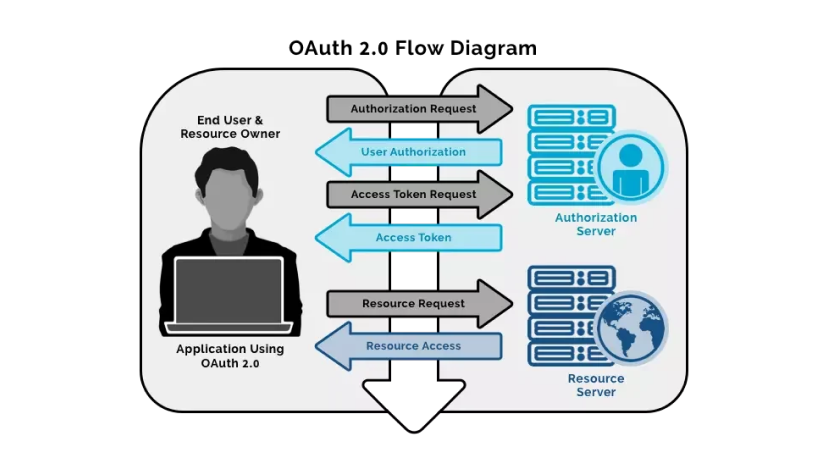
- Smaller attack surface by removing orphaned accounts, stale integrations, and dormant OAuth tokens.
- Consistent MFA and access policy enforcement across all sanctioned SaaS apps.
3. Governance and Compliance
- Centralized access history across SaaS apps for easier, faster audits.
- Periodic access reviews that clearly demonstrate ongoing access governance.
- End‑to‑end lifecycle records that support access control and data governance requirements.
4. Operational Effectiveness
- Quicker onboarding with automated, role-based provisioning.
- Lower IT workload by replacing manual access tickets with policy-driven workflows.
- Better employee experience because the right tools are available from day one.
- Shared visibility for IT, finance, security, and HR into the same SaaS landscape.
Organizations that implement a structured SaaS lifecycle management program realize benefits across four dimensions:
The Business Challenges Organizations Face
SaaS adoption has grown faster than most organizations' ability to manage it. The result is a set of recurring business challenges that lifecycle management directly addresses.
1. Unused Licenses and Wasted Spend
Unused SaaS licenses are one of the biggest silent drains on software budgets. Common causes of unused licenses are poor offboarding, over-provisioning during growth, changing roles, and overlapping tools for the same use case.
Further, every inactive account is not just a wasted budget but also a potential access point for attackers or ex‑employees if deprovisioning is missed.
2. Security Risks from Unmanaged Applications
Unmanaged SaaS apps store sensitive data, connect via OAuth tokens, and bypass security controls. When users leave an organization and their SaaS access is not fully revoked, dormant accounts become entry points for attackers.
3. Compliance and Regulatory Exposure
Industries like finance, healthcare, and government face strict requirements around access control, data governance, and audit readiness. Without centralized lifecycle management, maintaining a complete access trail across hundreds of applications becomes nearly impossible.
4. Rising SaaS Costs
Rising SaaS costs are being driven less by “buying more tools” and more by how existing vendors are changing pricing, bundling AI, and quietly pushing through increases at renewals.
As per the SaaS inflation 2026 trend analysis, the inflation rate in March 2026 touched to 13.2%, which is nearly 2% points higher than March 2025.
5. Shadow SaaS Applications
Shadow SaaS tools are those that are adopted by employees or teams without IT knowledge or approval. These tools exist outside governance frameworks, bypass security controls, and create financial and compliance exposure that IT teams often don't discover until a breach or audit.
6. Manual Provisioning and Deprovisioning
Many organizations still rely on service desk tickets, email approvals, and manual processes to provision and deprovision SaaS access. This creates delays, inconsistencies, and gaps, particularly during employee offboarding, where a missed SaaS application can leave a former employee with active access to sensitive data.
7. Data Exposure During Offboarding
When a departing employee's offboarding is incomplete, the risks extend beyond their user account. OAuth tokens they created, third-party integrations they configured, and external data shares they set up may all remain active.
The 7 Stages of the SaaS Management Lifecycle
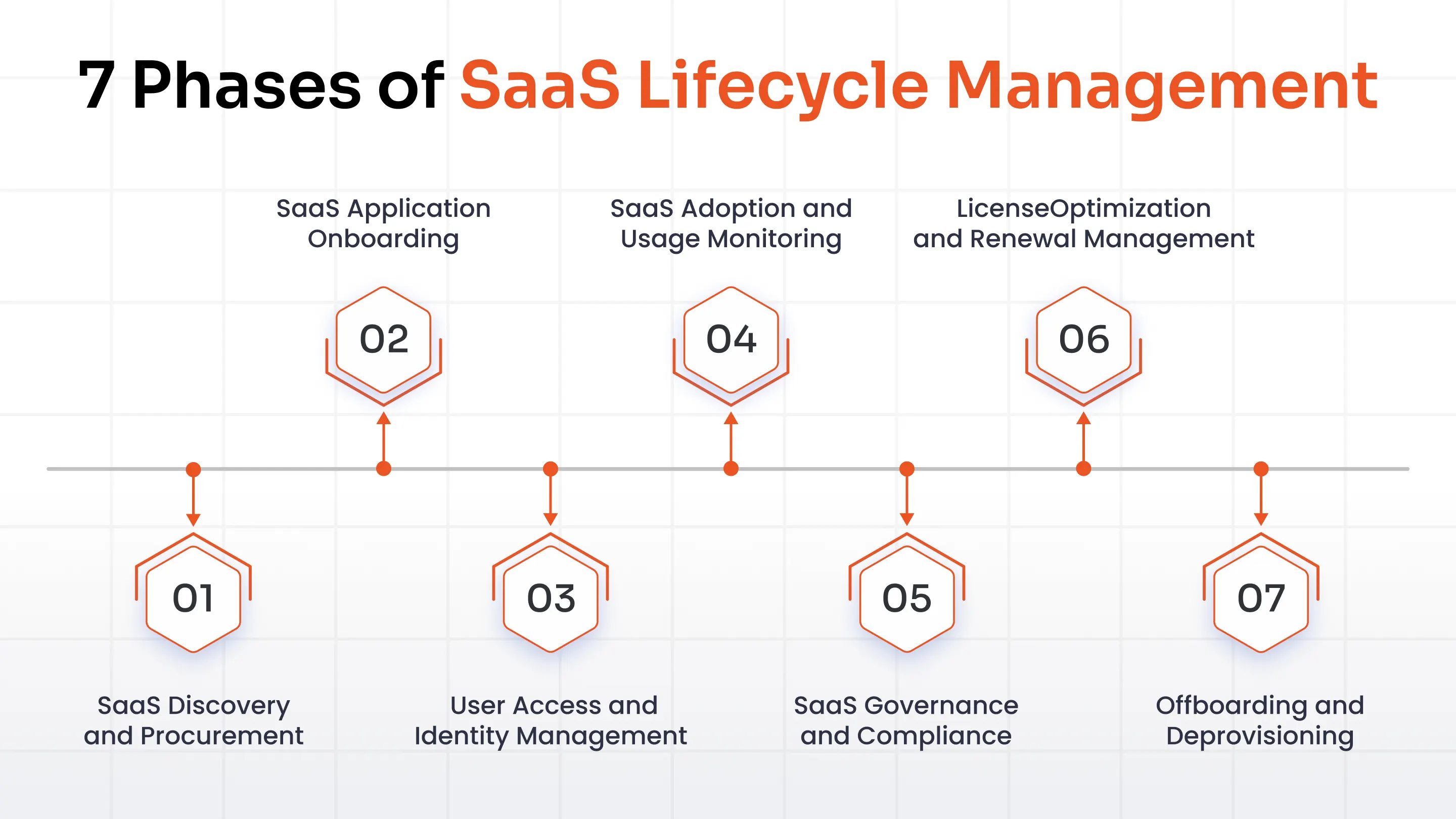
A well-structured SaaS management lifecycle consists of seven distinct stages. And these are as follows:
1. SaaS Discovery and Procurement
The lifecycle starts before purchase, when a business need is identified and checked against existing tools to avoid duplication.
Discovery scans the current SaaS landscape, including shadow IT, using finance data, SSO logs, browser extensions, and network traffic. This baseline reduces redundant spend.
Procurement then runs a structured process: validate the need, define requirements, evaluate vendors on security, compliance, and functionality, negotiate pricing and contracts, and run legal/security reviews.
Centralizing this process blocks duplicate tools and ensures every new app meets organizational standards before deployment.
2. SaaS Application Onboarding
Once a SaaS tool is approved and procured, the onboarding stage ensures it is deployed securely and integrated into the existing IT ecosystem.
Key activities during onboarding include:
- Deployment and configuration: Setting up the application with the correct security settings, data handling policies, and integration points.
- Initial user provisioning: Assigning access to the right users based on predefined roles and responsibilities.
- Integration with identity infrastructure: Connecting the application to the organization's identity provider (IdP) to enable Single Sign-On (SSO) and centralized access control.
- Documentation: Registering the application in a central SaaS inventory with ownership, contract details, and renewal dates.
A structured onboarding process prevents security misconfigurations and ensures user adoption is both fast and controlled.
3. User Access and Identity Management
This is the most critical stage in the SaaS lifecycle. As users gain access to many apps, controlling who can access what becomes a major governance challenge.
Effective controls include:
- Role‑Based Access Control (RBAC): Access is assigned based on pre-defined job roles.
- Single-Sign-On (SSO): This centralizes authentication and reduces password fatigue.
- Multi-Factor Authentication (MFA): This adds a strong extra verification layer on top of passwords.
- Automated provisioning: This creates, updates, and revokes access based on HR‑system roles instead of manual tickets.
Together, these measures reduce risk, improve compliance, and keep access aligned with real job needs.
4. SaaS Adoption and Usage Monitoring
SaaS adoption doesn’t end at provisioning. Organizations must continually monitor how applications are used to ensure they deliver value and adjust access or licenses.
Key signals include active users, login frequency, and idle accounts. Teams should also track feature adoption to see if premium tiers are underused and examine department‑level usage to find where tools are essential or ignored.
These insights directly inform license optimization and renewal, helping identify apps or tiers that should be downgraded, consolidated, or cancelled.
5. SaaS Governance and Compliance
SaaS governance ensures that the use of SaaS applications aligns with organizational security policies, data governance requirements, and industry regulations.
Key governance activities include:
- Security policy enforcement: Ensuring all SaaS tools adhere to authentication standards, data encryption requirements, and access control policies.
- Data governance: Understanding what data lives in which SaaS applications and ensuring it is handled according to regulatory requirements (GDPR, HIPAA, SOC 2, etc.).
- Access reviews and certifications: Periodically reviewing who has access to what, confirming that access is still appropriate, and removing unnecessary permissions.
- Audit readiness: Maintaining complete, timestamped logs of provisioning events, access changes, and deprovisioning actions that can be produced during audits.
Without strong governance, even well-procured and well-onboarded SaaS tools can become compliance liabilities over time.
6. License Optimization and Renewal Management
SaaS contracts usually auto‑renew, so without active oversight, you keep paying for tools you no longer use or at higher tiers than needed. The renewal stage is where most savings are unlocked.
By reclaiming unused licenses, tracking renewal dates, and consolidating overlapping tools, you can cut waste and negotiate better pricing. Teams that come to renewals with clear usage data consistently secure stronger terms than those that accept default renewals.
7. Offboarding and Deprovisioning
Offboarding and deprovisioning cover retiring entire SaaS apps and removing access for individual users when they leave. Employee exit offboarding is a common failure point: SSO deactivation may not remove local SaaS accounts, leaving hidden access and even admin privileges.
Key offboarding activities include:
- Revoking access across all SaaS apps
- Disabling OAuth tokens, API keys, and user-created integrations
- Transferring or exporting business-critical data
- Verifying no active sessions or local accounts remain
For app retirement, also handle data export, contract closure, integration cleanup, and workflow migration. Automated, SCIM-based deprovisioning keeps offboarding consistent and auditable.
SaaS Lifecycle Management: Tools and Features
A purpose-built SaaS lifecycle management platform brings together all the capabilities needed to govern SaaS applications at scale.
| Feature | Why It Matters |
|---|---|
| SaaS Discovery | Automatically identifies all SaaS tools in use, including shadow IT, giving IT teams complete visibility into the application portfolio |
| User Provisioning | Automates account creation, role assignment, and access updates across SaaS applications based on identity events |
| SSO Integration | Connects SaaS applications to a central identity provider for unified authentication, session management, and access control |
| Access Reviews | Enables periodic certification of user access, surfaces outdated entitlements, and produces evidence for compliance audits |
| License Management | Tracks active and inactive licenses, identifies reclamation opportunities, and optimizes spend based on real usage data |
| Audit Reporting | Provides timestamped, exportable access history across all SaaS applications for compliance and governance |
| Offboarding Automation | Triggers access revocation across all connected applications when an employee exit event is recorded in the HR system |
| SCIM Provisioning | Enables real-time, automated provisioning and deprovisioning for SCIM-compatible SaaS applications |
| Renewal Tracking | Alerts teams ahead of renewal dates so contracts can be reviewed, renegotiated, or cancelled proactively |
SaaS Lifecycle Management and Security
Security is woven into every stage of the SaaS lifecycle. Managing applications without security controls leads to SaaS sprawl. Key security aspects for SaaS lifecycle management are:
- Identity security: Ensure all identities are strongly authenticated and authorized by enforcing SSO and MFA across every app and tightly controlling privileged accounts.
- SaaS Security Posture Management (SSPM): This adds configuration governance. It continuously checks SaaS settings against policies and frameworks, alerting you when risky changes appear, like overly open sharing or missing MFA.
- Access reviews and certifications: These keep access clean over time. Regular checks reveal unused accounts, permissions that no longer match current roles, and temporary admin rights that were never removed.
- Privileged account governance: Privileged Access Management (PAM) for SaaS should include regular reviews, strict justification for admin privileges, and real-time monitoring of privileged activity.
- Compliance reporting: A mature SaaS lifecycle produces an auditable record of who had access, what they did, and when access was granted, changed, or revoked.
SaaS Lifecycle Management Best Practices
Here are the key best practices to look at:
1. Centralize SaaS Visibility
Build a comprehensive, real-time inventory of every SaaS application in use, whether IT-approved or not. This inventory should include application owner, user count, contract details, renewal dates, and cost.
2. Automate User Provisioning
Replace manual provisioning workflows with automated, HR-driven processes. Connect your HRMS to your identity management platform so that onboarding, role changes, and offboarding automatically trigger the correct access changes across all SaaS applications.
3. Implement SSO and MFA
Require all SaaS applications to authenticate through your organization's SSO provider. For applications that do not natively support SSO, use access gateway solutions to enforce centralized authentication. Layer MFA on top to ensure that a compromised password alone cannot grant access.
4. Perform Regular Access Reviews
Schedule periodic access certification campaigns: quarterly for privileged access and annually for general access. Use the results to revoke stale access, right-size license tiers, and improve your RBAC model based on real-world usage patterns.
5. Monitor License Utilization
Track active users, login frequency, and feature adoption for every SaaS application. Flag licenses that have been inactive for 30 days or more as candidates for reclamation. Build license optimization into the pre-renewal workflow so decisions are always driven by real data.
6. Establish SaaS Governance Policies
Define formal policies for SaaS procurement (what goes through IT vs. what can be self-serve), acceptable use, data governance, and security configuration standards. Without written policies, governance is inconsistent and unenforceable across a growing SaaS portfolio.
7. Automate Employee Offboarding
The most security-critical SaaS lifecycle process is also the one most often done inconsistently: employee offboarding. Automate deprovisioning so that access revocation begins immediately when an exit event is recorded in the HR system, and not hours or days later when an IT ticket is processed.
Future Trends in SaaS Lifecycle Management
SaaS lifecycle management is evolving fast as organizations scale, adopt AI, and face new threats.
- AI‑driven governance: AI will increasingly spot anomalous behavior, suggest license optimization, and prioritize access review issues faster than manual analysis.
- Deeper SSPM integration: Configuration security and lifecycle management will converge into unified platforms that handle both access and configuration risk.
- Identity‑first security: Zero Trust and ITDR approaches will make identity the primary control point across every lifecycle stage.
- Zero Trust SaaS access: Every user, device, and session will be explicitly verified before app access, regardless of network location.
- Automated compliance: Continuous monitoring will detect misconfigurations and access violations in real time, replacing periodic, manual audit-driven checks.
How Identity Lifecycle Management Supports SaaS Lifecycle Management?
Identity lifecycle management (ILM) is the engine that powers the user-centric dimension of SaaS lifecycle management. Where SaaS lifecycle management governs applications, identity lifecycle management governs the users who access them.
- HR‑driven provisioning: HR events (joiner, mover, leaver) automatically trigger access creation, updates, and removal in all connected SaaS apps, replacing manual IT tickets.
- SCIM provisioning: A standard protocol to push identity changes (create, update, deactivate) in real time from the identity platform to SaaS apps, enabling scalable, automated user lifecycle management.
- Identity Governance and Administration (IGA): Manages roles, enforces separation of duties, runs access reviews, and produces reports so SaaS access is consistent, policy‑driven, and auditable.
- Access certifications: Periodic reviews that confirm people still need their SaaS access, surfacing stale or excessive permissions and generating evidence for auditors.
- Automated deprovisioning: HR “leaver” events automatically revoke access from every connected SaaS app within minutes instead of days, closing security gaps.
miniOrange provides a comprehensive Identity Lifecycle Management platform that connects HR systems with SaaS applications through automated JML workflows, SCIM-based provisioning, access certifications, and real-time deprovisioning. So, organizations can manage their full user lifecycle across their entire SaaS portfolio from a single, unified platform.
How to Choose a SaaS Lifecycle Management Solution?
Choosing a SaaS lifecycle management solution starts with a tight, practical checklist of essentials.
- Integration support: It must connect cleanly to your HR system, identity provider, and key SaaS apps so joiner–mover–leaver events flow automatically.
- SCIM provisioning: Native SCIM is critical for scalable, real-time provisioning and deprovisioning.
- SSO compatibility: Ensure it works with your existing SSO and supports SAML 2.0, OAuth 2.0, and OpenID Connect.
- Reporting and audits: You need detailed, exportable logs of who got access, what changed, and when.
- Governance depth: Look for strong access certification, role management, separation of duties, and policy-based provisioning.
- Automation workflows: HR events should automatically trigger provisioning and offboarding; manual steps will not scale and will introduce security gaps.
In practice, the right path is to centralize SaaS visibility, tie automation to HR-driven identity changes, enforce SSO and MFA across apps, run regular access reviews, and fully automate deprovisioning so no ex-employee retains access.
FAQs
What is SaaS Lifecycle Management?
SaaS lifecycle management is the end-to-end process of governing SaaS applications from procurement and onboarding through active management, optimization, and eventual retirement.
Why is SaaS Lifecycle Management important?
Without SaaS lifecycle management, organizations face SaaS sprawl, unused licenses, security risks from unmanaged applications, compliance gaps, and rising costs.
How does SaaS Lifecycle Management improve security?
SaaS lifecycle management improves security by enforcing consistent authentication standards (SSO, MFA) across all applications, automating access revocation when employees leave, conducting regular access reviews to remove stale permissions, and maintaining complete audit logs of all lifecycle events.
Can SaaS Lifecycle Management help reduce software costs?
Yes, SaaS lifecycle management directly reduces costs by identifying unused and underutilized licenses for reclamation, eliminating redundant tools with overlapping functionality, enabling data-driven renewal negotiations, and preventing automatic renewals on applications that are no longer needed.
How does SCIM provisioning support SaaS Lifecycle Management?
In the context of SaaS lifecycle management, SCIM ensures that when an employee joins, changes roles, or leaves, their access across all SCIM-compatible SaaS applications is automatically created, updated, or revoked, without any manual steps.
How does user lifecycle management fit into SaaS governance?
User lifecycle management, built around the Joiner-Mover-Leaver (JML) model, is the user-centric layer of SaaS governance. It ensures that employees receive the right access when they join, that access is updated when they change roles, and that all access is fully revoked when they leave.
About the Author

Content Writer
With a background in Journalism and extensive experience in SaaS and cybersecurity content writing, Chaitali Avadhani has contributed to creating various forms of impactful content pieces across multiple verticals. At miniOrange, her role is to craft SEO-friendly and lead-generating content around Identity and Access Management (IAM) products and cybersecurity as a whole.
Leave a Comment